Pentecost Pandemonium

Monday, June 1st, 2020

A Panda at the National Zoo in Washington, DC.
Pentecost Pandemonium, Audio Version


In a nod to the calendar, I ought to mention that yesterday was Pentecost Sunday. Yesterday was Holy Spirit distribution and installation day. Yesterday was the birthday of the Church Universal. She is almost 2,000 years old, or young. Happy Birthday, Bride of Christ!  

It was a rough birthday for the Church, though. At least, it was rough here. This past weekend fit the definition of pandemonium. Protests, unrest, rioting, vandalism, and looting occurred in many cities across the United States. Here in this country, we had plenty of pandemonium on Pentecost. The pandemonium was everywhere on social media and everywhere in the news. It was nearby; and it was unsettling. Even now, we are hoping and praying it all calms down.  

Until someone else mentioned that it was Pentecost, I had forgotten. Yesterday we spent part of the day visiting my parents. One of them mentioned that it was Pentecost. “Oh, yeah,” I thought as I was startled to recollection. I had completely forgotten. The pandemonium of the previous days had me preoccupied. Until that moment, immediate circumstances and events had loomed a lot larger than a long-past historical event, however significant. The immediate overwhelmed the permanent. Yet the spiritual effects of Pentecost are permanent and eternal, while this present pandemonium is only sporadic and passing. The Holy Spirit is here to stay, as long as the Church remains on Earth below. 

Did you know that the outpouring of the Holy Spirit on Pentecost is referenced symbolically in the Book of Revelation? I did not know that until last year. But I hope to show it to you and convince you that it is there. The birthday of the Church Universal is mentioned in Revelation. More accurately, it is symbolically depicted in Revelation. But the depiction is easy to miss, because it is veiled in oblique references to the Old Testament and in surprising symbolism. 

Are you ready? The Pentecostal birthday of the Church Universal is depicted in Revelation chapter 8, verse 7. If you go read it, you’ll come away wondering if I am a bit crazy. You may suspect that I’m seeing things that are not there. A trumpet is blown. Hail and fire follow, mixed with blood. The hail, the fire, and the blood are thrown upon the earth. A third of the earth is burned up. A third of the trees are burned up. All the green grass is burned up.  

Is this fulfilled literally or symbolically?

Yep, that is Pentecost. That is how Revelation depicts the Pentecostal birthday of the Church way back in the first century AD. Admittedly, this claim requires a lot of interpreting and explaining. I cannot do it all here, because it will take too long. But I will, eventually. Let me say a few initial things here. First, the seven trumpets symbolically depict seven chronological events, most of which have already occurred. The first four occurred in the first century. Those first century events can be precisely named and dated. The first event is the Pentecostal birth of the Church Universal, which you can read about non-symbolically in Acts chapter 2.

None of this makes any sense unless you pick up on the fact that the seven trumpets are decoded by referencing the Old Testament. What is symbolized by the hail, the fire, and the blood? These are actually allusions, or subtle references, to Old Testament events and prophecies. Once you know that, you can begin to piece together what the events and prophecies point to. You can begin connecting the dots. In the case of the first trumpet, the dots connect in a portrait of Pentecost, the Birthday of the Church. 

You don’t need to believe me yet. Just give me a chance to make my case, which I will attempt to do in upcoming posts.    

Temple Visitors

Saturday, May 30th, 2020

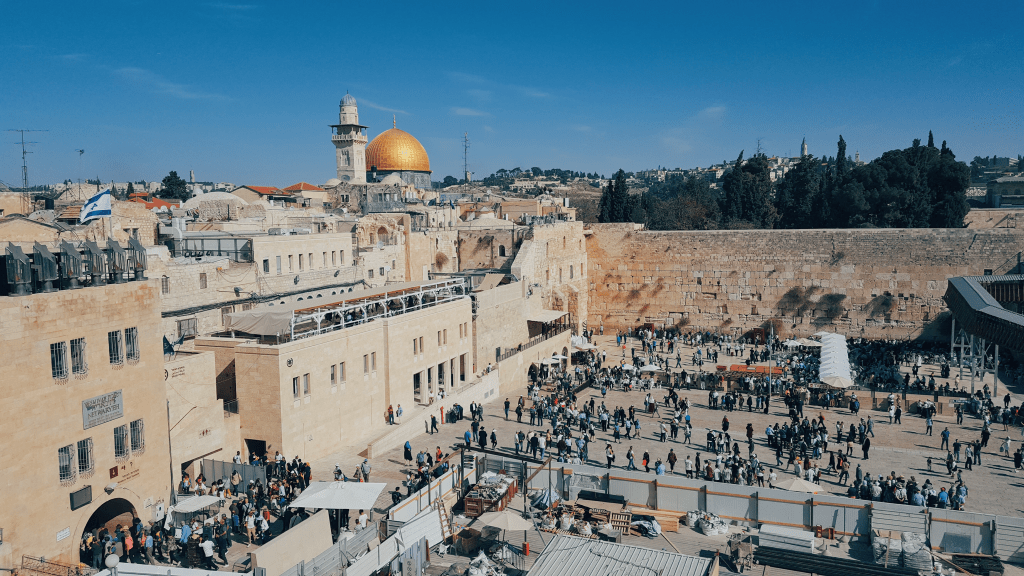
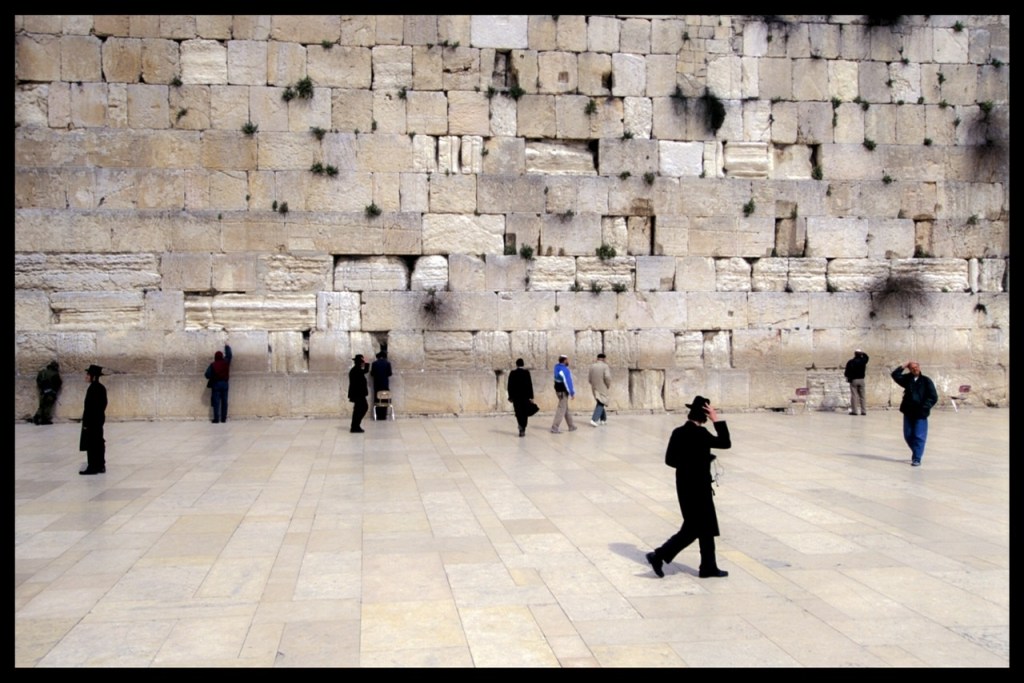
The Dome of the Rock and the Wailing Wall in Jerusalem
Temple Visitors – Audio Version

Temple. This blog post considers the theme of temple and how it relates to the Book of Revelation.

In a previous post, I explained how I was once an angel in Los Angeles. In the original Greek, from which English eventually inherited the word, angelos really just means messenger. A messenger can be a glorious heavenly being or an unimpressive, ordinary earthling. For a while, I worked for a successful county-line law firm as a courier, driving around the greater LA area. As a courier, I had navigate my way through traffic to various court houses and hand-deliver important legal documents and time-sensitive messages. Thus, in my mind, I officially qualify. I can claim that I was briefly an angelos in Los Angeles. 

A few years after I drove and delivered messages for the law firm, someone from my school asked if I would be willing to drive a van for them. A delegation of English-speaking scholars from across the Muslim world was about to come to Los Angeles. Was I available and would I be willing to drive them around? Yes, I was available. And yes, I would drive them around LA.

The year was 2002. September 11th was a very recent and raw memory. The United States State Department, in cooperation with some institutions of higher learning, had arranged for a delegation of English-speaking Muslim scholars to tour the United States. I believe that the US State Department and the American schools hoped that the scholars would return to their respective countries and speak positively about what they had seen and experienced in the USA. The tour was an attempt at academic and religious diplomacy. Good PR was surely the goal. I’m not sure if that’s what happened, though. Still, it was eye-opening to be their driver.  

One of the destinations to which I drove the scholars was Wilshire Boulevard Temple. As the name indicates, Wilshire Boulevard Temple is located on Wilshire Boulevard, a road that runs right through downtown Los Angeles. You may have heard of it before. The Temple, which I will abbreviate from hence as WBT, is an impressive historic building that belongs to a Jewish congregation. From an artistic standpoint, WBT visually wows a visitor. It has a big central rotunda, much like most state capitol buildings. If you stand underneath the rotunda and look upward, as I did, golden gilded Hebrew letters and words go around the inside of it. To my surprise and delight, I could read it. I knew exactly what it said. It was the Shema. 

“Hear, O Israel: The LORD our God, the LORD is one.” That would be Deuteronomy 6:4; and that is the Shema.

For me, it was an electrifying moment. Not long before that, I had taken Hebrew. I stood there, looking upward, and actually read what it said, with ease. And I was struck by the weight and the serendipity of that moment. Representatives of the three religions that lay claim to the monotheism proclaimed in that verse were all gathered there. However, we were hardly in harmony. For one thing, we disagreed about the identity of the Temple (of God).

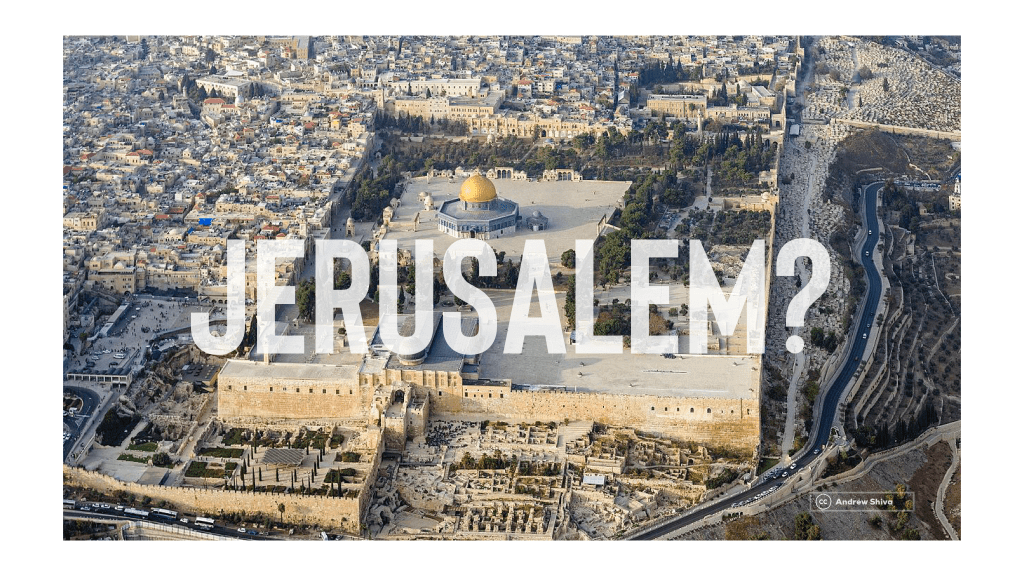
Temple Mount in temporal Jerusalem

The Jewish temple that once stood in Jerusalem — will it be rebuilt someday? For centuries now, the temple’s former location has been a Muslim sacred site. The Dome of the Rock was constructed where the temple once stood. It is there to this day. The site is under the jurisdiction of Muslim authorities. They are determined to hold it. If the Israelis attempt to take control of the location, a regional war will probably immediately ensue. 

With all that in consideration, hear what one of the Muslim scholars asked the head rabbi at WBT. While we all stood around in the office of the rabbi, a visiting Muslim scholar asked him, “Do you want the temple to be rebuilt in Jerusalem?” It was a loaded question. The rabbi’s answer surprised me. It probably surprised the Muslim scholars, too.

The rabbi said, “No, I don’t, because if the temple were rebuilt we would need to resume the whole sacrificial system. I don’t want that to happen.”

Alternatively, there are other Jewish religious authorities who do want the temple in Jerusalem rebuilt. That was not discussed with the visiting Muslim scholars at WBT that day, though.

A lot of Christians have been taught and believe that the Jewish temple in Jerusalem must be rebuilt before Jesus returns. The Book of Revelation briefly mentions “the temple of God” in the first two verses of Chapter Eleven. Interpreters have to decide which temple is referenced. Is it a rebuilt Jewish temple in Jerusalem, or something else? That is a super-important question. If it is understood to be a rebuilt Jewish temple in Jerusalem, then we ought to intently watch what happens at that contested location in Jerusalem. However, if it is not a rebuilt temple in Jerusalem, then fixating on events in Jerusalem is unnecessary. Again, interpretively, a lot hangs the identity of the temple in Revelation 11:1-2.

The temple mentioned in Revelation 11:1-2 is actually the Church, not a rebuilt temple in Jerusalem. That is how I read it. We are mistaken to expect a rebuilt temple in Jerusalem, which might never happen, anyway. Here, the Rabbi at WBT, along with the Muslim scholars, may have their collective way. There may never be a rebuilt temple in Jerusalem, at least, not prior to the parousia of Jesus, that is, prior to the Second Coming.  

The New Testament repeatedly says that the Church is now the temple of God. We ought to believe it. The Church really is the temple of God now. God’s presence is no longer to be found in a brick-and-mortar building or a stone-and-mortar temple, but in a living temple, in and among the corporate people of God. Ephesians 2:19-22 says as much, and is worth a quick read.

All of this said, the land and the people of Israel are not irrelevant. On the contrary, the nation of Israel is still relevant to Revelation and will be important in The End. After all these centuries of time, God continues to be faithful to the Jewish people for the sake of their ancestors; and they still do have a role to play in the fulfillment of prophecy. Explaining that will have to wait for another day and another blog post, though.    

Apocalyptic Numbers

Friday, May 29th, 2020

Apocalyptic Numbers, Audio Version

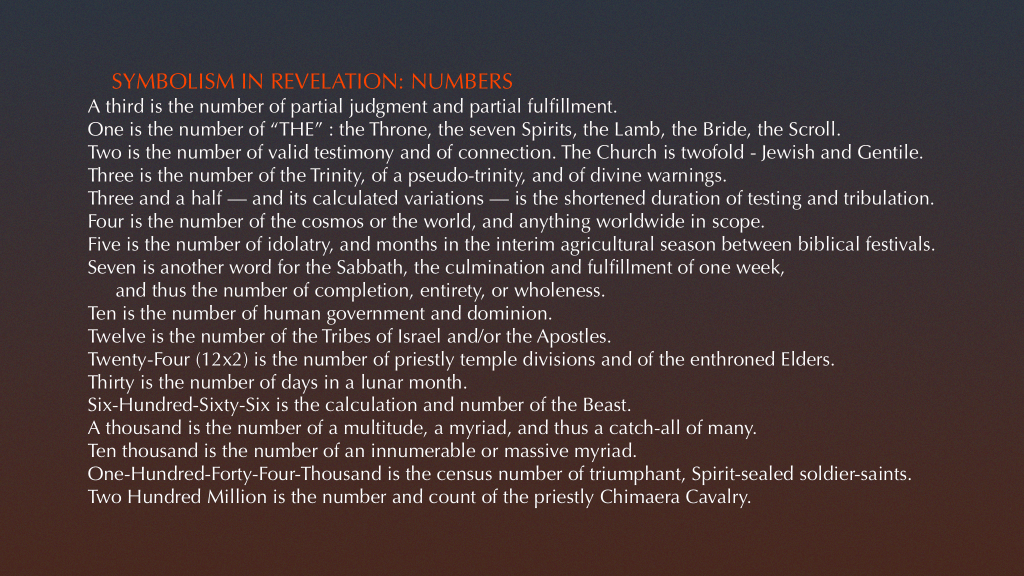
Today I am feeling unmotivated, so I am just going to post the following list of frequently occurring numbers (or otherwise significant numbers) in the Book of Revelation, along with the suggested symbolic meaning of each number. Some of the suggested symbolic meanings I have listed will be totally understandable; others will probably leave you saying “huh?” and wanting more of an explanation. You will either have to email and ask me directly for an explanation, or stay tuned for future posts. I am not claiming that this list is exhaustive. But it does cover a lot of the numerical symbolism in Revelation pretty well.

Once an Angel

Thursday Afternoon, May 28th, 2020

Back in the Day.
Once an Angel, Audio Version

From August 1994 to August 2006 I lived in the greater Los Angeles area. First I worked there. Then I studied there. Eventually, my wife and I met there. We got married there. Our daughter was born there. The course of my life was effectively set there. Those twelve years will forever stand in my memory as simultaneously the worst and the best of my life. Bittersweet is an apt word to describe those years. I am grateful for the time I had there. And I am even more grateful that those years are behind me. It was a hard and yet formative period of life.     

For a little while, I was also an angel there. It’s true. I really was briefly an angel in Los Angeles. Just barely, though. Just barely in Los Angeles county, is where I was, I mean. The law firm where I worked as an angel was less than two miles from the county line — maybe even less than that. Had the law firm been a little farther east, I would not have been an angel in Los Angeles. I would have been an angel in San Bernardino, which is nowhere nearly as catchy. Wouldn’t you agree? But I can honestly say that I was an angel in Los Angeles at about the turn of the millennium. Yes, angelic me.

Are you confused? Angels are simply messengers. Please hear that now. They are messengers. That is exactly what the word means. Angel equals messenger. That’s all. 

I was a courier for a law firm. As a courier, I delivered documents and messages. That was my job. I was hired to make speedy deliveries. I was told to drive around Los Angeles County and Orange County delivering highly important legal documents and time-sensitive messages. Sometimes I even got to drive eastward to San Bernardino County or southward to San Diego County. The drive into San Diego is very pretty, by the way. As just mentioned, San Bernardino County was very close; but the law firm did most of its work in LA County and Orange County. My assignment was: “Go, deliver, and bring back certification of delivery. And hurry!” I spent a lot of time driving Interstate 10 into and out of the actual City of Los Angeles. Yes, angelic me. I was very briefly an angel in Los Angeles.       

Dear Pastor, Hang Tough.

This has everything to do with the Book of Revelation. As you read, you will bump into many angels throughout. Various angels are mentioned in Revelation. And most people reading Revelation just assume they know what an angel is. “Surely this entity called angel is an immortal heavenly being, with powerful wings and brilliance of countenance.” And that is often exactly right. But sometimes in Revelation the entity said to be an angel does not fit the description. Sometimes the entity is not described as an immortal heavenly being. Sometimes the entity is not described at all. The entity is simply called an angel. And sometimes it seems like the entity — even though called an angel — might be a mere mortal, just an ordinary hum-drum human being: a courier, or a messenger, like me back around the turn of the millennium.

Lots of people find this claim somehow annoying, alarming, or amazing. “Angel means angel,” they insist. But no, you cannot and should not assume that. Angel does not mean angel, if what you mean is a brilliant, immortal heavenly being, every single time. Immortal heavenly beings can serve as angels, yes and for certain. That’s true, and biblical. But human beings can serve as angels, too. That’s also true, and also biblical. God can call human beings to serve as messengers. Furthermore, God does call human beings to serve as messengers, lots of times. Need I name names? How about Malachi, which means my angel. The prophet Malachi was just a man, though, a mere mortal.

When you bump into an angel in the Book of Revelation, ask yourself this simple question: Is this angel/messenger actually described as a heavenly being or not? If not, please entertain the thought that the messenger might not a brilliant, immortal heavenly being. I say that because the angels/messengers of the seven churches in first three chapters of Revelation seem quite human to me (and to a number of other interpreters). That’s exactly how Jesus treats them, too — like humans. Jesus speaks words of affirmation to them, and words of encouragement, and words of correction, and words of warning. “Get your act together, angel, or else.”

Jesus’ words all make perfect sense if you’re willing to reconsider what the word angel must mean. Here Jesus speaks not to heavenly messengers but to human messengers. Human beings here receive his words of encouragement, and words of correction, and words of warning. It makes much less sense that Jesus would commission John to write a corrective circular letter addressed to brilliant heavenly beings. Why wouldn’t Jesus just directly communicate himself to heavenly beings? Why use a human intermediary? But these angels need to receive a snail-mail letter from John. These terrestrially-tied angels seem less likely to be luminous immortals and more likely to be ordinary mortals; don’t you think? Perhaps these seven angels are simply the head pastors of the seven municipal churches of Roman Asia. That’s what makes the most sense to me. That’s my interpretive suggestion. And I do speak with some authority on the matter. After all, I was briefly an angel.

Why does this matter? It matters because reading Revelation carefully will keep you on your toes. You will need to rethink your categories and reconsider your assumptions. In Revelation, things are not always as they seem on first glance. Revelation does a lot of that, actually. What at first seemed to be this is actually something else. A lion is a lamb is Jesus. A beast is actually the emperor. Another beast is a false prophet. A beautiful bride is actually the church. An angel is actually a pastor. Get used to it. Get used to the use of symbolism and to symbolic shifts. Revelation re-construes reality, because what we perceive and what we assume is often inaccurate. Repeat that last sentence to yourself over and over. Revelation re-construes reality, because what we perceive and what we assume is often inaccurate, and even distorted.

Please don’t blame me for this. I’m just the messenger.

Here We Have Brilliant, Immortal Heavenly Being.

Happening Right Now

Thursday Morning, May 28th, 2020

Happening Right Now, Audio Version

“Why bore people with long historical sketches, and not actually say much about the Book of Revelation itself?” A candid friend recently challenged me with a variant of this question. 

In response, I will start by saying that the historical stuff does not bore me. In college, I was a history major. Personally, I enjoy doing the historical research and presenting what I learn. It’s fun for me. But I realize not everyone else wants to hear all the history. All the historical stuff might come across as unnecessary and irrelevant. I will try to make it seem more relevant. 

A second response is this: A solid understand of Revelation really does require knowledge of what has happening when Revelation was first written and first heard, about 96AD. I do you no disservice by giving you information about evil Emperor Domitian. He sent John into exile. His policies resulted in the difficulties and the persecution loosed upon the seven churches in Roman Asia. Domitian instigated the historical circumstances behind the Book of Revelation.     

A third and important response would be this: What happened then is going to happen again, albeit under different circumstances and with a different cast of characters. History does indeed rhyme. We are supposed to be on the lookout for someone like Domitian. We are supposed to be on the lookout for deceivers and imposters. Revelation speaks not just of the past, but also of the future. Revelation points to the past to show us what the future will hold.

Furthermore, sometimes tyrants and dictators do come along resembling Domitian. There are several on the world stage right now. They behave a lot like Emperor Domitian behaved. They make life difficult for the Christians under their dominion. They insist that Christians toe the party line and sing the party’s song — literally. It is happening right now. But if you do not know about Antiochus and Domitian, the significance of it will not register with you. So I do you no disservice by giving you historical information about Domitian. And I intend to tell you more about Antiochus Epiphanes in a future post.

Please stick with me. The temptation you will face is to think I am just an ignorant blowhard bent on rambling. Even if I take tangents and go directions that seem irrelevant, please stick with me. I am going somewhere with it. You will come away with a better sense of how to read both Revelation and history, including today’s current events. It is not irrelevant. Revelation is not irrelevant at all. Many of the prophecies of Revelation are playing out before our very eyes. And if we read Revelation carefully, we will recognize it. And we will be ready for what may come, if we just have an ear to hear what the Spirit says to the churches.           

That does not mean that everything I say will be one hundred percent right. No one can claim that. I may get some things wrong along the way. Revelation requires extensive interpretation. Interpreters sometimes make mistakes. But just because some interpreters mess up does not mean that the study of Revelation is only for crazies and quacks. Revelation actually belongs in the Bible. It is intended to be a blessing to the readers and the hearers. I urge you to listen to it. The Spirit is speaking to the churches through it. We ignore it at our own peril.