
Chapter Eleven Bankruptcy

Audio Version

Here in the United States, the two words “Chapter Eleven” are usually associated with debt, insolvency, and bankruptcy. The eleventh chapter of the U.S. Bankruptcy Code provides a means of debt reorganization under court supervision. A Chapter Eleven Bankruptcy becomes an unhappy legal necessity when a corporation or an individual has debt that cannot be met. No one wants to go through the considerable trouble of a Chapter Eleven Bankruptcy. It is always best avoided. But sometimes it has to happen. Sometimes it becomes inevitable. When creditors come knocking and the bills go unpaid, a Chapter Eleven Bankruptcy sometimes becomes unavoidable and necessary. A Chapter Eleven Bankruptcy is unwelcome, unpleasant, and undesirable — except if it ends well. And every once in a while, it does end well.  

Now let’s turn from Chapter Eleven of the U.S. Bankruptcy Code to Chapter Eleven of the Book of Revelation. It ought to be said up front that one major similarity exists between the two Chapter Elevens: yuckiness. They’re both rather unpleasant eventualities. Both Chapters Eleven are very, very undesirable. Like Chapter Eleven of the U.S. Bankruptcy Code, Chapter Eleven of Revelation involves a lot of hardship, humiliation, and hostility. For faithful Christians, Chapter Eleven of Revelation is no fun. But it ends quite well.     

Welcome to Chapter Eleven of the Book of Revelation. Welcome to an uncertain future. Expect a bumpy ride. Our immediate future will likely be a dystopian nightmare. Chapter Eleven brings us past the present day and into a dismal future.

In Chapter Eleven you will read about Two Martyrs. The English translation you read will almost certainly say “two witnesses.” Your translation is not wrong; it just fails to catch the nuance of martyrdom that is there. The original Greek word is actually martyr. And in Chapter Eleven, the two witnesses are more than just witnesses. They physically die. They are killed. They are killed for their testimony. They are martyrs. 
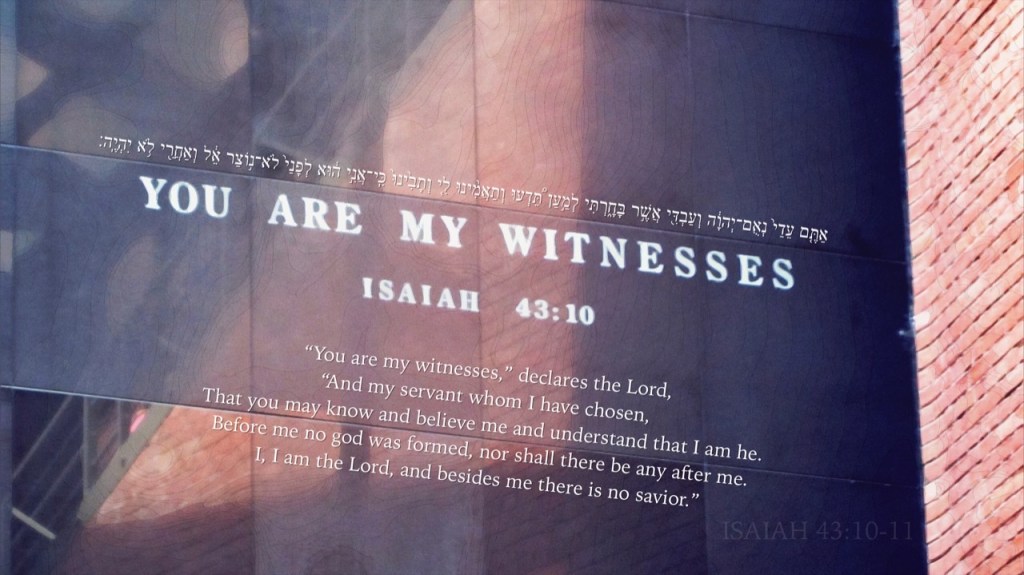
Some interpreters will say that the Two Martyrs will be Moses and Elijah. Those interpreters are slightly right and mostly wrong. The Two Martyrs will be prophets like Moses and Elijah. But Moses and Elijah will not be the Two Martyrs. The text never says they will be. Instead, the two martyrs are much more immediate. You and I will potentially be the Two Martyrs. Yes, you may be a martyr. And I may be a martyr. Reconcile yourself to that possibility right now. We are supposed to count the cost. It could well cost you your life. Jesus made that very clear when he called his disciples to take up their cross and follow him. He was serious. 
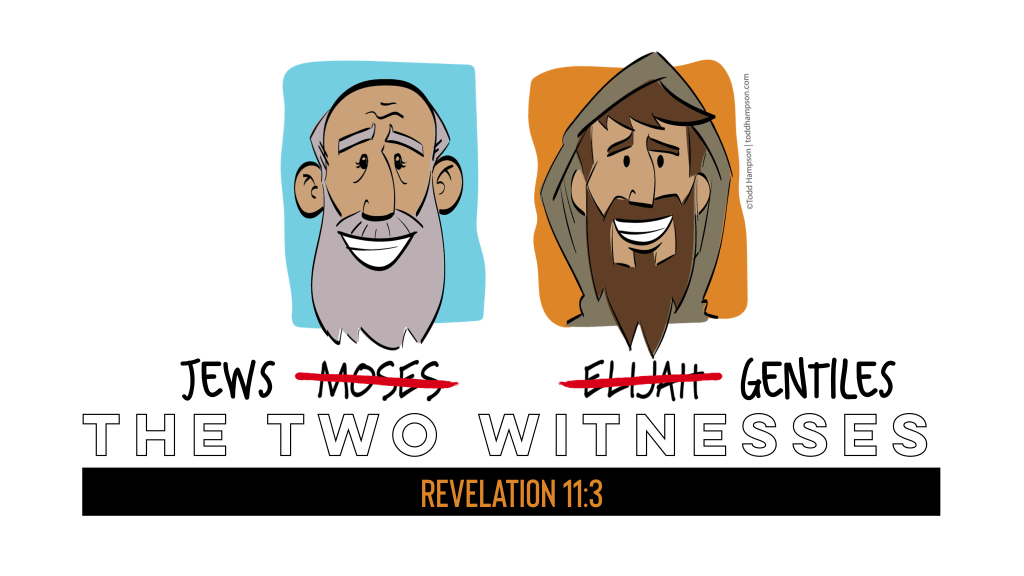
The Two Martyr-Witnesses: Jewish and Gentile Believers

I forewarned you. This is not a pleasant chapter, at least not up front.

Someone somewhere is asking how I see all this in Chapter Eleven. How do I come to these conclusions? Why do I settle upon this interpretation?

As I mentioned in my last blog-cast, Chapter Eleven presents a number of symbols from the very first verse. It mixes a lot of seemingly strange metaphors. And yet for someone familiar with the Bible, these are easily recognizable metaphors. Most of the metaphors presented in Chapter Eleven are used elsewhere in the Bible as metaphors for just one thing: the Church Universal. We are being presented with a symbolic, metaphorical collage of the Church. 

In the end, when the Two Witnesses are finished with their testimony, the ascendant Beast from the Abyss will make war on them, conquer them, and kill them (see Revelation 11:7). The Beast from the Abyss will bring about their elimination. The Two Witnesses will be slain in the Public Square. Their corpse (singular) will be under close watch. Their corpses (plural) will be left unburied. Their opponents will celebrate their demise, albeit only briefly.
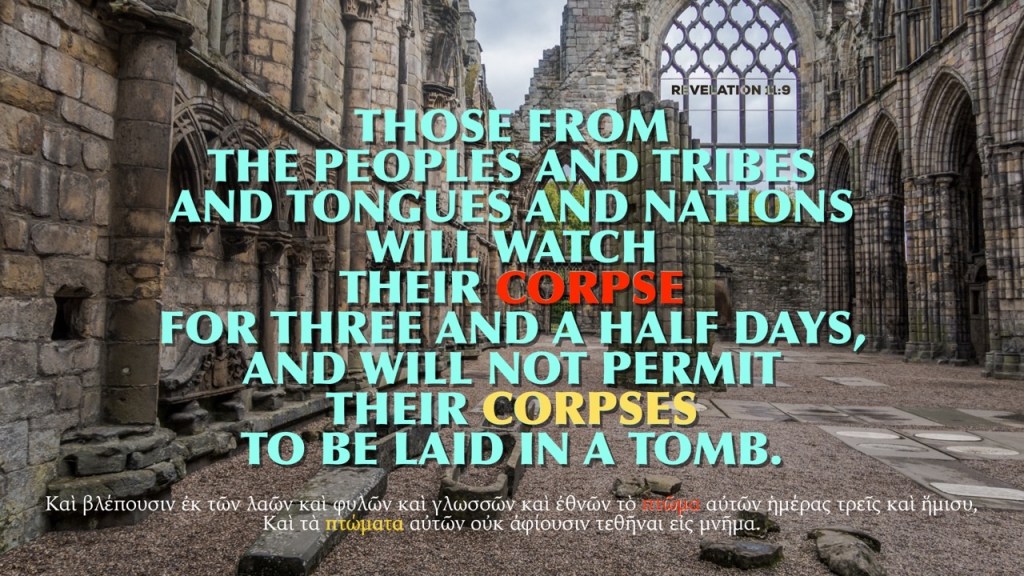
On one hand, this can be understood to mean that the Two Witnesses will be physically killed. On the other hand, it can be understood to mean that the Two Witnesses will be politically or economically eliminated. I mean that the Two Witnesses will be forcibly silenced or otherwise rendered incapacitated. Based on what has happened historically, I think that both types of killing will occur. Not every Christian will be physically killed, but some will. And those who are not physically killed will be incapacitated through social or economic means. The Church will be silenced, sidelined, and persecuted immediately before Christ returns. Yes, I do know in some places this is happening right now. I just think that the scale and the intensity will increase immediately before the Church is resurrected and rescued. When he taught about the events at the end of the age, Jesus instructed his disciples to pray that they have the strength to escape all these things (see Luke 21:36). It is no mistake that his words were recorded in scripture for later generations. We likewise are supposed to pray that we have the strength to escape or endure all these things. 

This is the gist of the first ten verses of Chapter Eleven. This is the ugly part of the chapter. Much happier events are soon to occur. But for now, those happier events must wait. 

Many interpretive questions linger. I did not cover everything in the first ten verses. I know that. I am leaving a lot of questions unanswered. I mean to answer more questions sometime soon. But I wanted to cover the essential message of the first half of Chapter Eleven first. I intend to work through more of the details in upcoming blog-casts.    
The Corpus Christi Coupled Mystery

The Corpus Christi Coupled Mystery

The Mystery of God could be called the Corpus Christi Coupled Mystery. No, I do not mean a mysterious married couple from a city in Texas.

The Mystery of God goes without elaboration or explanation when first mentioned in Revelation 10:7. It is just suddenly dropped into the Apocalypse’s eccentric mix. Because that is so — because it is not elaborated upon or explained, the Mystery of God can be missed by readers. Joe Reader might not consider what the Mystery is. Joanna Reader might not even notice it there. Nevertheless, the Mystery of God carries a lot more narrative importance than Joe or Joanna Reader may recognize. Since the Mystery of God immediately follows an awe inspiring celestial appearance and a solemn vow made by the Mighty Angel (who is actually Christ Jesus incognito), it must matter. Indeed, the Mystery matters a great deal. The mentioning of the Mystery even serves as a rudder for the ensuing narrative. It steers the remaining course of the Book of Revelation. Everything to follow 10:7 concerns the Corpus Christi Coupled Mystery. That is not an overstatement.

Although I discussed the Mystery of God in my last blog-cast, a refresher may be necessary and helpful here. Just what is the Mystery of God? For the sake of simplicity, readers can equate the Mystery of God with the Church of Christ, which is sometimes metaphorically called the Body of Christ. The Mystery of God could be called the Corpus Christi, since Corpus Christi is the Latin translation of the Body of Christ. Since the Latin phrase helpfully rhymes, I suggest readers remember it as the Corpus Christi Mystery. But one more elaborative word should be inserted into that that title. The word to add is coupled, resulting in the Corpus Christi Coupled Mystery.

The Mystery of God, the Church, can thus be likened to a body. This is an anatomical analogy. Like a body, the Church is an extension of and living instrument of its Head, who is Christ. Corporately, believers form a living entity that cooperatively accomplishes Christ’s purposes. Believers do so by daily drawing upon the power of the Holy Spirit. Cooperative Christians function on Earth as the Corpus Christi, the instrumental anatomy of Christ.

In my last blog-cast I used another analogy. I equated the Mystery of God with adoption. That analogy has not been abandoned. It still holds true. Adoption is a great way to think about the Mystery of God, about the Church, the Christian community. Adoption brings a blended family immediately to mind. A blended family could also be called a coupled family. And that is how the Church is supposed to behave — like a caring, nurturing blended (or coupled) family.

The adoptive coupling is the big surprise. It is a marvel and a mystery that God invited Gentiles into the household. Even Gentiles are invited. Gentiles! This was shocking and scandalous to Jesus’ first followers. Gentiles were hitherto anathema. Gentiles were polluted. Gentiles were infectious. Was it possible that God would open the family of faith to Gentiles?

It was possible. And today God continues to invite distant strangers and even once hostile enemies to come join the household of God. That even includes foolish, stubborn sinners like you and me. God has invited us turn away from our sin and from ourselves. God has invited us to take a new path and follow Christ. And God has invited us to become part of a larger, longstanding family of faith. Surprisingly, complete strangers and awkward aliens like us are included in the invitation. We too are welcome to join the family, if we will only accept the invitation to submit to the leadership of Christ.

Once we are adopted into the family, we are incorporated into the anatomy. Notice the metaphorical mix and the symbolic switch, then. Anatomy and adoption are my two operative metaphors. To talk about the Church, we may and sometimes should switch up the descriptive symbolism. We do this since various metaphors are variously apt. Also notice that both the adoption metaphor and the anatomy metaphor are taken straight from scripture (see Ephesians 1:5; 1 Corinthians 12:27).

In subsequent episodes, beginning in Chapter Eleven, Revelation is going to switch the symbolism some more. Revelation will use several additional metaphors or symbols for the Church, for the Corpus Christi Coupled Mystery. Borrowing from the end of the Prophecy of Ezekiel, the Church will be depicted as a temple. Borrowing from the middle of the Prophecy of Zechariah, the Church will be depicted as two olive trees and two lamp-stands. But the primary, overarching symbolic image for the Church will be that of two fire-breathing martyrs — two testifying, miracle-working, persecuted, slain, but eventually resurrected and raptured martyrs. Be ready. We will see a mash-up of metaphors for the Church.

In summary, as we follow the narrative of Revelation our focus now and from hence is the Church of Christ, which is a blended family of native Jewish believers and adoptive Gentile believers, believers who have been coupled together by one Spirit to form a body — the Corpus Christi Coupling, the Mystery of God.

The Colossus, A Vow, and An Edible Small Scroll

The Colossus, a Vow, and an Edible Small Scroll

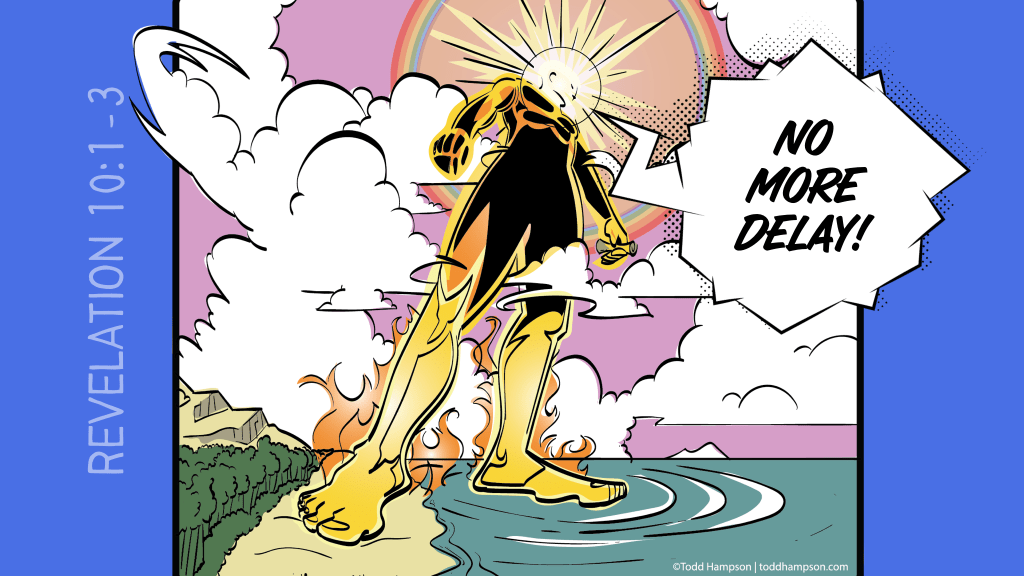
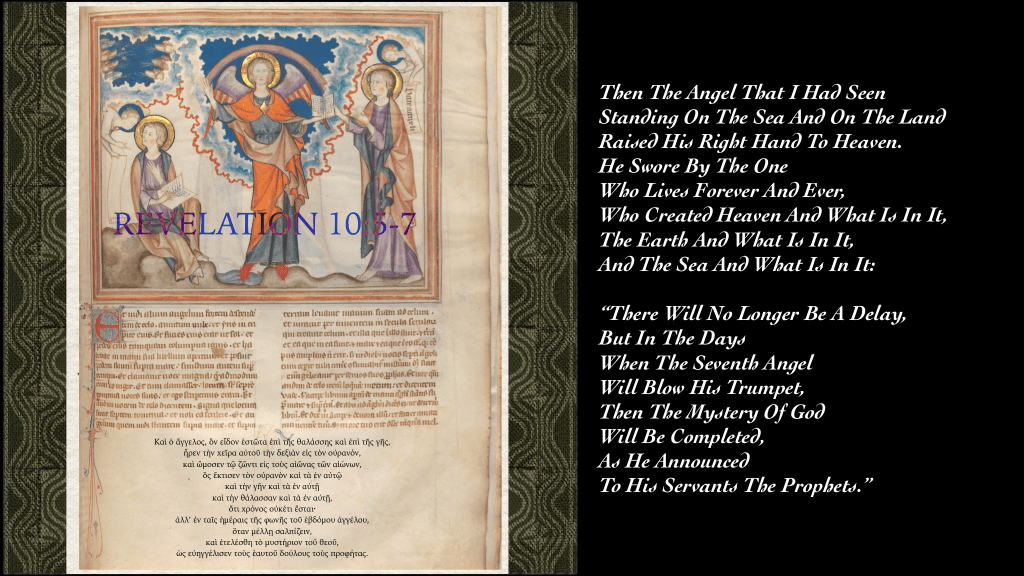
Aside from shouting loudly with a roar like a lion, the Mighty Angel in Revelation Chapter Ten performs two conspicuous actions. First, he raises his right hand to heaven and makes a solemn vow by Him who lives forever and ever that there will be “NO MORE DELAY!” And second, he gives Narrator John an edible small scroll and instructs him to eat it, but warns John beforehand that it will hard on his stomach. Therefore, we will focus here on a solemn vow of prompt completion and an edible, yet indigestible small scroll. In my previous blog-cast I mentioned that I would get to each these two loose ends from Revelation Chapter Ten, so here I go.

As I explained previously, the Mighty Angel is actually Christ Jesus himself, but in the guise of the Angel of the Lord, which was how he appeared to people over and over throughout the Old Testament. The Mighty Angel (who is Christ Incognito) stands on the sea and the land. To stand on the sea and the land is a symbolic action of dominance. It shows the Mighty Angel’s supreme sovereignty over the Sea and the Land. Throughout the Book of Revelation the Sea represents foreign and distant nations, especially the diverse ethnic groups that populated the Roman Empire. The Land represents local and native people, which would mean the Jewish people, if and when Israel is the narrative point of reference, or alternatively, the natives of Roman Asia, if the Province of Asia is the point of reference. Thus the strident symbolism is meant to show that even when Christ is Christ Incognito, he is still sovereign and dominant over the the various peoples of the Roman Empire, and by extension, the whole world.

For the first recipients of Revelation, the natives of Provincial Asia, this imagery of the Mighty Angel astride the land and sea very likely (read: almost certainly) brought to mind the nearby ruins of the Colossus of Rhodes. The Colossus of Rhodes was once a tourist-attracting giant harbor-front statue, something like the Statue of Liberty near Manhattan. Like the Temple in Jerusalem, the Colossus of Rhodes was one of the Seven Wonders of the Ancient World. And also like the Temple in Jerusalem, the Colossus of Rhodes was associated with one particular deity; in the case of the Colossus, that deity was the Hellenistic sun god Helios. But by the time Revelation was written and circulating, both had been toppled and were in ruins. The Temple in Jerusalem had been demolished by Emperor Titus’s troops, the Colossus of Rhodes by an earthquake. It is contextually telling, therefore, that the Mighty Angel of Revelation Ten stands astride the sea and the land. Revelation’s message must be that Jesus Christ stands supremely sovereign, where the Colossus had fallen.

Back to the narrative of the passage, though. In the fifth verse of Chapter Ten, the Mighty Angel raises his right hand to make his vow of prompt completion. This hand-raising action refers back to not one but two key Old Testament passages. The first passage is Deuteronomy 32:39-42, wherein God says, “For I lift up my hand to Heaven and swear, ‘As I live forever … I will take vengeance on my adversaries and will repay those who hate me.’” With the threat of certain vengeance, this might disturb a 21st century reader. But it makes the point clear that God is not to be trifled with. It also begs the question of whether the Mighty Angel is somehow the same person as the Divine Vow-Maker of Deuteronomy, given the strong similarities and the slight differences of the two passages. See my previous blog-cast entitled “The Cast of Chapter Ten” on that point.

The second passage is Daniel 12:5-13, where we see a Mysterious Figure — a Man. The Man is clothed in (white?) linen. He stands atop or above the Tigris River (see Daniel 10:4). He raises both his right hand and left hand to Heaven in a vow. He then informs (or perhaps more accurately, declines to clearly inform) the statesman-prophet Daniel how long he and his readers must wait until the end arrives. Daniel is given the cryptic answer of “a time, times, and half a time” until everything is accomplished. For Daniel, there will be delay — a very long delay. In the ninth verse of Daniel 12, the Mysterious Man solemnly says, “Go your way, Daniel, for the words are to remain secret (that is, a mystery) and sealed until the time of the End.” This passage is exactly what Revelation 10:5-7 references. Daniel is informed of a very long delay. Alternatively, John and his readers are promised that the delay will end promptly, when certain conditions are fulfilled. We are meant to catch that.

Of utmost importance, the Mighty Angel/Christ tells John that the Mystery of God will be fulfilled (or accomplished) when the seventh angel sounds his trumpet. What then, is the Mystery of God? Recall that the Mystery of God was sealed to Daniel. Does it remain sealed? Can we know what the Mystery of God is before the End? We can know it; and we do know it. We are already living in the last days, which is the Church Age. And we are privy to the Mystery of God.

While the Book of Revelation usually references the Old Testament, here we have to look to the New Testament. The Mystery of God is an important theme of the Apostle Paul’s. And yes, John’s listeners would have known that, because they were very familiar with the Pauline Epistles. Paul had written to them and their near-neighbors before John wrote Revelation. Therefore, when Jesus through John began talking about the Mystery of God, they knew exactly what he was talking about. The Mystery of God was their own adoption into the family of God. Adoption was and is the Mystery of God. Even though most of them were once pagan Gentiles, they had been invited to come join the household of God. Before the Church began, this was something unheard of and almost entirely unexpected. But God had extended an invitation to outsiders and foreigners. They, too, could accept the invitation and choose to be part of the household of God. The Mystery of God was the extent of his gracious invitation: It was even for Gentiles, who were previously excluded (see Ephesians 1:3-14; Colossians 1:24-27; 1 Timothy 3:14-16).   

Consequently, when the Mighty Angel/Christ says in Revelation 10:7 that the Mystery of God will be fulfilled when the the seventh angel sounds his trumpet, he means that when the End comes, all the Gentile peoples will have had a chance to accept the invitation to be adopted — to join the family of God. The Mystery of God is accomplished when the Church accomplishes its mission of proclaiming the Gospel of Christ worldwide (see Matthew 24:14; Mark 13:10).   

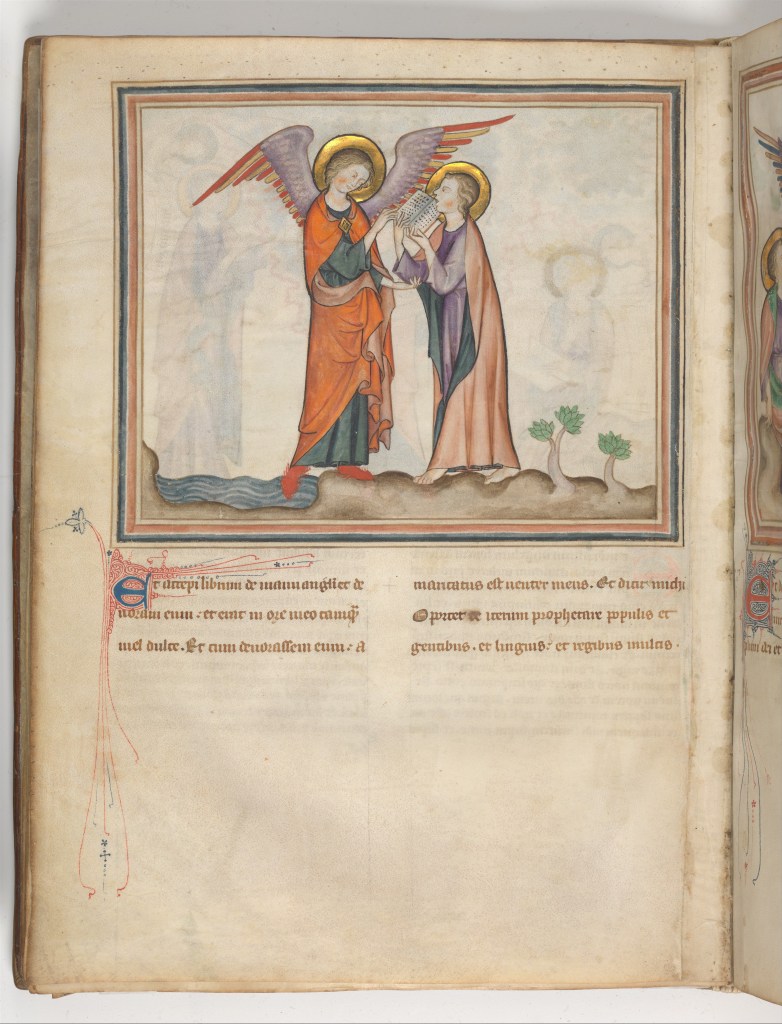
As for the scroll that the Mighty Angel gives to John, it contains information — bittersweet information. Although it is true and ultimately good, it is nonetheless very difficult and even sometimes terrifying. As with Ezekiel, the scroll that John must eat contains information about various trials and catastrophes that are yet to come (see Ezekiel 2 through 5, where God tells Ezekiel of the forthcoming destruction of Jerusalem). This is unwelcome information that the recipient must nonetheless pass along. It is information that pertains to the events of the End, as in, the end of the Church Age.

Considered as a whole, Chapter Ten is about Christ’s commissioning of John to pass along a preparatory revelation of the events to occur at the end of the Church Age, which I believe is about where we find ourselves in history. (Parenthetically, I say that because the fulfillment of the Great Commission seems both foreseeable and likely within the next century, if not sooner.) The contents of the Little Scroll are found in chapters eleven through twenty-two of the Book of Revelation. The Little Scroll reveals what Daniel 12 conceals. What was sealed to Daniel has been revealed to us by Christ via John in the Book of Revelation.

The Cast of Chapter Ten

The Cast of Chapter Ten, Audio Version

Count the characters. This chapter of Revelation presents listeners with a variety of characters. How many do you count? While some observers say Chapter Ten presents listeners with ten different characters, I see six fewer. No, not ten — only four. One, two, three, four, and no more characters are to be found in Chapter Ten. Of those four, one or two are primary and focal, while the other two are mostly peripheral. You might not agree with me. You might count more. How is it I count only four? Why so few? 

John, of course, counts as one character, albeit a relatively minor character. John serves throughout the Book of Revelation as the vision transcriber and as our narrator. For the most part, John quietly and inconspicuously narrates what he sees and hears, and does so whenever possible from the periphery. He does not focus on himself. That is true here in Chapter Ten, except for when he must eat the edible yet indigestible scroll. More on the edible scroll in a forthcoming blog cast.  

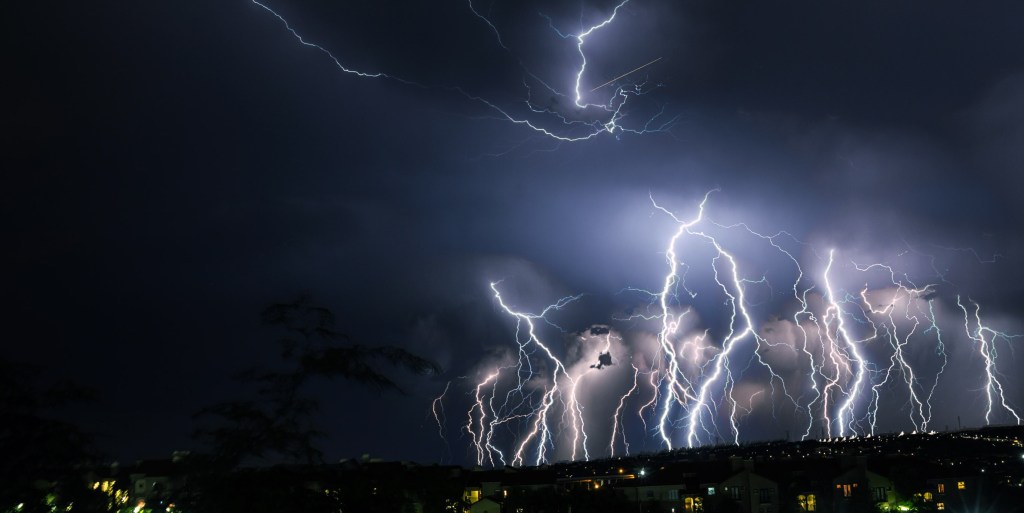
The Seven Speaking Thunders count as a second character. I say they are a character, as opposed to an event, since they do more than rumble. They speak, and speak intelligibly. Although they are said to number seven, they neither do nor say anything obviously distinctive from each other, but appear to function just as one message bearer. Perhaps they spoke simultaneously in stereo surround sound or echoed the same message in turn; yet nothing in the text indicates that they delivered seven different messages. Again, the Seven Speaking Thunders seem to function narratively as just one character. Furthermore, the Thunders cannot be considered a major character in Chapter Ten, since they appear only briefly in verses 3 and 4, where they deliver a message that is curiously censored, and immediately so. 

Forgive me, but to make my point I must resort to Seminary-speak in this paragraph. As I already said, the Seven Speaking Thunders function narratively as one — as a singularity. That fact may be intended to point Revelation’s listeners to an underlying ontological/essential reality: Somehow the Seven Speaking Thunders are best understood as one — a unified one. Ontologically (that is, in essence), they may be just one spiritual entity. Like the Seven Spirits of Revelation 1:4 and 4:5, the Seven Speaking Thunders may constitute not seven separate and distinct individuals, but just one single, yet diverse, entity. Indeed, if Chapter Ten is best interpreted using a Trinitarian hermeneutic, as I would argue it ought to be, then the Seven Speaking Thunders may well be one and the same as the Seven Spirits before the Throne — the one Holy Spirit. I am suggesting that the Seven Speaking Thunders may be the same entity as the Seven Spirits before the Throne, also and more commonly known as the Holy Spirit. Please reference in particular Revelation 4:5, where peals of thunder and seven flaming torches are some of the phenomena associated with the Throne of God. 

As for Chapter Ten’s third character, the Mighty Angel stands center stage. And the fourth character, though very, very important, is heard but never seen. That would be the Voice from Heaven. Throughout its eleven verses, Chapter Ten turns John’s attention, and thus the listener’s attention, to these two primary characters, who sometimes act and speak in tandem. Do notice that the Mighty Angel gets most of Chapter Ten’s airtime, by far. Thus the Mighty Angel ought to be considered Chapter Ten’s central character and primary focus.  

Now that the four main characters have been counted, I will move on to my next controversial claim. Here it is: The main character is probably not whom you think he is.  

Many Revelation-readers/listeners will quickly get the identity of one of these characters right, and just as quickly get identity of the other character wrong. The Voice from Heaven must be God, they will decide, and correctly so. As for the Mighty Angel, he is most likely a high-ranking angel, such as an archangel, many will conclude, incorrectly. Sorry, but that’s the wrong answer, albeit entirely understandable. No, the Mighty Angel is not merely a high-ranking angel. He is mighty. The adjective is there for a reason. He is mightier than other messengers, and far greater than other heavenly emissaries. The Mighty Angel is someone mightier than other messengers, and yet someone other than God Almighty. Who could it be?   

Many Revelation interpreters will doubt with my assertions at this point. Some may anticipate where I am going, and disagree with me on this point. They will argue that the Mighty Angel is obviously portrayed as a high-ranking angel. The text clearly says he is an angel, so he must be a heavenly emissary, simply an angel. What else or who else could he be? If not a high-ranking angel or an archangel, what else or who else could the Mighty Angel of Revelation Chapter Ten possibly be?

That is a key question, a crucially important question. Chapter Ten effectively poses that very question to those who are familiar with the Bible. But those who are not well acquainted with Old Testament prophecies will likely make some quick assumptions and even miss the question altogether, because it is implied. The Book of Revelation makes a lot of subtle scriptural references and drops a lot of detailed hints. Key questions and leads are there to be discovered; but they usually require a significant degree of prior biblical knowledge and a substantial measure of theological discernment. The Book of Revelation does this sort of thing very frequently. You gain deeper understanding of the Book of Revelation as you catch the subtle referential hints, which are almost always hidden in plain sight, there in the details. In fact, it may be an accurate statement to claim that no detail whatsoever in the Book of Revelation is extraneous. Every detail given to the listener and provided by the Book of Revelation is there deliberately and intentionally. Such details often require further study. The interpreter will have to reference and re-read Old Testament prophecies. But it will be worthwhile, since the details will help a careful interpreter arrive at a clearer interpretation.
To be blunt, the hints all point to the Mighty Angel being Jesus Christ himself. More specifically, the Mighty Angel is a New Testament cameo of the pre-incarnate, pre-existent Jesus Christ. The Mighty Angel is who Christ Jesus was before he was born as a human being. Throughout the Old Testament, Jesus appears and reappears as a mysterious figure known as the Angel of the Lord. And Revelation Chapter Ten is dropping hints galore that the Mighty Angel is the pre-incarnate Christ. That is indeed the correct interpretation, in spite of how things may initially seem on a superficial, un-referential read.

In particular, two key Old Testament passages are hidden in the details of Revelation Chapter Ten. The first key passage is the opening vision of Ezekiel the exiled priestly-prophet, found in the Book of Ezekiel chapters one and two. The second key passage is the concluding vision of Daniel the exiled statesman-prophet, found in the Book of Daniel chapters ten, eleven, and twelve. If a reader/listener compares Revelation Chapter Ten to the opening chapters of Ezekiel and the closing chapters of Daniel, the detailed references are overwhelmingly obvious.

In both the opening of Ezekiel and the closing of Daniel, a Mysterious Figure appears. Although the Mysterious Figure seems like he might well be God himself, the two passages leave the  identity of the Mysterious Figure something of a mystery, because unlike God, he is described as visible and likened in form to a human being, a man. So if he is not exactly God, who is the Mysterious Figure? Is he a variation or manifestation of God, or an angelic proxy, or what? Revelation Chapter Ten points the discerning listener directly to both prophetic passages, and links the Mighty Angel to the Mysterious Figure therein, leaving the distinct impression that the Mighty Angel is one and the same as the Mysterious Figure in both passages. 

Therefore, at least three claims can be made. First, the Mysterious Figure in Ezekiel and Daniel is, at very least, God-like in position, appearance, and glory. Second, the Mysterious Figure in Ezekiel and Daniel personally and authoritatively delivers divine messages and interpretations to the respective prophets. Third, Revelation Chapter Ten ties or even fuses these two Mysterious Figures together into one. In Chapter Ten, the equation is not one plus one, but one times one. This is just one individual. The Mysterious Figure in the opening chapters of Ezekiel is one and the same as the Mysterious Figure in the closing chapters of Daniel; that is what Revelation Ten portrays in the person of the Mighty Angel.  

So if the Mysterious Figure of Ezekiel, Daniel, and Revelation is the same singular being throughout, who is he? If your inclination is to say that he is an angel of some sort, I would caution you with the observation that he is enthroned in glory among the cherubim in Ezekiel (see also Ezekiel 10:20). Enthroned in glory, like God and as God. Among the cherubim, like the mercy seat of the ark of the covenant, where the presence of God resided. However, if your inclination is to say that he is simply God, I would ask you, How is it that he appears visibly in the likeness of a man in both Ezekiel and Daniel? How is it the prophets can see anyone at all, since God is invisible, and since no one can see God and live (see Exodus 33:20, John 1:18, and 1 Timothy 6:16)?

This individual defies easy categorization because he actually fulfills all three. He is wholly divine. But sometimes he takes the role of a heavenly angel/messenger in order to appear to human beings. But then he went an additional condescending step and even assumed full humanity in the incarnation. He became a man for our sake. Only one individual in history fits all three categorizations: Jesus Christ. Therefore, especially when its two primary Old Testament prophetic references are taken into account, Chapter Ten of Revelation pushes a trinitarian portrait of God, the whole way through. The Voice from Heaven is God the Father. The Seven Speaking Thunders are the Holy Spirit. And the Mighty Angel is Jesus Christ. 

But I have not covered everything in Chapter Ten yet. There are two big remaining narrative issues from Chapter Ten that need to be addressed. There is a vow made by the Mighty Angel. And there is an edible scroll given by the Mighty Angel.    

Five More Interpretive Insights

Five More Interpretive Insights, Audio Version
  1. My last point (that is, point # 18 from yesterday’s blog-cast) brought us to the climatic 7th Trumpet; but I ought to backtrack a bit because in jumping directly from the 6th Trumpet to the 7th, I skipped over a small and yet very important section of Revelation. Between the conclusion of the 6th Trumpet and the beginning of the 7th, readers will discover a 24 verse narrative digression, which includes all of Chapter 10 and over two-thirds of Chapter 11. Why does this textual digression occur? My hunch is that it allows for a period of time. A considerable amount of time must elapse between the 6th Trumpet (which is essentially the ongoing fulfillment of the Great Commission) and the 7th Trumpet (which is — or will be — the Second Advent of Christ and the Rapture of the Church). To synchronize the text chronologically to the here and now, that’s precisely where we presently find ourselves on Revelation’s redemptive timeline: somewhere between the 6th and 7th trumpets.
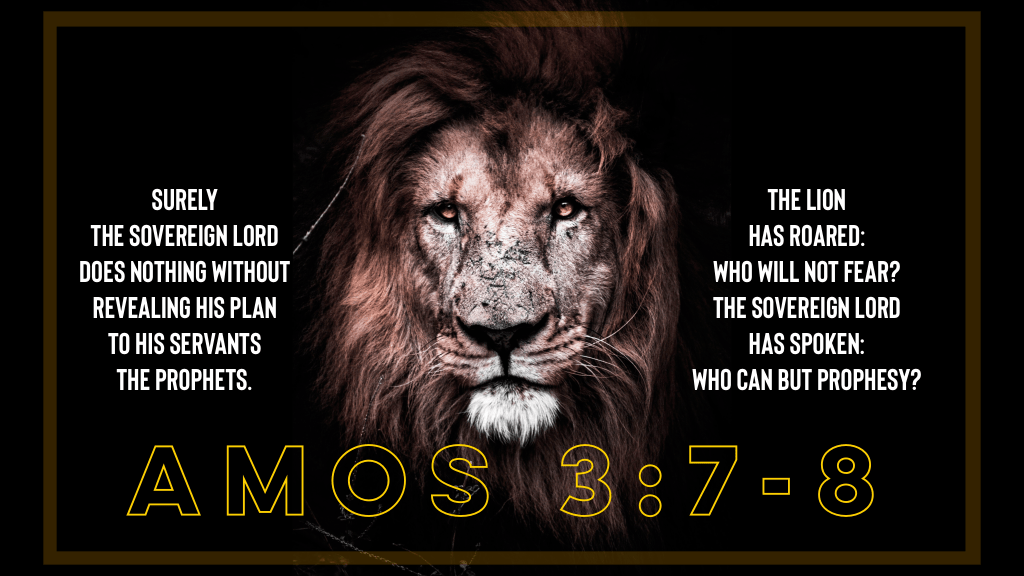
  1. In Chapter 10, John sees “another Mighty Angel coming down from Heaven.” Additional details provided about the Mighty Angel must not to be overlooked, though — details that lead to the conclusion that this particular “angel” must be someone other than an ordinary angel. The Mighty Angel 1) is wrapped in a cloud, 2) has a rainbow over his head, 3) has a face like the sun, 4) has legs like a pillar of fire, and… drum roll… 5) has a scroll in his hand. Here there is more than one Old Testament allusion — plus a very clear, direct reference. The reference is to the opening chapters of Ezekiel, in which an extraterrestrial Cherubim-carried Throne appears to an awestruck Ezekiel. The One seated on the Throne has a human appearance (Ezekiel 1:26) and delivers an edible scroll (Ezekiel 2:8-10), just as the Mighty Angel does in Revelation 10:8-9. The Mighty Angel/Messenger also roars like a lion. That’s likely another Old Testament allusion, and perhaps even a direct reference, to Amos 3:7-8, which links the Lion’s Roar to the Spoken Word of the Sovereign Lord. Therefore, the Mighty Angel of Revelation is very, very likely one and the same as the One seated on the Throne in Ezekiel, who roars the word of the Sovereign Lord. This Mighty Angel/Roaring Lion is Christ himself. And Christ himself was the One seated on the Throne in Ezekiel. Thus Christ existed long before his lowly birth in Bethlehem, and existed as the Enthroned One. In Seminary-speak, this is extremely high Christology. Christ is on par with God.
  1. But if the Mighty Angel of Revelation 10 is actually Christ himself, John could just say so plainly; right? So why keep it a big mystery, and force the reader to detect subtle Old Testament allusions and references? Why indeed. We are supposed to ask ourselves exactly such questions. The reason why Christ is “disguised” as the Mighty Angel in Revelation 10 is because Christ is likewise disguised in various ways throughout the entirety of Old Testament, especially as a reappearing character known as the Angel of the Lord (see Genesis 16:7-13; Genesis 22:15-18; Exodus 3:2; Judges 6:12; Zechariah 3). In English translations, the first four words of the Book of Revelation are “The Revelation of Jesus Christ.” The Book of Revelation is exactly that. It is a Revelation of Jesus Christ, from Jesus Christ, about Jesus Christ.
What is the Mystery of God that will be completed at the 7th trumpet?
  1. In Revelation 10:3-4, John hears Seven Thunders speak. And yet John is instructed not to write down what the Seven Thunders have said. My proposal is that the thunders revealed information about historical events to occur between the Sixth and Seventh Trumpets. Although God foreknows the course of the future, we are not supposed to know too much in advance. We are better off not knowing some things to come. That’s just my guess, though. Someday we will know what the Thunders thundered.
  1. Just like Ezekiel before him, John is told to eat the scroll that the Mighty Angel/Christ gives him. It tasted as sweet as honey, but was hard on his stomach. This probably means that the message contained on the scroll was not particularly pleasant. In fact, the message contained on the scroll probably immediately follows in Revelation 11. The gist of that message is that the Church cannot triumph unless it first suffers as Christ suffered. Like Christ, the Church will be raised triumphant; but first it must suffer rejection and face the prospect of death. It is a message that is hard to stomach, for us as well as John.

Eighteen Interpretive Insights

Eighteen Interpretive Insights, Audio Version

Here are some of my key insights into the Book of Revelation:

1. Beginning with the Trinitarian Benediction in the first chapter, Revelation repeatedly, if subtlety, depicts the doctrine of the Trinity. In Revelation 1:4-5 grace and peace issue forth from the I Am, the Seven Spirits, and Jesus Christ. The Old Testament’s Yahweh or I Am equals the One who is, and who was, and who is to come. The Seven Spirits equal the Holy Spirit, in a nod back to the Menorah symbolism of Zechariah 4:1-6, where an angel deciphers the Menorah as a symbol for the Spirit of the Lord. And Jesus Christ is simply and unambiguously called by his name and title.

2. Jesus is presented as fully divine, insofar as he is worthy of all worship. Compare the worship of the Creator (the Lord God Almighty) in chapter 4 to the worship of the Redeemer (Jesus Christ, the Lion/Lamb) in chapter 5; and note 5:13 in particular. No one else is worthy of worship — regarding that Revelation is emphatic (see 19:10; 22:9). Jesus also shares the Throne in Heaven with God (Revelation 22:1-3).

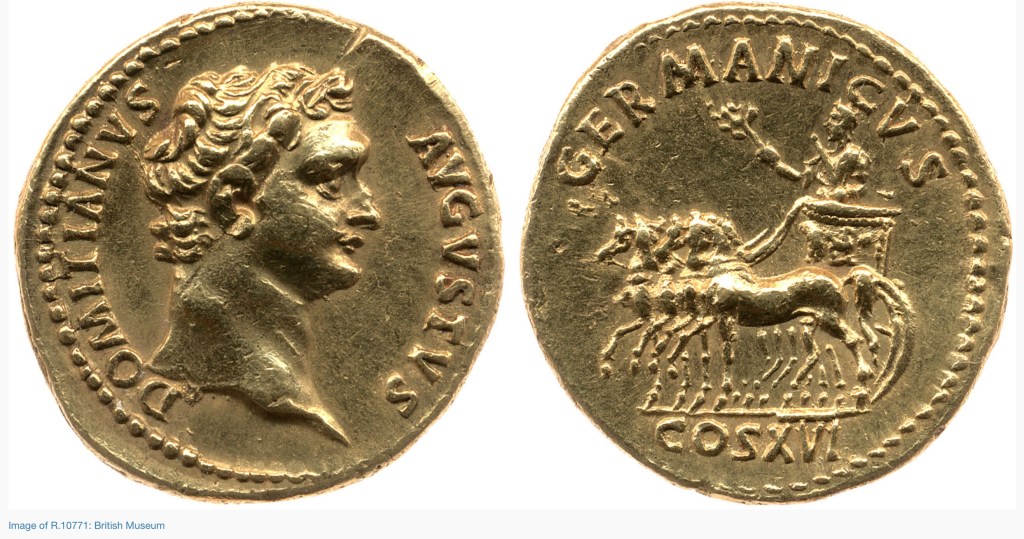
3. Jesus is presented as royally sovereign over and present amidst the seven churches (see Revelation 1:5; 2:26-27; 17:14), as opposed to the self-aggrandizing, satanically-inspired Caesar. At the time Revelation was written, Emperor Domitian became the first Roman Emperor to encourage his subjects to hail him while alive as “Dominus et Deus,” which translates to Master and God. By Revelation’s reckoning, Domitian’s blasphemous claim to divinity made him an incarnation of the Beast from the Sea, that is, an Antichrist.

Domitian Coin, with Germanicus Triumphant Quadriga reverse.

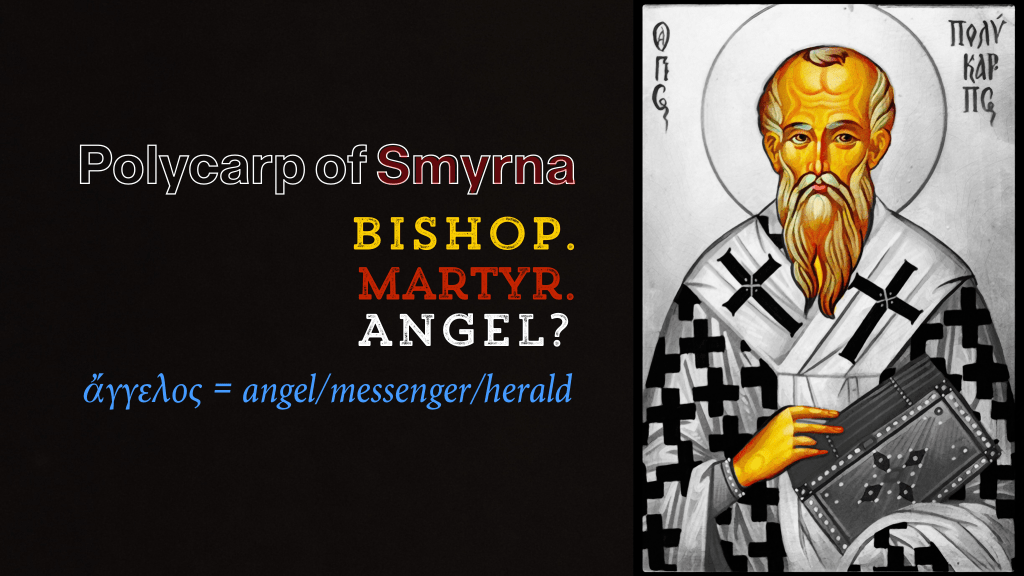
4. The messages to the seven churches of Roman Asia are addressed only secondarily to the seven congregations, but primarily to actual, fallible human messengers/heralds — emphatically not to heavenly messengers (angels), nor to figurative proxy-personifications (see Revelation 1:20; 2:1; 2:8; 2:12; 2:18; 3:1; 3:7; 3:14). These are mere mortals. These are seven (hopefully correctable) human heralds who have pastoral responsibility over seven distinct late-first-century churches. Said a bit differently, the “angels” of the churches are just the duly established human messengers — simply the pastors or bishops.

5. While they were absolutely meant for the seven churches back then-and-there, Christ’s messages to the seven churches are also intended to be typological and trans-historical. Each message is meant (if the shoe fits) for additional messengers/pastors and their congregations throughout Church history. “Whoever has an ear ought listen to what the Spirit says to churches.”

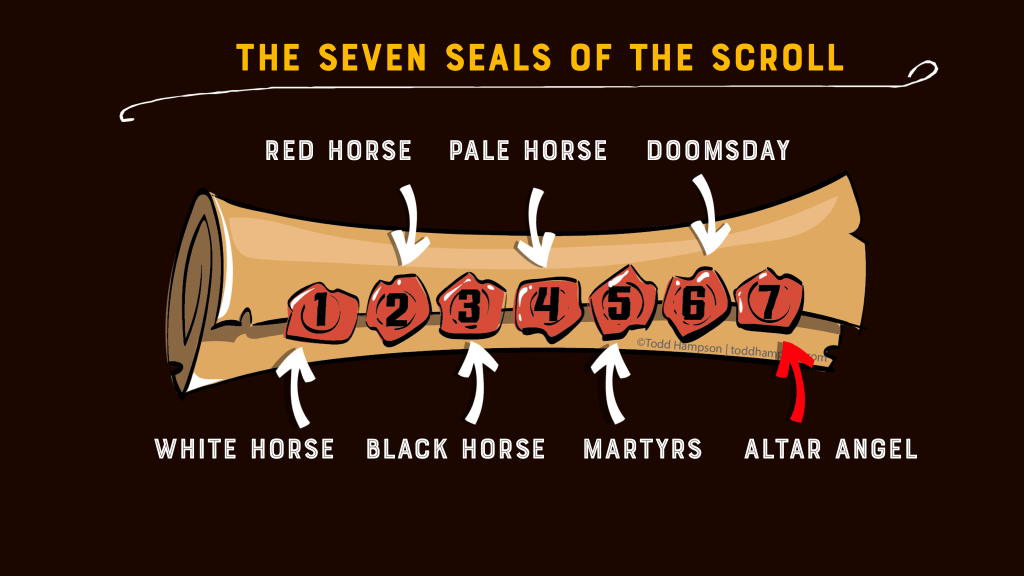
6. Jesus Christ, the Lion/Lamb, has always been and remains sovereign, even in the darkest, most tragic events of history. This is shown through the breaking/opening of the seven seals to the scroll, and the cryptic or frightening personifications and representations that present themselves in turn. Manifestations of evil are only allowed for a short season; and they are never on equal footing with Christ, in spite of grandiose, blasphemous claims or circumstantial appearances.

Pale Horse

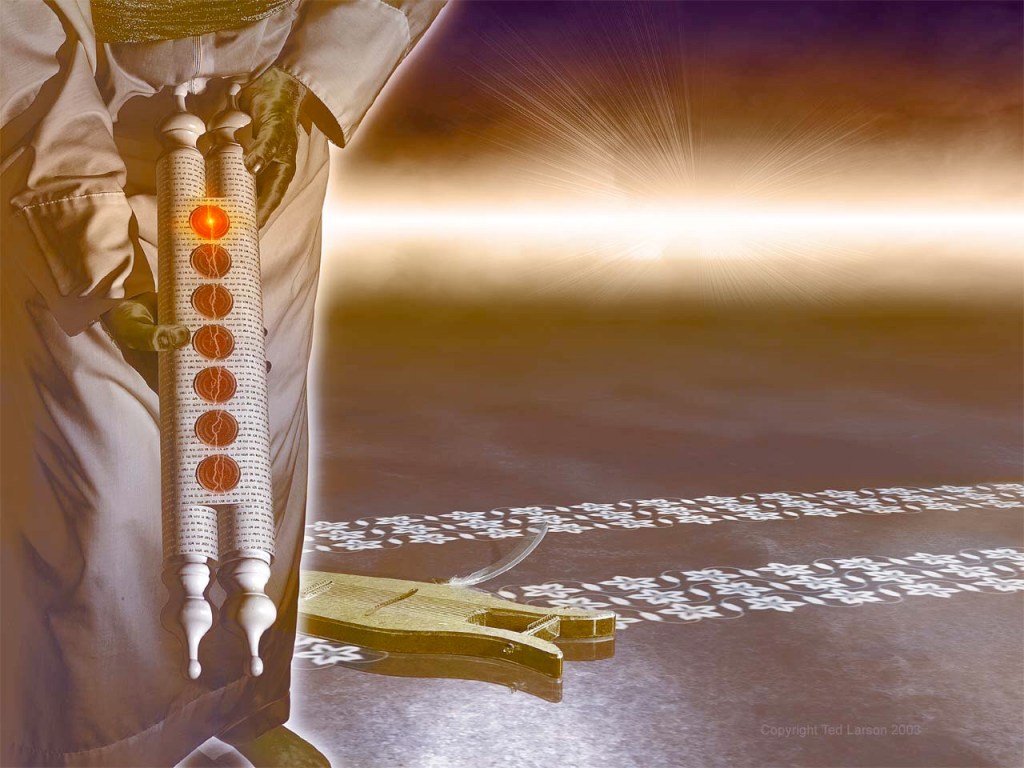
7. The Scroll which the Lamb opens is a completed covenant — a will, which the sacrificed Lamb himself has duly fulfilled (see Revelation 5:5). The resurrected living Lamb now serves as the executor of that same will.

8. Six of the seven seals to the Scroll are the unresolved mysteries/tragedies/horrors of history, especially of the prophetic sort. They are the curses/judgments upon disobedience threatened and foretold in the “fine print warnings” of pivotal passages like Deuteronomy 28.

Revelation 6-8

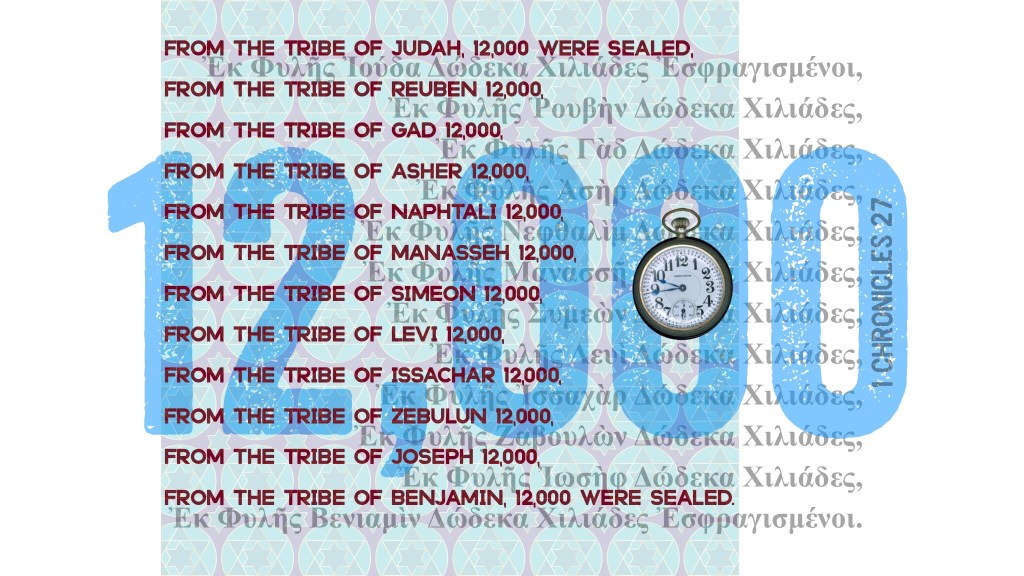
9. The 144,000 servant-soldiers sealed after the sixth seal are all the saints — all the Elect — throughout all of human history, right up until the Second Advent/Parousia of Jesus Christ. The number 144,000 derives from a military census in 1 Chronicles 27, where the number of total troops from Israel doubles 144,000. Not all of Israel is actually elect; but the number of God’s elect greatly exceeds the number of Israel (see Revelation 7:9, where the 144,000 servant-soldiers are paradoxically said to be an innumerable multitude).

10. All the tragedies/curses/horrors of Deuteronomy 28 are resolved or overturned through the final seventh seal, which silences all of Heaven as “another angel” makes an important offering (see Revelation 8:1-5). This Angel offers incense at heaven’s golden altar — incense mingled with the prayers of the saints. This “other Angel” may well be Christ himself and/or the Holy Spirit, since his offering is explicitly priestly and turns the entire course of redemptive history.

Christ Himself?

11. The opening of the seventh seal initiates another series of seven — the Seven Trumpets, which are symbolic depictions of the most significant Church-age historical events and efforts. The first six trumpets herald various Christophanies, or veiled appearances of the sovereign Christ throughout the Church age. The seventh trumpet heralds Christ’s unveiled final arrival/second advent.

The Battle of Jericho made military use of Seven Shofars.

12. The First Trumpet is a symbolic depiction of the outpouring of the Holy Spirit on the Day of Pentecost, as told in Acts 2. The Pentecostal outpouring is symbolized (unsurprisingly) as falling fire — and (surprisingly) as hail mixed with blood, thrown down upon the Earth. This hail reference likely points back to the seventh plague of the Exodus from Egypt (see especially Exodus 9:20-21, for a further interpretive insight on the importance of belief). The Earth here is symbolic of the Jewish people — not just their land, but the people themselves. The Holy Spirit first fell as transformative fire on believing Jews in Jerusalem, but also fell as destructive (albeit invisible) hail on their unbelieving counterparts. The outpouring of the Holy Spirit on Pentecost seems to fulfill a prophecy in Isaiah 28, which significantly includes the phrase “thrown/cast down to earth” (compare Isaiah 28:2 with Revelation 8:7). The prophecy in Isaiah 28 also mentions both destructive hail and unintelligible foreign languages, within the threat of a terrifying impending judgment.

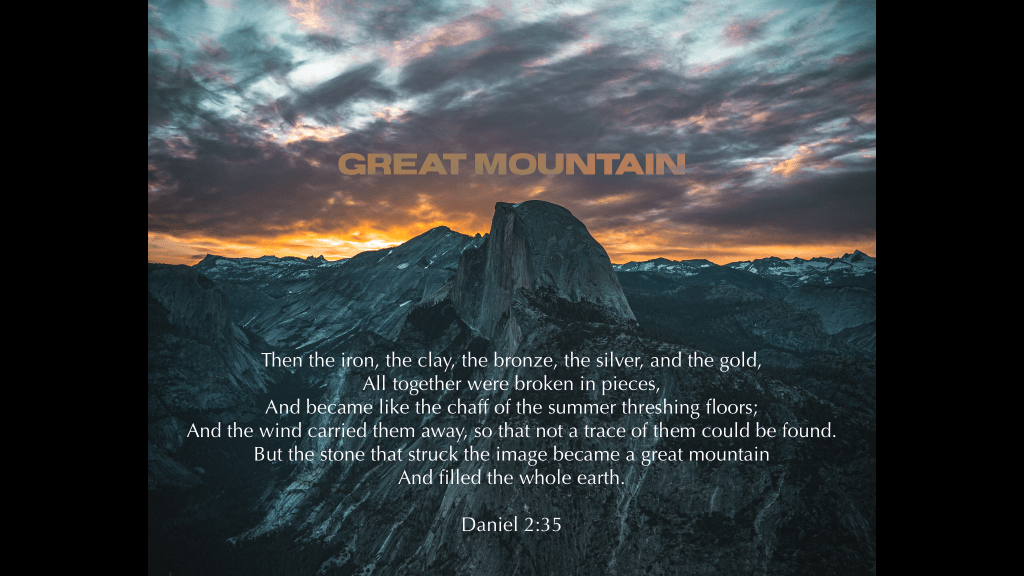
13. The Second Trumpet is a symbolic depiction of the Conversion of the Roman Centurion Cornelius at Caesarea Maritime (for the account read Acts 10). The Conversion of Cornelius and his whole household was effectively a second Pentecost/Outpouring of the Holy Spirit, but this time specifically upon the Gentiles. This event is depicted symbolically as a Great Mountain thrown into the Sea. The Great Mountain symbolizes the Kingdom of God/the Church (see Daniel 2:35; 7:18). The Sea symbolizes the Gentile nations (see Psalm 89:25), especially the ethnic groups that comprised the Roman Empire. Note that the Romans proudly claimed the Mediterranean as “Our Sea,” and used shipping to project their power Empire-wide. Caesarea Maritime was an artificial harbor city constructed by Herod the Great on the Mediterranean shore. It was only possible to construct the harbor because of innovative Roman engineering, or more specifically, hydro-hardening concrete. Understanding that the Sea symbolizes Rome and diverse Gentile nations unlocks other symbolism in the Book of Revelation, such as the Beast from the Sea.

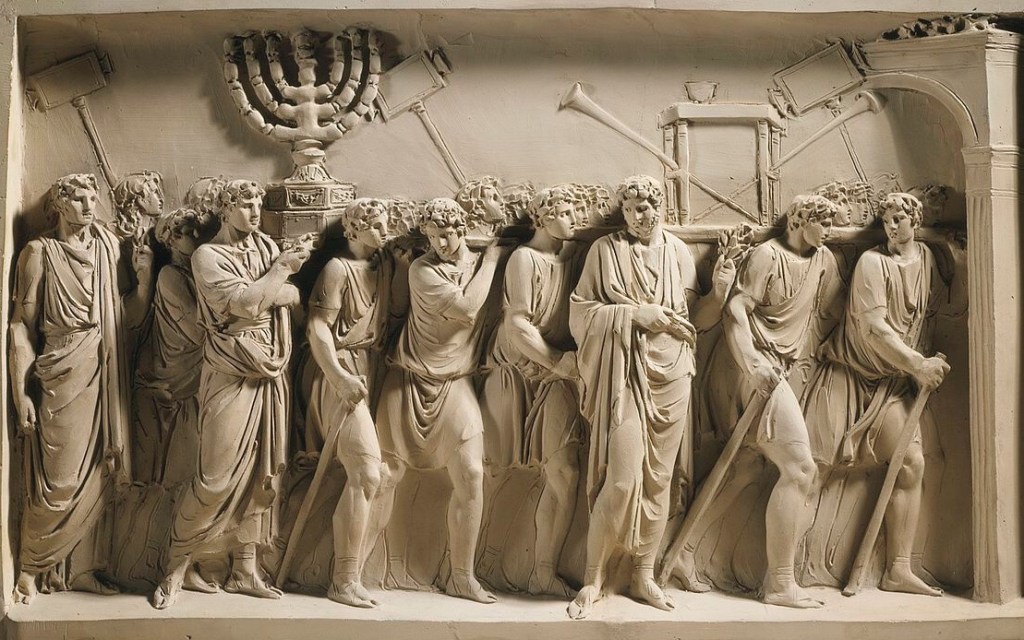
14. The Third Trumpet is a symbolic depiction of the Destruction of Jerusalem and its (now God-Forsaken) Temple in 70AD on Tisha B’Av (the same calendar day that Solomon’s Temple was destroyed in 587/586 BC). This cataclysmic event is depicted symbolically as a great shooting star, resembling a “flaming torch,” named Wormwood. Shooting Star Wormwood crashes and contaminates or poisons “the Rivers and Springs.” There are several important key explanatory Old Testament references here. That Wormwood resembles a “flaming torch” refers to God’s solemn covenant-establishing appearance to Abraham in Genesis 15, in which Abraham receives a promise of both descendants and delineated property. The name Wormwood itself refers to a solemn warning in Deuteronomy 29:18, and, more importantly, to a prophecy of judgment upon Zion/Jerusalem in Jeremiah 9:13-22. The Rivers and the Springs are a reference to the well-watered land promised to Abraham (see Genesis 15:18, and, significantly, Deuteronomy 8:7, which describes the Promised Land as “a good land, a land of brooks of water, of fountains and springs.”

Trophy spoils from the demolished Jerusalem Temple.

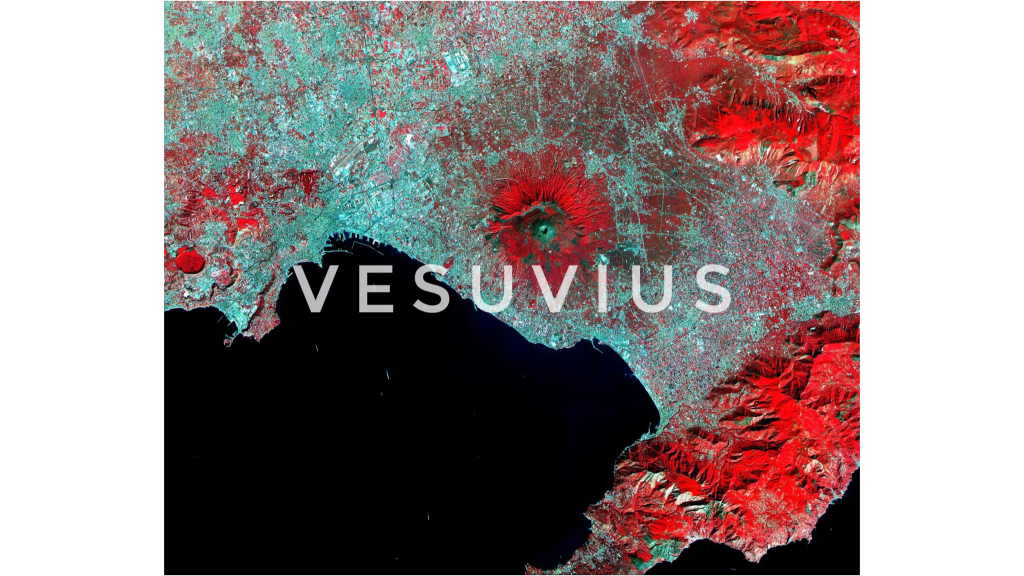
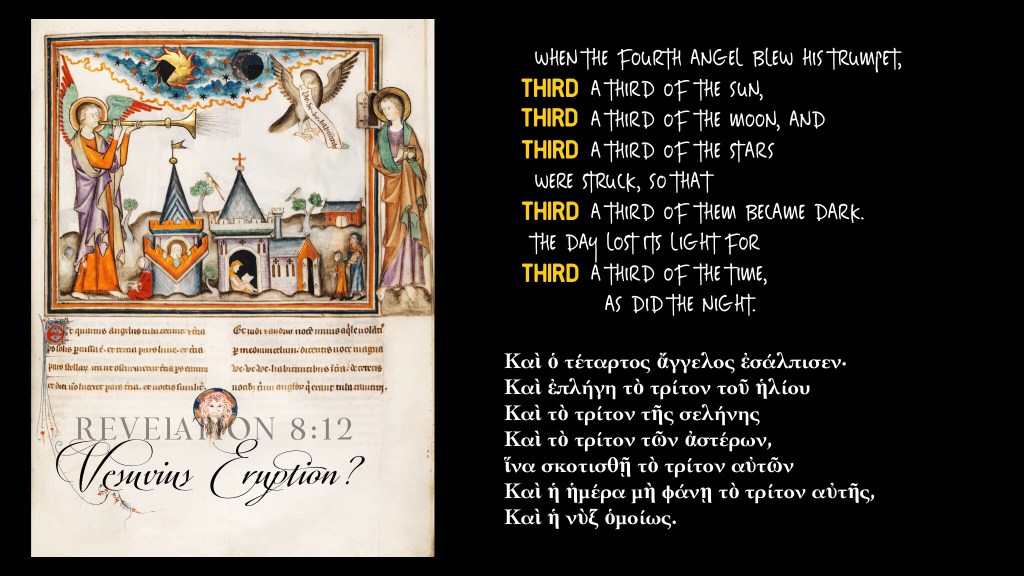
15. The Fourth Trumpet symbolically depicts the historically momentous Eruption of Mount Vesuvius, which was God’s judgment upon seemingly-Triumphant Emperor Titus (Domitian’s older brother and predecessor), as well as God’s assault upon the celestial Roman Pantheon. Before becoming emperor, Titus commanded the Roman legions that destroyed Jerusalem and demolished God’s earthly temple. In Revelation 8:12, the sun, moon, and stars (or planets) are “struck,” and dimmed by a third. When Italy’s Mount Vesuvius explosively erupted in 79AD, it poured so much volcanic ash into the atmosphere that both the day and night were darkened over the Mediterranean world for a period of time. Interestingly, Isaiah 24:17-23 can be read as a prophetic depiction of both the eruption of Vesuvius and the fearsome concomitant destruction of Sodom-like Pompeii.

16. The Fifth Trumpet symbolically depicts historic (demonically inspired) efforts to stop and counter the spread of the Gospel. Vast swarms of locust-like hybrid creatures (somewhat similar to mythological Manticores) go around afflicting (deceiving) those who do not have the seal of God on their foreheads. The threatening locust swarm motif harkens to the Old Testament Book of Joel. The fantastical description of the hybrid locusts borrows in part from locally-known Græco-Roman mythology.

Manticore

17. The Sixth Trumpet symbolically depicts the inexorable worldwide advance of the Gospel of Christ. Christian martyrs/witnesses are likened to another mythological creature — the chimæra, which breathes fire and kills a third of mankind. Two things signal that these creatures are Godly and good, not bad. First, they wear a breast plate that is tricolored, like the breast plate of the High Priest. Second, they breathe out (holy) fire. In the Book of Revelation, exhaling fire is symbolic of preaching the Spirit-inspired Word. To be slain by such fire is actually beneficial. We die to ourselves (to our egos) when we receive the Gospel message.

Chimæra

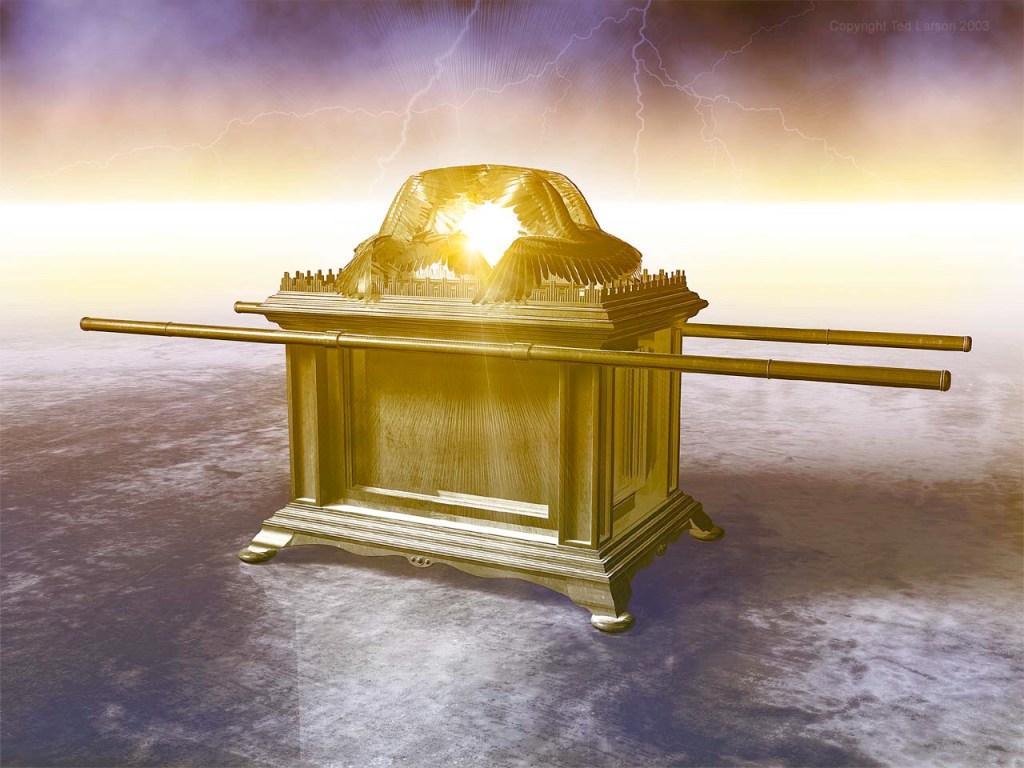
18. The Seventh Trumpet in Revelation 11:15 announces the Second Advent/Eschatological Arrival of Christ and the Rapture of the Church. The Ark of the Covenant in Revelation 11:19 symbolizes Christ reunited with the Church, which has been temporarily raptured/taken from Earth to Heaven.

No, not this ark; it’s just a symbolic shadow of something or someone.

19. To be continued…

Identification, Please

Wednesday, July 8th, 2020

Identification, Please – Audio Version

At least three other people have shared my first and last name. To my knowledge, one other person has shared my first, middle, and last name. His name was identical to mine. He died within the last fifteen years. He was a resident of the same state, and lived not far away. The fact that he has died and that I am still alive could potentially bring me trouble. In fact, it may have already caused some trouble, as I recently had to take documentary pains to establish my identity with state officials. On that occasion, I had to submit official paperwork to prove that I am who I claim to be, lest perhaps I be an imposter, attempting to steal a dead man’s identity. 

Although I have not needed to have this conversation face-to-face yet, I imagine the day may come when I need to explain in person that I share my name with a deceased person. I may need to say something like this: “Yes, I am actually who I claim to be. Yes, that’s my legal name and has always been my name. Yes, I’m still alive, as you can see. The other guy who happened to have my same name is no longer alive. He’s dead. He died some time ago. He was not me. Same name, but different guy. He’s dead; I’m not. And I have the means to prove that I am who I say I am.”  

The reason I say all this is because people and even whole communities share the same name in the Bible. Consequently, the reader has to keep straight who is who. It isn’t always easy to do. There are two or three Zechariahs in the Bible. There are two or three Joshuas. There are two or three Marys. There are two Sauls. There are two James. There are two or three Johns. 

Usually, the individuals who share the same name are helpfully separated by big stretches of time, which makes it easier to keep things straight. The two Sauls are separated by well over a thousand years; and the latter Saul did everyone a favor by assuming the Græco-Roman name Paul, thereby erasing any confusion. But that is not always true. The three Marys are pretty close to each other in time and place. There is Mary, the mother of Jesus, and Mary, the sister of Lazarus and Martha, and Mary Magdalene. All of the Marys were closely associated with Jesus. If we had photos of the three Marys, it would be easier. But alas, no photos back then. Someday in glory, it will be easier. 

And then there are cities. Caesarea serves as a prime example. There is more than one Caesarea mentioned in the New Testament. One sits right on the Mediterranean Sea. It is therefore known as Caesarea Maritime. An extremely important New Testament event happened there (see Acts 10, where the Holy Spirit dramatically fell upon a believing Gentile household). The other Caesarea does not sit on the sea, but near a spring in the northern highlands of Israel. It is known as Caesarea Philippi. A crucially important New Testament conversation happened there (see Matthew 16:13-20, where Jesus candidly affirms Peter’s claim that Jesus is the promised Messiah). If you’ve traveled to Israel (which I have not, yet) and visited either or both locations, the two Caesareas should be easy enough to keep separate, since one is a beach-front Mediterranean resort; and the other is definitely not. But if you’re just reading through the gospel accounts, the two cities are not easy to distinguish.

Making matters even more complicated, sometimes one biblical name is deliberately used two ways. Israel is both an individual man (also known as Jacob) and a nation. Ephraim is both an individual man and a region. Judah is both an individual man and a nation. Context usually makes it clear whether you’re reading about a person or an entire nation. But not always. Sometimes biblical writers even deliberately play on the eponymous ambiguity. When such situations present themselves, biblical readers may need to slow down, re-read, cross-reference, and even take some notes. Again, context usually clarifies matters, eventually.  

Now, we must turn our faces toward Jerusalem. When they appear in prophecy, the names Zion and Jerusalem are effectively synonymous; and they are conceptually hard to keep straight. You may want to repeat that statement aloud about fifteen times, because it is an extremely important point to grasp. 

In prophetic literature, the names Zion and Jerusalem are conceptually hard to keep straight.

In prophetic literature, the names Zion and Jerusalem are conceptually hard to keep straight.

In prophetic literature, the names Zion and Jerusalem are conceptually hard to keep straight.

Keep going…

Just be very aware that should you encounter the names Zion or Jerusalem in a prophecy you may be on slippery interpretive ground. In the Bible, Jerusalem is usually what you might guess — that is, a geographically-defined, map-able ancient city. But not always. Sometimes in prophecy, Jerusalem is used as a metaphorical reference or a spiritual designation. Therefore, as a prophecy reader you have to ask yourself exactly which particular Jerusalem or Zion you have before you. Here are some of your interpretive options:

  1. This is indeed and simply Jerusalem/Zion, the literal geographical city.
  2. In this passage, Jerusalem means the populace of the literal, geographical city.
  3. In this passage, Jerusalem stands for something larger, such as the entire Jewish nation.
  4. In this passage, Jerusalem signifies the elect people of God, including Jews and Gentiles.
  5. In this passage, Jerusalem designates not an earthly city, but a heavenly or spiritual city.                  

Since these various Jerusalems play such an important and recurring part in both Old Testament and New Testament prophecies, careful Bible readers cannot escape these interpretive decisions. Which Jerusalem or Zion is this? You have to ask the question, time and again.

When I read the Bible and encounter the name Jerusalem or Zion, I generally start by asking myself if the passage I am reading is prophecy. If the answer is no, then it is almost always safe to assume that it is the literal geographical city or the populace thereof. But if the answer is yes, this is indeed a prophecy, then it matters greatly if I am reading from the Old Testament or New Testament. In general, the Old Testament thinks of Jerusalem in either literal, immediate, and usually negative terms or in futuristic, utopian, and positive terms. In the Old Testament, there is the corrupt, sinful Jerusalem that existed back then; and there is the purified, holy Jerusalem that is to come. But to think of Jerusalem as the entire elect people of God, including even redeemed Gentiles from outside Israel — well, wait… what? That idea is mostly foreign to the Old Testament and a rather surprising mystery, a mystery that is only hinted at here and there, a tiny bit.

In New Testament prophecy, though, that once seemingly foreign mystery comes to forefront. In the New Testament, Jerusalem/Zion is very often a symbol of the entire elect people of God, including Jewish believers and redeemed Gentiles. More simply stated, in much of New Testament prophecy, Jerusalem is one and the same as the Church Universal and Everlasting throughout all of human history. You can repeat that statement to yourself a bunch of times, too.

An extremely important thing to keep in mind is that in the end all the various Jerusalems will merge into just one holy community anyway. The Church Universal and Everlasting in heaven will someday descend down to Earth and be established here as a permanent city, both spiritually and literally/physically. That is because what is now distinct spiritually and literally will someday be fused together. In the end, there will be just one Jerusalem where God will dwell with the redeemed.

For further reading, I would suggest Isaiah 62 and Revelation 21.            

Talk to the Birds

Thursday, June 25th, 2020

Talk to the Birds, Audio Edition

In 1799 Napoleon Bonaparte fought the Ottomans in the Jezreel Valley, alternatively known as the Megiddo Valley. Napoleon deemed the valley the most natural or perfect battlefield on earth. According to the Book of Revelation, it just might be the final battlefield on earth — at least the final terrestrial battlefield for a very, very long time.  

A hill positioned towards the western edge of the valley gives the entire area its name. The Israelis call the hill Tel-Megiddo. Because of an ancient fortress on top of it, the hill has been the focus of extensive archaeological efforts for well over a century, yielding lots of interesting discoveries. There are layers upon layers of history there, going back before the children of Abraham arrived. In the Book of Revelation, Tel-Megiddo has a hybrid Hebrew-Greek name: Armageddon.

Biblical scholars debate whether the Battle of Armageddon will be a literal, physical battle or a spiritual battle. In my estimation, one verse settles the question. That verse is Revelation 19:17: “Then I saw an angel standing in the sun. And with a loud voice he called to all the birds that fly directly overhead, ‘Come, gather for the great supper of God.’” The verse is almost a direct quotation from Ezekiel 39:17. The whole of Ezekiel 39 should therefore be referenced to give prophetic context. When I read Ezekiel 39, I cannot help but conclude that the chapter refers to the aftermath of a massive, literal, physical battle. I would encourage you to read the passage for yourself to see if you come to the same conclusion. Doesn’t it seem like Ezekiel is talking about a massive, literal, physical battle? If that is a correct read, I am ready and willing to take an additional step and conclude that Revelation 19:17 and Ezekiel 39:17 probably refer to the same final battle, a future final Battle of Armageddon. 

To summarize in brief, I am arguing that the Battle of Armageddon mentioned in Revelation 19 is one and the same as the massive, future battle described in Ezekiel 38 and 39. That battle takes place on a map, in what is now the nation of Israel. Again, read Ezekiel 39, but also read the prior two chapters, chapters 37 and 38. All three chapters focus on Israel. Just count the occurrences. It is all about the people of Israel, the house of Israel, and the land of Israel.

Israel, Israel, Israel. Okay then, could Ezekiel mean anything other than Israel as it is commonly understood? I mean, Israel, the Jewish nation that currently exists? Ezekiel seems to be talking about that self-same Israel, and only that Israel. Ezekiel is talking about the Hebrew-speaking Jewish nation that once existed and that now exists again.       

If everything I have argued for thus far is right, then the nation of Israel does indeed appear in the Book of Revelation. And it is the location for the final battle. Therefore, Israel should be of special interest to Christians. Prophecy is yet to be fulfilled there. 

Without Qualification

Wednesday, June 24th, 2020

Without Qualification, Audio Version

We are very close to the apocalyptic final return of Jesus Christ. Because we are close to the return of Jesus Christ, the study of the Book of Revelation is not just somewhat pertinent, it is essential. The Book of Revelation was given for such a time as this. It was given to the Church for the purpose of discerning these days — these very days, right now. And it was given in order to help us understand how to make it through these days without losing hope or losing faith. We do well to be wise and take heed to what is written therein. The wise will pay close attention to the message of the Book of Revelation during this time.

Is the previous paragraph propeller-hatted crazy talk? Does it come across as the ranting of a fanatic fundamentalist? Does it sound like something a cult leader would say to attract the naïve and impressionable? Or is it spot-on? I will show my cards here: I believe every word of it. I believe we are living just before the return of Jesus Christ. Thus we are wise to live accordingly, and foolish to live otherwise. Matthew 25:1-13 comes to mind here.   

As I wrote the first paragraph, I gave thought to how it might be perceived. People will deem it outlandish, I thought. People will think it extreme. I imagined someone I know well shaking his head in disapproval, not necessarily because he would disagree with what I say, but because I say it so bluntly. After I wrote it, I thought about editing it extensively. Perhaps I should add lots of qualifiers, in order to sound less loony. Academics will disapprove of the lack of nuance, I realized. They will immediately think of numerous crazies throughout history who misled people with exactly this kind of apocalyptic talk. Should I qualify it somewhat? Should I nuance it?  

But I decided not to. Even knowing how it might be perceived, I decided to let it stand as is, because I actually believe every word of it. And because I do, I think it is extremely important that people hear it. The time is very near. It really is. 

But what if I’m wrong? What if the time is not near? What if the return of Christ is decades or even centuries off? Am I willing to go down as another crazy zealot predicting the end of the world? People might even call me a false prophet for saying what I say here. Am I okay with that? 

Sigh. I guess so. I’m willing to be wrong. I’m willing to be called crazy. I’m willing to be misperceived, or alternatively, rightly perceived as an apocalyptic kook. I believe what I’m saying enough to say it, even if I am wrong. 

Of course, at this point, I sorely want to launch into an explanation for why I am right and why you should believe me. But I will not do that yet. Yes, I will do it, but not yet.

Instead, I just ask you to consider everything I am saying with a dose of empathy. For a moment, try to view it hypothetically. You don’t need to believe a word I’m saying; just put yourself in the shoes of someone who truly does believe that Jesus Christ is about to come back. If you were that person, what would you do? Would you feel compelled to say something? Would you want to warn people? I would like to suggest that yes, you would.

Without doubt, you would be tempted to qualify and nuance what you say, because if you’re even a bit smart, you would realize how crazy it might come across. You would also realize that if you’re wrong, you would become a laughingstock and another case study in the history of apocalyptic crazies. But if you truly believed what you claim, you would say it all the same, because you are convinced that a lot of people need to repent, and a lot of people need to get ready to face their Maker. Love for others would compel you to run the risk of sounding crazy.

That’s me. I am that guy.     

So I am left with burden of trying to convince you and everyone who reads or listens to this that I’m not crazy. I do realize that. And I know ahead that I will not be entirely successful. A lot of people will just sign off here. Alright, thank you for your time and goodbye.

But for those of you who are still listening, I’ll just start by calling your attention to current events. The world around you is going crazy. Have you noticed? Have you noticed that we are living in especially turbulent times? In Matthew 24:8, Jesus spoke about global birth pangs. Do you recall that? These are those. When you hear the news, do you wonder, even in passing, if these might indeed be the end times, the last days? Perhaps you ought to wonder about that some more. Perhaps you should not immediately dismiss that thought, even if it feels scary. We are indeed seeing the fulfillment of many biblical prophecies, right now. There are many biblical reasons to think that Jesus might be coming back, and very soon. Most importantly, what we are seeing happen increasingly fits what Revelation symbolically prophesies, as I hope to demonstrate and convince you. When you see that, it is both astonishing and awesome.   

It all admittedly hinges on how the Book of Revelation is interpreted. Know that from the get-go. Whether I’m right or not about our proximity to Christ’s return depends entirely on my interpretation of Revelation. So I need to explain that further and in greater detail. It’s worth your time, I believe. But you have to decide for yourself. If you are interested in learning my interpretation, please continue to read or listen to this blog. 

You Lost on Jeopardy

Thursday, June 4th, 2020

You Lost on Bible Jeopardy, Audio Version

Over the next few days, I will focus directly on the Day of Pentecost. It will seem like I’m straying very, very far from the Book of Revelation. Really, though, I’m not. I have Revelation in mind here and somewhat in view; and in the end, I assure you, I will circle back. 

If you were a contestant on Bible Jeopardy, you might face the following answer: “These three phenomena accompanied the arrival of the Holy Spirit on Pentecost.” Being the quick-witted game show whiz that you are, you might ponder momentarily and then offer a question like, “What are a loud rushing wind, head-top flaming tongues of fire, and about one hundred twenty disciples spontaneously speaking in unlearned foreign languages?” After which, you would be congratulated on your correct answer… question, I mean. Way to go, you!

Although you are first-time contestant on Bible Jeopardy, at this point you’re feeling more confident. You decide to stick with the same category, that being, The Day of Pentecost. The answer presented to you next is this: “The Fiery Revelation of the Ten Commandments to Moses at Mount Sinai.” Now you feel confused. You are absolutely certain that the category is still The Day of Pentecost. But this answer does not make any sense to you. What does the Day of Pentecost have to do with the Fiery Revelation of the Ten Commandments to Moses at Mount Sinai? You stand there, silent and befuddled, until you hear a triple beep. Beep, beep, beep. Sorry, you failed to respond in time. You lost on Bible Jeopardy. And then he reads the question…  

“What is the original meaning of Pentecost?” Good question. What exactly was the original meaning of Pentecost? Here’s the answer: The original meaning and occasion of Pentecost was the divine revelation of the Law, otherwise known as the Torah, to Moses the Man of God at Mt. Sinai. 

In all likelihood, the reason you were confused about the matter is because you were raised a Christian, and not a Jew. Christians correctly associate the Day of Pentecost with the coming of the Holy Spirit. Jews associate Pentecost with the Fiery Revelation of the Torah at Mt. Sinai. Both Christians and Jews are correct on their respective points. It is about the divine gift of the Torah. And it is about the divine gift of the Holy Spirit. As a Christian, you’re not wrong about the coming of the Holy Spirit; but you probably have never heard anything about the original meaning, occasion, and focus of Pentecost. Now, though, you have. 

You might also want to remember the coincidental timing of the seminal Old Testament and New Testament events. They both happened on the same calendar day, the Day of Pentecost. That coincidental timing means that for the first Christians the Holy Spirit and the Torah were always theologically associated. We should make the same association. The Torah and the Spirit should alway be associated with each other. The two have something in common. But given their differences, the two are also to be distinguished from each other. They are similar but different. This association-yet-distinction point is worth repeating and remembering. Torah, Spirit: Similar, Different. Torah, Spirit: Similar, Different. Torah, Spirit: Similar, Different. Got it. 

But how? How exactly are the two similar and how are they different? 

A key similarity is that they are both a means of divine communication. Back at Sinai, God appeared in fire and communicated to the leaders of Israel directly. At Sinai, God gave his people a record of what he said in the instructive written words of the Torah. Similarly, on the New Testament Day of Pentecost, God also appeared in fire and communicated to his people directly. On Pentecost, the resurrected Christ fulfilled his Father’s promise and gave the instructive Holy Spirit to his people. 

A trio of key differences that separate the Spirit from the Torah is location, duration, and identification. The Torah is an external written record of long-past divine communication, whereas the Spirit resides internally. The Spirit indwells individual Christians, even now, communicating daily. The Holy Spirit lives and speaks continually within each one of God’s people and among all of them.

Therefore, as Christians we should aspire to cultivate our attentiveness to the Holy Spirit who indwells us and wishes to communicate with us. Indeed, as we do cultivate our attentiveness to the Holy Spirit, we will be increasingly effective in ministry. We will thereby make ourselves useful to God. And we should want that and aspire to that. 

In summary, then, on Pentecost in the Old Testament, God gave his people a good gift, whereas on Pentecost in the New Testament, God gave his people an even better gift.