The Château Apocalypto and its Four Grand Pavilions
The Château Apocalypto, Audio Version
Welcome to the Château Apocalypto, where time and space stand as no impediment whatsoever to your reliable and knowledgable extraterrestrial guide.
At the Château Apocalypto, your extraterrestrial guide will take you on a breathtaking tour of not just one, not just two, not three, but all four of our Grand Pavilions, each pavilion in its proper sevenfold sequence, one pavilion after the other.
In the first Grand Pavilion of the Château Apocalypto our reliable and knowledgable guide will spirit you and your fellow travelers back in time nineteen centuries, where you go from city to city a total of seven times, in a diagnostic tour of the Seven Luminary Churches of Græco-Roman Asia. During your tour, you will be asked this most challenging and introspective question, “Of these seven luminary churches, which is most like me and my own community?”
In the second Grand Pavilion of the Château Apocalypto our guide will deliver you and yours straight up to highest Heaven — narratively, that is — where you will witness the indescribable beauty of the Throne of the Almighty and there behold a most worthy sacrificial Lamb, a Lamb who progressively breaks open the shocking and somewhat disturbing seven seals to an entirely important, yea, wholly determinative document — a document that unfurls before you in the telling form of an Ancient Scroll. Reassuringly for you, the sacrificial Lamb asserts his hard-won authority over the seven somewhat disturbing seals of the scroll and its exacting contents.
Worthy is the Lamb.
In the third Grand Pavilion of the Château Apocalypto our guide will direct you and the rest our guests to gaze downward from your heavenly vantage point upon the earth below. You will be given Heaven’s own perspective on seven of the most significant events in all of human history, each of which is heralded with a Conqueror’s trumpet blast. These seven chronological events unfold during the Church’s wilderness sojourn, beginning shortly after the ascension of the Messiah and ending with his second advent or Parousia. This advent coincides with the resurrection and immediate ascension of the Church herself, an event otherwise known as the Rapture. As it so happens, you are currently living during the midst of the sixth, penultimate trumpet event — an exciting time indeed to follow the Lamb and participate in His conquests!
Between the third and the fourth pavilions, your guide will prepare you for a difficult and troublesome period. He will personally escort you and your fellow travelers through that difficult and dark season ahead. Your guide will give you an up-close-and-personal preview of the sinister characters and the intense hardships that the followers of the Lamb must endure during the period immediately preceding and immediately following the seventh and final trumpet blast. Although this is an extremely difficult transitional period, it is necessary to endure it, if you desire to make it safely to the Coming Kingdom. And please believe us, you definitely do want to have a place in that Kingdom! Its rewards far outweigh any temporary hardship someone may have to endure.
In the fourth and final Grand Pavilion of the Château Apocalypto, you and your fellow guests will again watch from the safety of Heaven as the deceptive Beast from the Abyss and the pitiful Inhabitants of the Earth are subjected sequentially to the seven bowls of the wrath of God. This is every bit as terrifying a spectacle as it sounds. And yet it is God’s way of demonstrating his righteousness to the Inhabitants of the Earth and of vindicating his faithful followers.
However, the fourth and final Grand Pavilion is not our travelers’ final destination in the Château Apocalypto. Beyond the final Grand Pavilion, the Kingdom of God and a great Eternal City await you, where the Lamb will rule with his saints, and the Almighty will forever reside with those who have faithfully followed God.
Foolish or Wise?Bridesmaids, Beware – Audio Version
Sometimes what comes immediately before and what comes immediately after explains that something in between so much better. A frustrated reader can spend hours or even more trying to figure out what a section or particular passage means, but to no avail — none whatsoever. Sometimes the reader’s real problem is the immediacy of his focus, or rather, the narrow constraint thereof. And by reader I happen to mean me. And by a particular passage I happen to mean Matthew 25:1-13, a passage which is otherwise and more catchily known as the Parable of the Ten Virgins, or else, the Ten Exhausted Bridesmaids, or perhaps, the Ten Sleepy Lasses.
For a very, very long time, I could not figure out what Jesus was trying to teach his listeners in the Parable of the Ten Virgins. In my vigorous self-defense, I will point out that most other interpreters (at least those I have read) come across as equally clueless. This is a parable, after all. Parables can be problematic, an interpretive headache. Parables contain a variety of symbols that can be quite slimy and slippery. Still, you might think by now interpreters would have figured it out. You might think.
Jesus, always a masterful storyteller, here tells the story of ten young women — ten virgins — who “went out to meet the bridegroom.” The bridegroom would be Symbol Number One of the parable. Thankfully, Symbol Number One is easy enough to figure out. The Bridegroom is — drumroll — Jesus himself, upon his return, his second-coming, his parousia. We know this because the New Testament often symbolizes Jesus’ parousia as a wedding, with Jesus as the groom and the Church as the bride (for example, see 2 Corinthians 11:2; Ephesians 5:32; Revelation 19:7 and 21:9).
The story goes on: Five of them are wise lasses, while the other five are foolish lasses. But just who are these maidens, really? And is it anachronistic to think of them like the bridesmaids we see in weddings today? Who exactly is symbolized as these ten virgins? See? It is getting trickier and more slippery already here at Symbol Number Two.
The story goes on: In case they must wait for the Groom past dark, the five foolish virgins do happen to bring some lamps along, but somehow fail to bring enough oil for their lamps. The five wise virgins also bring their lamps, but have the foresight to bring some extra oil.
So here we have a few additional parable symbols: darkness, lamps, and oil.
Oil Lamp
To their disappointment, the Bridegroom’s anticipated arrival is delayed well into the night, and so all ten of the bridesmaids get drowsy and fall asleep. At midnight, the ten bridesmaids hear an urgent, awakening cry, “The bridegroom is here!” They all get up and grab their lamps. Though still groggy, the five wise bridesmaids are ready to meet him, with their lamps now lit and with adequate oil. But sadly, the five foolish lasses are caught unprepared and off guard. Their lamps sputter and start going out, because these five foolish bridesmaids did not prepare adequately by bringing enough oil.
Perhaps if this parable were updated for today, the bridesmaids’ situational crisis might be that the batteries for their mobile phones get weaker until they died. And no battery chargers were brought.
The five foolish lasses then turned nervously turn to the five wise bridesmaids and said, “Hey, we have a problem. We are in a bit of a fix here. We need some more oil. Please share some of yours with us; okay?” But the five wise bridesmaids respond by saying, “OMG! So sorry, but we really don’t have enough for both you and ourselves. Maybe you should hurry out to the store, and go buy some of your own.”
While the five foolish lasses were away to buy more oil, the Bridegroom and his party arrived. The wise bridesmaids who were ready and waiting found themselves totally caught up in the happy moment, and thus completely forgot about the foolish lasses. The entire bridal party then accompanied the bridegroom to the wedding reception, except, of course, for the absent foolish lasses. No one waited around for them to return. They were left behind.
Finally, the foolish lasses found their way to the banquet hall. But when they attempted to get inside the reception, the bridegroom himself went to the door and turned the irresponsible bridesmaids away, saying, “Sorry, you foolish, negligent bridal attendants, but I do not know you.”
And thus it ends, with Jesus warning his listeners to watch, for they are ignorant of the day and the hour (of his appearance). And so we are. And yet we must watch.
Watch for what, Jesus? How do we know if we are watching like we ought to watch? How do we know who the wise bridesmaids actually are and who the foolish bridesmaids are? In the end, how can we avoid being the un-admitted foolish bridal attendants? You want us to be wise and not foolish: That we do get. But what does this mean for us in practice, Lord?
If the parable is to be understood, the interpreter obviously needs to explain the symbolism.
For a long time, I got stuck in the oil, or on the meaning of the oil. I supposed that if I figured out what the oil symbolized, that would take me a long way towards a correct interpretation. But I had gotten ahead of myself, or ahead of the symbolism of the parable, since I had not actually figured out who the bridesmaids were. I had erroneously assumed that the ten bridesmaids were just ordinary Christians, some of whom were wise, and some of whom were foolish. But, as it happens, that ain’t right.
Eventually, it dawned on me: The parable is actually missing a key character, an all-important character. That character is the Bride. In this parable, the bridesmaids are not the Bride herself. They are instead attendants to the Bride. They are her designated servants. They are the bridesmaids.
Someone at this point may second-guess my interpretation. And I understand why that someone might second-guess my interpretation. Someone may think, “But the passage does not say that the ten virgins are bridesmaids. That’s just your contemporary understanding of it, based on your ethnocentric cultural experience of weddings nowadays. Your interpretation is both ethnocentric and anachronistic.”
And initially, I might be inclined to concede my erroneous interpretive ways. I might defer to that castigating someone, if not for the two passages that sandwich the Parable of the Ten Virgins.
In the passage immediately before, Jesus talks about two servants, one of whom diligently takes care of his underlings, and the other who abuses his underlings. This is easier to understand. Jesus is talking about leaders who are entrusted with the care of their Master’s populace. Some are good and faithful; others go bad and start abusing their Master’s people.
In the passage immediately after, Jesus talks about servants who are entrusted with their Master’s resources. Some make wise and diligent use of their Master’s resources and are subsequently rewarded. Others are less diligent, but receive a due reward. One, though, is entirely negligent, and receives a fearsome punishment rather than a reward.
Crucially, all three passages are speaking about the same thing: the faithfulness of appointed leaders in their respective roles. The bridesmaids are actually church leaders. Their assignment is to give light to the Bride of Christ, though she goes unmentioned in the parable. The foolish bridesmaids fail the Bride the worst the very moment she need them most. They let the fire go out before the Groom arrives. They give no light to the Bride. This particular interpretation might seem to be a stretch, if not for the passage that comes immediately before and the passage that comes immediately after. Jesus is speaking to just one topic, the rewards or the punishment that await his appointed servants based on their degree of faithfulness in serving him and his Bride, the Church.
An astute family member of mine pointed out that Jesus does something very similar in Luke 15: He uses three consecutive parables to illustrate his one point there, which is just how graciously and lavishly God responds to genuine repentance.
Back to this parable, then. The bridesmaids are church leaders entrusted with preparing and teaching the truth of God’s Word. The wise bridesmaids are diligent and faithful in preparing and teaching the truth. The flame of the Holy Spirit continues to shine where they serve because they persist and continue to present the pure truth of the Word, especially in the darkest hour. The foolish bridesmaids have also been entrusted with the solemn responsibility of presenting the truth of the Word, but they fail to do so adequately, and thus the flame of the Spirit is extinguished where they serve. Ultimately, because they have failed to do their part in keeping the flame of the Spirit lit, the foolish bridesmaids themselves are denied entrance into the Kingdom. They are left behind and shut out. Terrifying.
This is sobering stuff. Bridesmaids, beware: You are responsible to continually light the way for the people of God. Give me oil for my lamp; keep me burning. Give me oil for my lamp, I pray.
The word commentary — what does it mean to you? What comes to mind when someone mentions that word? Do you think of a thick, old, rarely-opened reference book that stands unnoticed on a library shelf somewhere, alongside others of its kind, waiting, waiting, waiting, indefinitely waiting in tedious silence, gathering dust, feeling ever sadder and unfulfilled? I do. When I think of a commentary, that is exactly what comes to mind. And although I have been told that books have no feelings nor longings nor pangs of forlorn grief, I am nonetheless inclined to feel pity for sad, neglected, unnoticed commentaries. The months, the years of waiting for a reader must be nigh to insufferable.
Sympathies aside, however, perhaps commentaries go unnoticed for a reason. Most library browsers do not see the particular pertinence of said commentaries, I would venture to say. Otherwise, they would not go neglected. What is a sad, dry, aging commentary even good for? Why bother paging through a commentary? More often than not, commentaries are just books about other books. Sometimes commentaries are even books about books about books. I beg you: Try not to let that confuse you. I will make that concept of bookish regress less abstract in just a few sentences. Though it is not a book, this here blog post is about a particular commentary, which, in turn, is about a New Testament book, yea, the 27th and terminal book. In other words, what you are reading is my own commentary, about a very old commentary, about an even older book.
Hang it there, please. Thinking it through backwards might help. The book at the terminus is the Book of Revelation. The commentary in the middle is Andreas of Caesarea’s Commentary on the Apocalypse. And the blog post most immediate is what you have before you. Simple enough; yes?
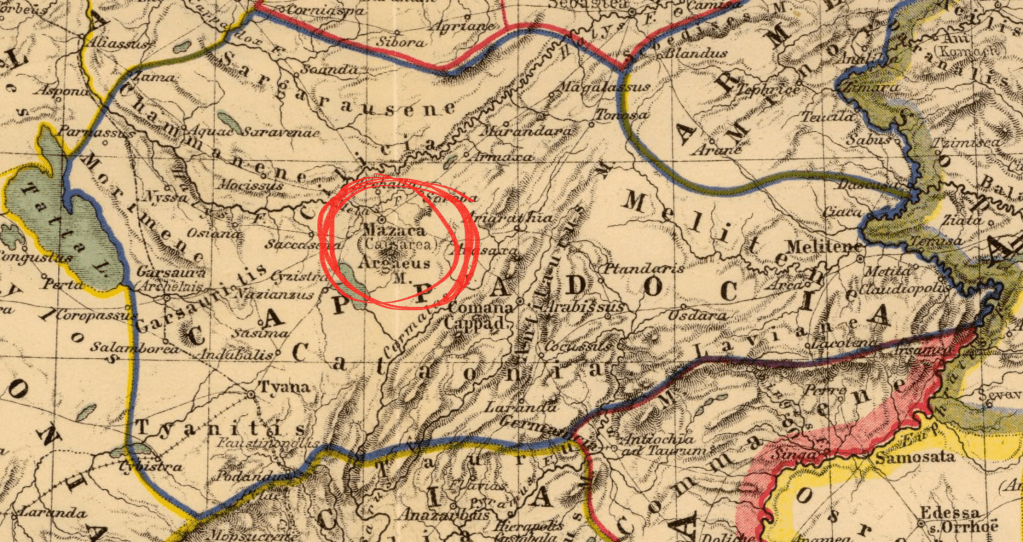
Okay then: Now why should you care about what some old, old churchman from Caesarea of Cappadocia said nearly 1400 years ago? And where in the world is this Caesarea of Cappadocia? Starting with the last question first, the city of Caesarea was located not too far from the seven cities mentioned at the beginning of Revelation. Today it is known as Kayseri, Turkey. And as for why should you care about what Andreas of Caesarea had to say about the Book of Revelation, that is a fair question; and I am glad you asked. Many of my readers/listeners probably have never even heard of Andreas of Caesarea before, I suppose. Andreas is otherwise known in the English speaking world as Andrew. The most concise answer as to why you should care about what Andreas-Andrew of Caesarea had to say is this: Andreas-Andrew of Caesarea wrote the first, good, complete, surviving commentary about the Book of Revelation ever, in all of commentary history. Again, Andrew’s Commentary on the Apocalypse was the first, good, complete, surviving commentary.
Yes, I had to write it exactly that way. His commentary is not really the first known commentary on Revelation in history. It is the first good commentary. It is also complete, insofar as it covers the entire Book of Revelation from its first verse to its last. And somewhat surprisingly, it has survived nearly fifteen hundred years. If those four factors are taken together — its age, its quality, its complete-ness, and its having-survived-ness — Andreas of Caesarea’s Commentary on the Apocalypse understandably prompts interest among Book of Revelation aficionados and scholars, even wannabe scholars, like yours truly.
Put another way and summarized a bit, Andreas of Caesarea gives us an open window into how the Book of Revelation was read early-on and understood by Christians very long ago. How, then, did people long ago make sense of the Book of Revelation? Given that they lived much closer to when it was written, did Andreas and the Christians of his day understand the Book of Revelation any better than us today? Or did they understand it worse than us today?
The answer to that question really depends on whom you count as us today, because we have a wide variety of interpretations circulating today, as you may be aware. Some of our current interpretations are pretty good, while others, not so much.
Until recently, English speakers did not have immediate lingual access to Andreas-Andrew’s commentary. But about five years ago (that is, in 2015) a good translation from the original Greek was published. The translator’s name is Eugenia Scarvelis Constantinou. She is now a professor of New Testament at a seminary in beautiful San Diego, California.
Within the last 12 days, I acquired Constantinou’s translation of Andreas’s commentary in an electronic format and began to read it. In particular, I wanted to learn how Andreas interprets some of the more controversial and difficult passages in Revelation. (Incidentally, I also want to know how his working manuscript of Revelation compares with what we now have.) Thus far, I have found what he says insightful and intriguing. That’s not to say that I think he is frequently right. He is not; and one reason he is not frequently right is because he commits himself early on to a particular chronology or textual timeline. Andreas believes that after the first three chapters the rest of the Book of Revelation must necessarily reference the future, and not the past. Because of his commitment to a futurist understanding, Andreas misreads entire sections of the book, IMHO. But then again, a lot interpreters do the same thing today: They commit themselves to a futurist chronology (or alternatively, to a long past chronology), and then attempt to force everything in Revelation to fit that pre-selected chronology. Alas, if an interpreter’s assumed chronology is faulty or skewed it will always distort how the Book of Revelation is read and understood. Yet choosing a chronology is unavoidable, as Revelation by its very nature does require chronological decisions from any would-be interpreter.
Although I disagree with his chronological scheme, I must say that Andreas’s reading is theologically sophisticated, and surprisingly so. In his favor, Andrew-Andreas understands that much of the Book of Revelation must be read symbolically. And he constantly endeavors to explain the various symbols. I am not surprised by that, though. He was (probably) a native Greek speaker; and knowledge of Greek makes the symbolic nature of Revelation all the more obvious. Sadly, English and English translations often stand in our way of understanding aspects of the Book of Revelation. Sad, but true.
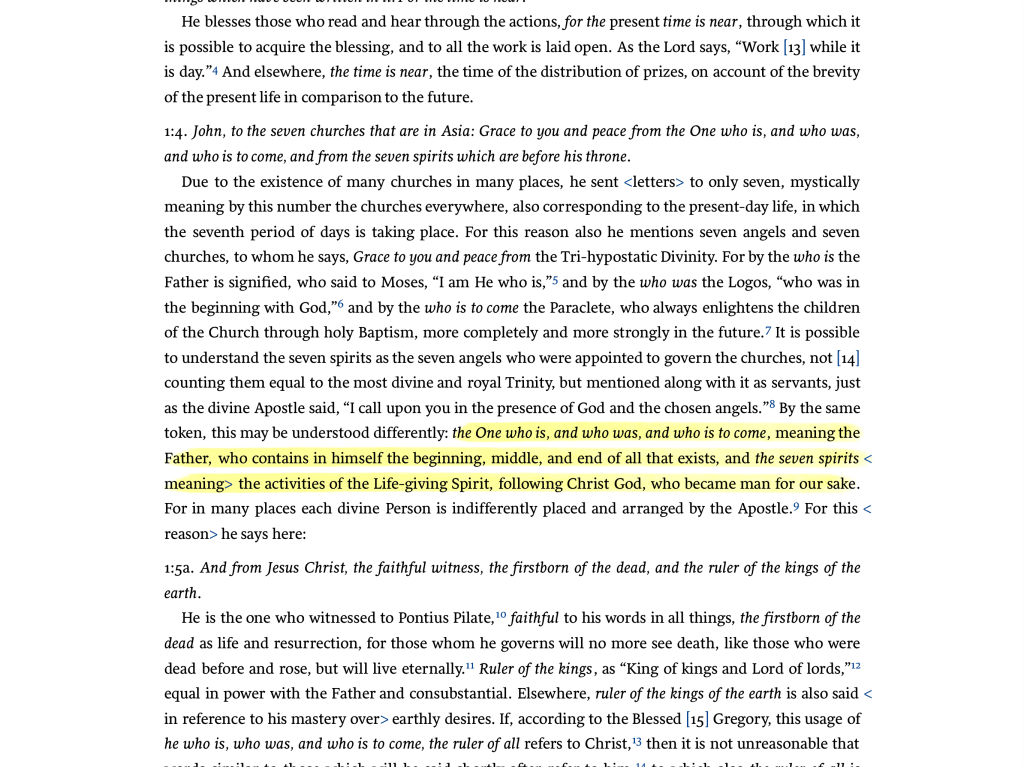
Finally and to be fair, Andrew-Andreas does get some very important things right. For example, he correctly explains that the introductory benediction in 1:4-5 can be understood as trinitarian, noting that “the One who is, and was, and is to come” can be understood in verse four to refer specifically to the Father, and that the Seven Spirits can be understood as “the activity of the Live-Giving Spirit,” and that Jesus Christ “became a man for our sake,” by which Andreas implies Jesus’ pre-existent divinity. Andreas thus interprets the book’s introductory benediction as a person-by-person-by-person depiction of the Trinity, which is exactly right and how it ought to be understood. Andreas nails the benediction.
Screenshot of the Commentary
All of these are just a few of my initial reading observations, though. I do look forward to learning more about Andrew-Andreas of Caesarea (Caesarea in Cappadocia, that is) and reading more of the English translation of his Commentary on the Apocalypse.
In conclusion, even very old commentaries should be appreciated, picked up, and read. It makes them feel purposeful, appreciated, and far less lonely. They also have more to offer than you might assume.
Won very affective weigh to draw attention too a word or even a hole sentence is two misspell on porpoise. Else-wise, them might-could use grammar bad and non-standard-ish-ly. Either way, a writer will likely confuse or at least annoy the reader or listener; would you not agree? Such deviations from the norm usually do get noticed, though; and that’s the whole point.
In case you’re listening to this and not reading it, I want to point out that I kind-of misspelled some words in my opening sentence. I say “kind-of misspelled” because what I actually did was replace four words with homophones and one word with a near-homophone. In one instance and as an example, I wrote w-o-n instead of o-n-e, because won and one sound exactly the same. They are homophones. The near homophone I used was porpoise instead of purpose. If you are a native English speaker, these alterations are easy to spot in written form. But if you are not a native English speaker, they may be more difficult to spot. Abnormal alterations to a piece of writing, such as those in my two introductory sentences, might even so confuse non-native English speakers as to make those sentences incomprehensible. Whatever the language, a writer’s deliberate stylistic alterations can be an affective effective barrier to some readers’ comprehension. But why would any writer want to obscure things for his or her readers? Sometimes a writer does indeed want that, though. Sometimes a writer wants to partially obscure his or her writing. Insiders will find it comprehensible, outsiders probably will not. Sometimes writers want to speak to insiders, and yet exclude outsiders.
In the opening to his biography of Jesus, Matthew does something very similar — not in English of course, but in a first century iteration of ancient Greek known as Koiné Greek. Matthew makes noticeable alterations to his genealogy of Jesus’ lineage. To arrive at a predetermined, theologically-meaningful mathematical equation (that is, 14 x 3), Matthew deliberately omits at least three consecutive generations from David’s royal lineage. He also seemingly miscounts his third and final grouping of names: Where there ought to be fourteen names, there are only thirteen. How come? For an explanation of these conspicuous and curious Matthean alterations (which I argue are intentional and instructional) please see my previous blog post, entitled Mistaken Matthew?. But wait, there’s one more alteration in Matthew’s genealogy I should explain…
Matthew also misspells two names: Asa and Amon, which he renders as Asaph and Amos. Perhaps I should qualify that statement, though. Perhaps I ought to say that he may have misspelled two names. Some of the ancient manuscripts of Matthew’s Gospel put it one way; some put it the other way. So which of the ancient manuscripts have it right? Did Matthew himself write Asaph and Amos, or Asa and Amon? If Matthew’s objective was historical accuracy, he would necessarily have spelled their names as Asa and Amon, because that is how their names are supposed to be spelled (or rather, as they ought to be transliterated from the original Hebrew into Koiné Greek). But if Matthew was instead taking an opportunity to make a subtle theological statement, he might have deliberately misspelled their names.
Parenthetically, if you have already opened your Bible to the first chapter of Matthew to review the genealogy, you might not see Asaph and Amos there, but Asa and Amon. That’s because the translators of the version you hold made the decision to be true to the Old Testament spelling of their names. Their decision is totally understandable. Yet it does not mean that the translators of your Bible got it right. Alternatively, if you happen to have a New American Bible, Revised Edition, you will see that its translators made the opposite decision: It has the names Asaph and Amos listed in the genealogy. The decision is not an easy one for translators. They have to either side with historical accuracy (on the one hand), or with the manuscripts that are probably more reliable to Matthew’s original writing (on the other).
Since he most likely intentionally skipped three generations in Jesus’ genealogy in order to make a theological point, I would not put it past Matthew to deliberately misspell Asa and Amon’s names as Asaph and Amos. Under the inspiration of the Holy Spirit, Matthew might have piled one type of genealogical error upon another type of genealogical error in order to make it increasingly obvious to his readers that his apparent errors are not actually errors or mistakes, but part of a deliberate premeditated design. These are deliberate editorial decisions of his. Through his organization and presentation of Jesus’ genealogy, Matthew meant for his own historical inaccuracies and lingual adjustments to be noticed and caught (by insiders), because he wanted something deeper to be taught (to insiders).
But more than merely assert my position, I ought to offer some substantiating evidence. And to do that, I must talk about the oldest known copies of Matthew’s gospel, which are otherwise known as manuscripts.
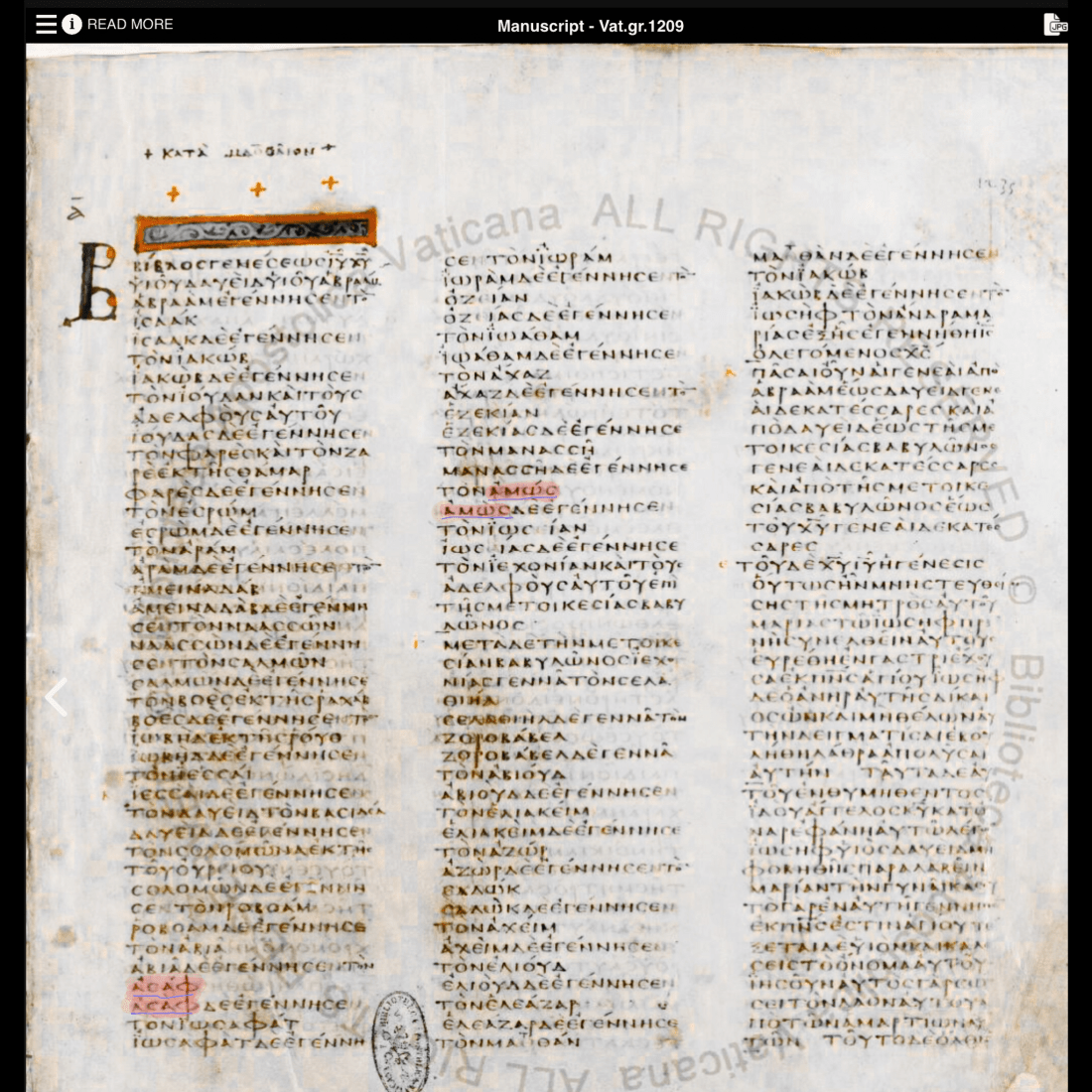
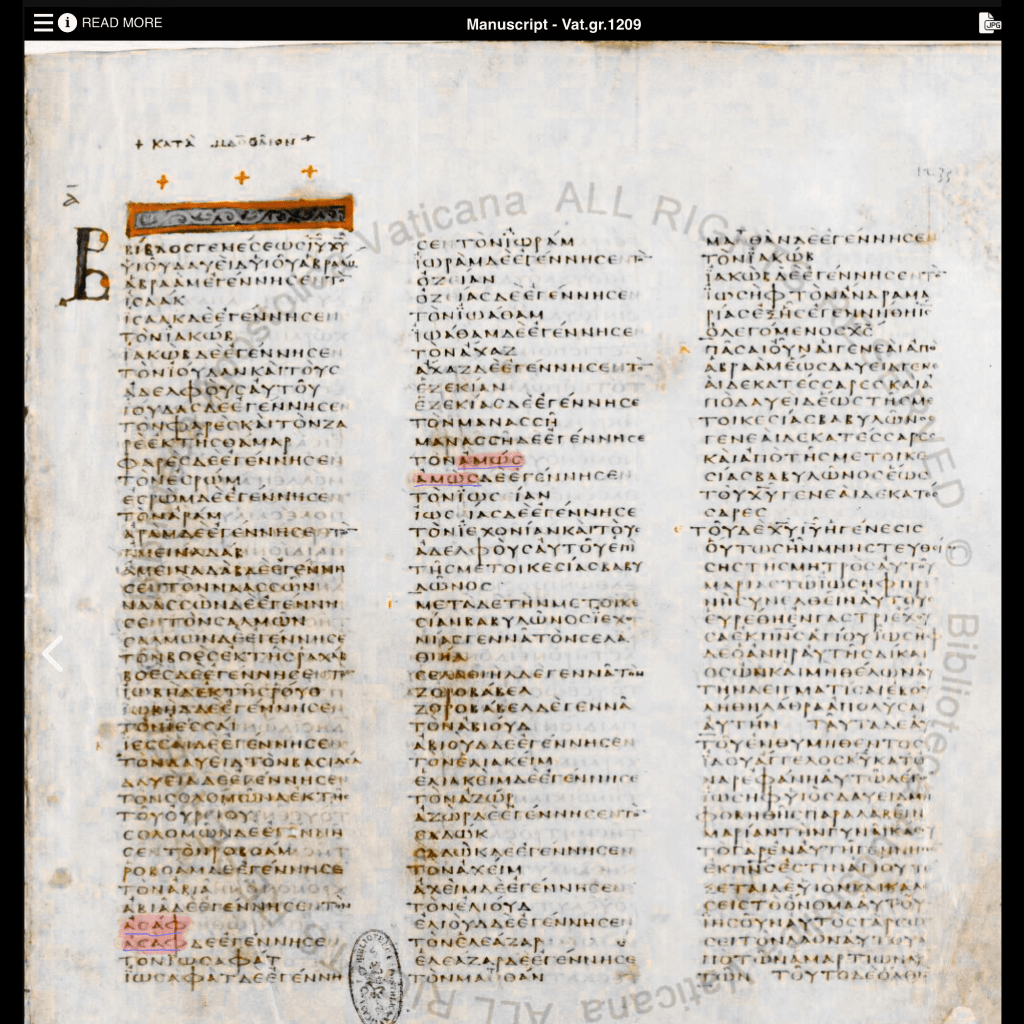
If you wanted to actually see examples of the real deal — the oldest known, hand-transcribed copies of Matthew’s gospel — you would need to pay a visit to a library, or a museum, or a private collector’s display. From what I have read, the most highly regarded manuscript copy of all is known as the Codex Vaticanus. As its name implies, it belongs to the Vatican; and thus you would need to travel to Rome to see it — if they would let you anywhere near it (which they won’t). To be honest, you might be better off just looking for the photographs of it on their website: There’s no time limit that way. Here’s a link: digi.vatlib.it ; and search specifically for Manuscript – Vat.gr.1209.
Screen Grab of Matthew’s First Page from the Codex Vaticanus
The Codex Vaticanus contains more than just Matthew’s Gospel, though. It contains the Old Testament (in Koiné Greek, a version known as the Septuagint) and most of the New Testament. The fact that it is nearly the entire Bible is a very big deal, given that it is dated to the 300s AD. As a rule, New Testament manuscript experts consider the Codex Vaticanus to be the gold standard of all early New Testament manuscripts. They judge the reliability of other New Testament manuscripts against it. And, as it so happens, in Matthew’s genealogy of Jesus’ lineage, the Codex Vaticanus renders the two names in question as Asaph and Amos, not Asa and Amon. And thus the conundrum: What does a translator do? Do you go with the spelling that the Old Testament requires? Or do you follow the New Testament gold standard, and translate the misspellings?
Which rendering of this disputable name shall a translator choose?
So if Matthew did deliberately misspell Asa and Amon and render them instead as Asaph and Amos, why might he have done so? Of course, Matthew himself does not tell us why, so we have to theorize a bit. One thing I notice historically about both the three generations that Matthew skips and about the Kings Asa and Amon is the common denominator of unfaithfulness, to the point of idolatry. These are all kings who were either godless throughout their entire reign, or who started out obedient to God but then turned to idolatry. Perhaps here Matthew is practicing a kind of damnatio memoriae, that is, the condemnation of the memory of these unfaithful kings. By not mentioning them by name or by calling them by alternate names, Matthew collars the memory of each of them with a permanent cone of shame. Let these serve as a somber warning to you: These be the unspeakable, utter failures.
At the same time, by deliberately fudging the historical record, Matthew paradoxically calls attention to these kings. That serves Matthew’s purposes, too. When a student of scripture takes the time to study these kings, he or she comes away with a stronger sense of God’s sovereignty and unrelenting faithfulness, even in the bleakest and most hopeless times. When David’s royal lineage is most at risk, God somehow unexpectedly comes through. Even when David’s own descendants made themselves active enemies of God, God remained faithful to the promise he made to David. Jesus did eventually arrive, in spite of all the efforts of the Evil One to the contrary.
Finally, Matthew may have substituted the names of godly Asaph and Amos for ungodly Asa and Amon as a means of comparison and contrast. Faithless Asa and Amon should have been like faithful Asaph and Amos. Imagine if these two kings had taken the right path instead of the wrong path.
Considering his curious omissions, his miscount of generations, and his likely misspellings, I do believe Matthew deliberately introduced inaccuracies into his genealogy of Jesus. In general, it does not matter to most people, because they just skim or skip the genealogy anyway. But for those who do study it through, Matthew’s alterations can prove to be theologically instructive. And that’s exactly what Matthew and the Holy Spirit intended, I believe.
When I read to children, I sometimes mis-read and mis-represent things. I stumble clumsily over what is plainly put in print. Sometimes I omit words. Sometimes I insert words that are not there. Sometimes I deliberately mispronounce words. But my mis-reading is all a big farce. I am merely pretending to make mistakes. At some point I make it obvious that my mistakes are not actual absent-minded blunders. My “mistakes” are not sloppy, stupid mistakes, but intentional alterations. Eventually, I let the kids know that I am purposely misreading what is there. It is all just a pedagogical ploy of mine. I did not want to drone on in monotone, and thus bore all of them and myself. I wanted to keep them all interested, attentive, and engaged. So I made some editorial changes, here and there. And it works well. If you have never done it yourself, I would recommend it. Kids almost always enjoy correcting an adult’s feigned mistakes. Misleading misreading makes for a lively, interactive learning activity.
The author of the Gospel of Matthew does something very similar. He makes some editorial adjustments to the historical record. Right from the get-go, on the very first page, Matthew makes several factual alterations. His alterations are not mistakes, though. They are deliberate editorial decisions. They are intentional.They are theologically instructive. Matthew is using his alterations to make some important points.
Someone out there may wonder what I am even talking about. The genealogy — that’s what. I am talking about Matthew’s introductory genealogy. Most readers skim it or skip it. It is just a list of mostly unmemorable names, after all. But if someone decides to get studious and starts cross-referencing those names, it all quickly changes. If Joe or Joann Reader bothers to delve into the Old Testament record to learn more about those names in Matthew’s genealogy, Joe or Joann will soon realize that either Matthew himself or a scribe after him must have made some alterations. As we have it, the text of Matthew’s genealogy has obvious omissions, curious misspellings, and even faulty math. The E word has even be invoked in discussions of this genealogy. Some have said that Matthew’s introductory genealogy has errors.
Danger!
Red Alert! Red Alert! Red Alert! The Bible is not supposed to have any errors! A lot of Bible-believing Christians will reflexively and immediately recoil at any suggestion of error in the Bible. Understandably so, I would add. I, too, get nervous, wary, and even defensive when I hear reputed scholars talk about errors in the Bible. After all, the Bible is the written Word of God. It is our primary, authoritative written witness to Christ and the Faith. Any assertion of error carries the implication that the Bible cannot and should not be considered reliable and trustworthy; right? Well actually, it depends. It depends on whether those claimed errors are human mistakes or deliberately crafted theological pointers. Moreover and more crucially, it depends on whether God actively inspired the inclusion and transmission of those pointers.
Please know and be very aware that I am talking about intentional, deliberate (and divinely inspired) authorial decisions on Matthew’s part, not unintentional mistakes, nor dubious and deceitful claims. What I am about to describe might be called error by some (because the information recorded is demonstrably not historically accurate). But that information is meant to be caught and noticed as just such, as intentional inaccuracy. These inaccuracies cannot be excused away, because they are not slight, but significant. These inaccuracies are even so glaringly wrong that it becomes increasingly evident Matthew deliberately introduced them to impress something more than mere genealogy — something deeper, more profound, and true. These errors are thus theological pointers. Careful readers are meant to catch his inaccuracies and also catch the theological intention behind his redirecting inaccuracies.
Now, for the evidence: In the eighth verse of chapter one, Matthew says Joram fathered (or begot) Uzziah. In so doing, he simply skips over three (and-a-half) generations of monarchs in the line of David (King Ahaziah, Queen Mother Athaliah, King Joash, and King Amaziah: see 2 Chronicles chapters 21-25). Why skip these three generations, though? The skipped-over period of Judaean history was crucially important, since the royal family, the dynasty of David, was nearly annihilated — not once but twice. So, is Matthew’s strange three-generation genealogical omission a mistake or a deliberate decision? Gospel readers well acquainted with the Old Testament accounts would have noticed Matthew’s obvious omission. Inquiring readers would be quick to ask why. Usually there are three possible explanations in cases like this: 1.) The author himself made a seemingly-sloppy mistake. 2.) An early scribe missed a verse or two when copying the manuscript, resulting in the loss of three generations. And lastly, 3.) The author may have made a deliberate omission. In this case, the second possible explanation does not work. It cannot be a simple scribal mistake, because the author carefully (and yet inaccurately!) counts up the number of generations for his readers.
Keep Count.
Someone might point out that Matthew did not actually err in verse eight, since Joram did technically beget Uzziah, yet with several unmentioned intervening generations. Granted, that is true. Although he did not father Uzziah, Joram did beget Uzziah. But the real problem comes in verse seventeen. Matthew there carefully counts up fourteen generations between David and the Deportation to Babylon. He arrives at fourteen generations quite curiously. He does so by excluding the three generations between Joram and Uzziah. Matthew’s generational count is simply not historically accurate. If he had counted the three omitted generations, he would have arrived at 17 generations, not 14. Be not disturbed, though, for Matthew is not trying to be historically accurate here. He is instead striving to arrive at the number fourteen, and for a theological reason. Matthew has pre-determined his genealogy to arrive at a particular mathematical equation — that is, 14 x 3. And, I would add, Matthew made that pre-determination under the inspiration of the Holy Spirit.
Authoritative & Reliable
You may ask: Why fourteen times three? Well, there are two theological reasons why.
First of all, fourteen is the number of David. Just as the number of the Beast in Revelation 13:18 is 666, the number of David in Hebrew is 14. In many languages, letters double as numbers. You may be already familiar with this by virtue of the continued contemporary use of Roman numerals. It is exactly the same in Greek and in Hebrew. In Hebrew, the letters of David’s name add up to 14. By insisting that there are three sets of 14 generations between Abraham and Jesus, Matthew implicitly three-peats “David, David, David,” which can and should be biblically deciphered to mean that God was faithful through the generations to keep his promise to David and sustain his family line. Therefore, for theological reasons, Matthew intentionally and deliberately mis-represented the number of generations in Jesus’ genealogy in order to arrive at fourteen times three. Matthew was not confused, nor was he being deceitful. Instead, Matthew meant for his inaccuracy to be caught, and for the deeper truth to be taught.
As for the second theological reason, I admittedly indulge in conjecture. But I think it works. Mathematically, 14 x 3 = 6 x 7, which is significant because 7 is the number of the Sabbath and thus of completion in the Bible. Matthew is inferring a new climatic redemptive era has arrived with Jesus. There were six eras (or days) before the incarnation of Jesus. Jesus’ arrival marks the beginning of a final seventh era (or day). When Jesus began to preach his message was “The Kingdom of God is at hand.” This Kingdom of God is the seventh redemptive era or day. In saying this, I do not mean that we should look for six clearly delineated previous eras. I just mean that Matthew seems to imply a seventh seven has arrived with Jesus. Jesus brings redemptive history to its completion, to its final Sabbath.
One last (possible) Matthean inaccuracy for today: In his final set of generations, Matthew counts poorly. At least, it could be read that way. In verses 12 through 16, Matthew only lists thirteen generations prior to Jesus’ birth, not fourteen. Here they are, in Matthew’s order: 1.) Jechoniah, 2.) Sheatial, 3.) Zerubbablel, 4.) Abiud, 5.) Eliakim, 6.) Azor, 7.) Zadok, 8.) Achim, 9.) Eliud, 10.) Eleazar, 11.) Matthan, 12.) Jacob, and 13.) Joseph + Mary. Listed thusly, Jesus might be understood to be the last one in a set of fourteen, and not the expected first one in a new set. This mathematical difficulty might be explained as Jesus being both the last and first — the last generation in the third set, and the first generation in a fourth and final set. I find that explanation quite intriguing. The difficulty might also be explained as a very subtle way of indicating that God the Father Himself is an unmentioned 14th progenitor, since God begat Jesus, not Joseph. Both explanations are very interesting; but neither are original to me. I simply came across each explanation in a commentary. Do you find either explanation compelling?
In conclusion, Matthew’s Gospel opens with several factual inaccuracies (two of which are conspicuous spelling errors that I have not covered here). I contended that Matthew’s inaccuracies should not be seen as mistakes, nor should they be called misleading. Instead, his inaccuracies are actually intentional and Spirit-inspired. They should be understood as purposeful alterations, which are meant to be caught by careful readers, in order that theological truths may be taught.
At the very end of the Old Testament, in its second-to-the-last verse (Malachi 4:5), God declares that He will send Elijah the prophet before the great and awesome Day of the Lord. And so, based on God’s declaration regarding Elijah the Prophet, the Jews of Jesus’ day understandably expected Elijah to personally and physically return to Earth. They expected Elijah’s literal return. After all, why not? It seems like the simplest and most straightforward interpretation of God’s Old Testament-closing declaration. Indeed, such a reading makes scriptural sense. It does not strain credulity. And it can be explained readily. Hypothetically, since he had never died, Elijah could have physically returned. Since God had taken Elijah bodily to heaven with chariots of fire and in a whirlwind of fire (2 Kings 2:11), God could also return him again to Earth. So why not expect Elijah’s personal, literal, physical return? It stands to reason and seems to be the most straightforward reading of Malachi 4:5.
But no. That’s not how Jesus understood and explained the prophecy at the end of Malachi.
In Matthew 11:14 Jesus reflects on John the Baptist, “And if you are willing to receive it, he is the Elijah who is to come.” Notice, then, that Jesus does not interpret God’s declaration at the end of Malachi literally. Again, and for emphasis, Jesus does not opt for a literal interpretation here. Instead, Jesus clearly says that John the Baptist is the Elijah who was to come. In contrast to Jesus, not even John the Baptist recognized himself as the Elijah-to-Come (see John 1:21). Was John the Baptist wrong then? No, he wasn’t wrong: John was not literally the Elijah-of-Old. Was Jesus wrong? No, Jesus was right: John the Baptist fulfilled Malachi’s final prophesy.
Among his contemporaries, Jesus’ perspective was unique. Jesus saw what no one else did. And however it may be categorized, Jesus’ interpretation of Malachi’s prophecy is decidedly not literal. Jesus wanted his disciples (and wants us) to understand that the Elijah-to-Come mentioned at the end of Malachi is not the self-same Elijah-of-Old but is instead John the Baptist. Malachi’s Elijah-to-Come is not the Elijah-of-Old, but someone else entirely.
Desert
But why? Why in Malachi does God say it that way? Why does God say He will send Elijah the Prophet? Why not instead say that He will send a prophet who somehow resembles Elijah? God could have said things differently. God could have clarified things for us. Like his baffled disciples, we might find Jesus’ interpretation of Malachi a bit confusing, and maybe even suspect. Yet Jesus was right, of course. Jesus himself challenged his disciples (and us) to accept his interpretation. So because Jesus is Jesus, we accept it on his authority. But still, this particular interpretation leaves us somewhat perplexed. Would it be okay with the Lord if we were to ask a few follow-up questions? I hope this does not across as irreverent to my readers, since I really do ask interpretive questions like this, and often while in prayer.
One initial question: Why not, though? Why did Jesus not just make a literal interpretation of God’s Old Testament-closing declaration, when a literal interpretation was seemingly right there, almost begging to be had? The Transfiguration event allows for just such a literal interpretation (see Matthew 17:1-13; Mark 9:2-13; Luke 9:28-36). Elijah had reappeared. Elijah himself did indeed return in person, if ever so briefly. The Prophet Elijah made an intriguing cameo appearance, along with Moses. Moses and Elijah appeared out of nowhere, and appeared in glowing glory. The two of them spoke with Jesus at the Transfiguration. And yet, even though Elijah did appear again on Earth, his cameo at the Transfiguration was not the fulfillment of Malachi’s closing prophecy. It was John the Baptist who fulfilled Malachi’s closing prophecy. That point is twice emphasized by Jesus in the Gospel of Matthew, and, to a lesser degree, by the Angel Gabriel at the beginning of the Gospel of Luke (see Luke 1:17).
Raven
A second question: By giving us an unexpected non-literal interpretation of the final prophecy of the Old Testament, is Jesus perhaps teaching us something about the very nature of prophecy and how it should be approached? I mean, Jesus’ interpretation is unexpected. It does come as a counter-intuitive surprise. Almost everyone assumed that since Malachi’s final prophecy could be fulfilled literally, it would be fulfilled literally. Jesus’ own disciples pressed the question of the Elijah interpretation with Jesus, even immediately after the Transfiguration occurred (see Matthew 17:10-13). In paraphrase, the three disciples asked, “Hey Lord, we realize that we just witnessed Elijah and Moses in person up there on the mountain. We must say: That was spectacularly awesome. But it does raise a question or two for us: Why have we always been taught that Elijah will someday make a grand public reappearance? That has not happened, though. Isn’t Elijah’s reappearance supposed to precede your own public debut?”
And in essence, Jesus explained that it all becomes clear once someone realizes that they’ve been misidentifying who Elijah actually is.
This post-transfiguration conversation was not accidental. It was meant to be. The occasion was intended as an important interpretive lesson for those three disciples. Jesus did indeed mean to teach them (and us) a lesson about how to interpret that particular prophecy, at the very least. One clear take away is that not every prophecy should be understood literally. A literal interpretation can be very wrong, even if it is widely popular.
A third and final question: Why did Jesus get the interpretation right when everyone else got it wrong? Someone will immediately reply with “well, because he’s Jesus!” Well, granted; but is there anything more we can possibly postulate or extrapolate? If I may suggest an answer to my own question, I want to propose that Jesus had insight — unique, spiritual insight. Jesus was able to see something that others missed. Whereas his contemporaries had substantial scriptural knowledge, Jesus additionally had spiritual insight. More specifically, I suspect that Jesus discerned something crucial about the nature of John the Baptist’s personality and his ministry. In Jesus’ spiritual perspective, John the Baptist’s demeanor and ministry was a replay and reflection of Elijah’s demeanor and ministry. They had both been given a similar prophetic ministry — a ministry of urgently and zealously calling the wayward people of Israel back to devotion to God. Their respective ministries required an immediate and demonstrated repentance from the people. When Jesus saw how John the Baptist was preaching and what he was doing, he recalled what Elijah had once said and done. Jesus discerned the similarities in their return-to-God-right-here-and-now ministries. They looked alike to Jesus.
When we read prophecy, then, we need to realize that being smart is not enough. Knowing the Bible well is altogether helpful and immensely important; but it is still not enough. We will get our interpretations wrong if not for God’s help. We will need the guidance and insight that only the Holy Spirit can give. We need spiritual insight because apparent answers are not always the right answers. Literal readings are not necessarily the best readings. We need the Holy Spirit to give us understanding as we read and study. The good news is that the Holy Spirit is there for us whenever we open scripture, ready and waiting.
What do a distasteful beverage, a clueless customer, an immature child, an impolite host, a triumphant conqueror, and an attentive listener all have in common? Not much, except that through John, Jesus used all six of these illustrations in quick succession to depict, correct, and inspire the Church of Laodicea and its Messenger (see Revelation 3:14-22).
The Messenger of the Church of Laodicea is like a distasteful, disgusting beverage, neither hot nor cold, which (or who) is at real risk of being spat out.
The Messenger of the Church of Laodicea is like a completely clueless customer who must first be informed of his or her embarrassing lack of discernment, and then be advised as to what he or she actually needs to acquire.
The Messenger of the Church of Laodicea is like an immature (and perhaps naughty) child in need of firm correction and discipline from a loving disciplinarian.
The Messenger of the Church of Laodicea is like an impolite host who leaves an invited (and very important!) dinner guest waiting and knocking at the front door.
The Messenger of the Church of Laodicea might eventually be a triumphant conqueror.
And anyone hearing Jesus’ message to the Church of Laodicea and its Messenger should be an especially attentive listener.
Suffice to say, to deliver his message to the Church of Laodicea and its Messenger, Jesus used a lot of short sermon illustrations.
But I ought to make an aside. Why do I insist on being so wordy? Why do I keep referring to the Messenger of the Church of Laodicea, when I could cut out the extra three words and simplify it to just the Church of Laodicea? Good question. And the answer is this: I want my readers and listeners to catch what gets otherwise omitted, almost every time, in English-speaking settings. Grammatically, it is very clear that Jesus is not addressing the whole congregation of believers at Laodicea — at least, not immediately and directly. Jesus is not speaking directly to the Laodicean church en masse. He is instead speaking first and foremost to someone who is the individual messenger of the church.
But why does that matter?
It matters because the grammatical onus of the passage is clearly on an individual, on the individual messenger, who must personally make necessary personal and corporate changes. This messenger is probably otherwise and more commonly known as the pastor. When the messenger or pastor makes necessary personal and corporate changes, the whole congregation will be better as a result. Thus Jesus’ message indicates that good church leadership matters, and that church leaders sometimes need words of correction — even public correction.
Alternatively and admittedly, the messenger could possibly be understood as a collective singular. While this is a more abstract concept, it basically means that the collective church is personified as a single individual. Maybe this is how we are supposed to understand it. Maybe. But it begs the crucial question of why the singular-collective ambiguity would be used there in the text at all. Jesus could just have spoken to the churches using plural pronouns and plural grammatical forms in general. It is easy to do and would have been much simpler, if indeed the whole church is intended. But no, singular pronouns and singular forms are always used, as if Jesus is speaking to an individual person (which I contend, he is). Therefore, the consistent use of singular grammatical forms points to an intended individual recipient, who is best understood as the leader of the church. (Yes, I do wonder why this grammatical point is so hard for English speakers to accept. It is there for the finding.)
But then again, there is an even better and more nuanced way to understand Jesus’ message to the Messenger at the Church of Laodicea. We can and should read it as applicable to both the individual messenger and the entire congregation. Jesus’ message is meant for both an individual leader and for an entire congregation. Yes, Jesus is speaking most immediately and primarily to an individual messenger, who holds a position of ecclesiastical leadership. But Jesus is also speaking indirectly to the whole congregation. Since the message is supposed to be read publicly, the congregation is meant to overhear it, and take it to heart as far as it applies. If the shoe fits… the listeners should each wear it together. Thus the onus is not entirely on the individual leader. It is also on the congregation, personally and corporately. When we hear and read the Message to the Church of Laodicea in particular, and the Messages to the Seven Churches in general, we do well to keep this intended duality in mind. With each of Jesus’ messages, two recipients per church are intended: the individual leader and the whole congregation. We should strive to keep each of the recipients in view, without forfeiting one for the other.
Perhaps another time we can look at Jesus’ interesting illustration of an impolite host, who leaves an important dinner guest (that is, Jesus himself) waiting and knocking at the front door.
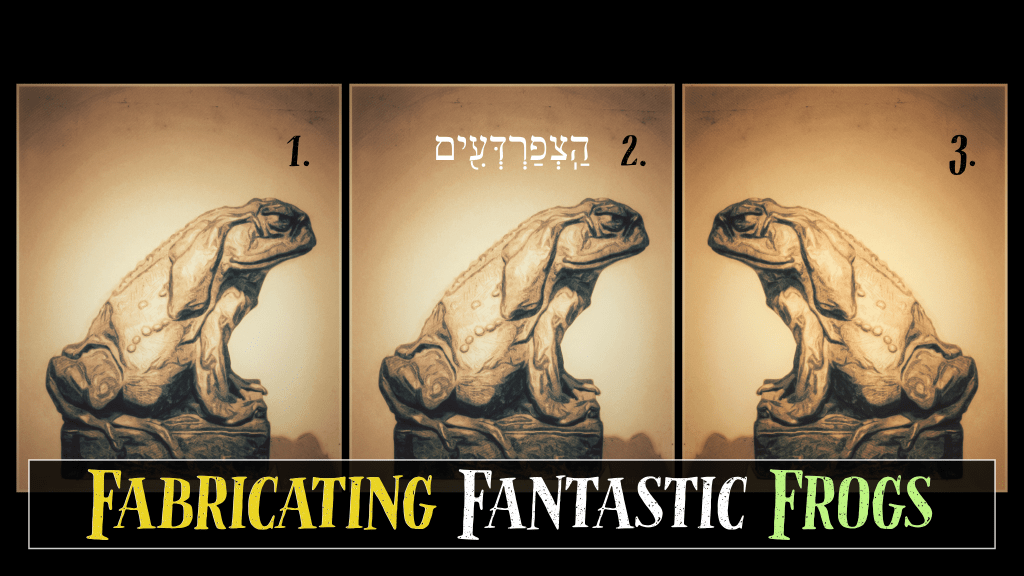
In Revelation 16:13-15, our vision narrator John sees three unclean spirits like frogs jump, or perhaps, oozeout of the mouths of the abysmal, evil pseudo-trinity. Whether they emerge simultaneously or each in turn, these three unclean frog-like spirits slip from the mouth of the serpentine Dragon, from the mouth of the despotic Beast, and from the mouth of the pretentious Pseudo-Prophet.
Revelation’s listeners are informed that the three unclean frog-like spirits are demonic spirits who perform something called signs. But exactly what sort of signs do they perform? We are not told, so we are left to wonder and to speculate. Their signs will probably seem astonishing and even miraculous. At the very least, they will be persuasively compelling. The three sign-performing frog-like unclean spirits will go out and abroad to summon, beguile, and gather a massive military coalition from here, there, and everywhere, on orders from the world’s mesmerized political leaders. And thus, having been persuaded, beguiled, and lured by the three frog-like spirits, the Kings of the Earth, along with their minions and massive armies, will assemble for the renown Battle of Armageddon, the fearsome climatic battle of battles to end the age. The Battle of Armageddon coincides with the Great Day of God, the Almighty.
And then, a sudden, unexpected parenthetical interruption in Chapter Sixteen occurs. A Voice interrupts this sweeping, bewildering, awesome narrative to forewarn Revelation’s readers and listeners, “Behold, I am coming like a thief. Blessed is the one who stays awake and remains clothed, so as not to go naked and be seen, shamefully exposed.”
Huh?
Question, questions, questions — for inquisitive interpreters, this passage prompts not only awe and bewilderment, but also a bunch of questions.
So where do we even start? What are we to make of all the elements in this passage? How are we to comprehend it?
For my purposes in this blog-cast, I want to focus narrowly on the frog-like unclean spirits. The most immediate question I wish to address is this: Why are the unclean spirits said to resemble frogs? I ask that on the assumption that no details go wasted in the Book of Revelation. If a detail is there in the text, it is never incidental or unimportant. Every detail in Revelation is intentional and has meaning. Every detail in Revelation conveys part of a message. Of that, I am thoroughly convinced.
Why, then, are these three unclean spirits said to resemble frogs?
One possible reason why these unclean spirits are likened to frogs is because frogs are noisy nocturnal creatures. Frogs are croaking creatures of the night. Frogs become especially noisy as daylight fades and darkness falls. Similarly, these three unclean spirits will be especially active and clamorous at the end of the age. I find this reason somewhat persuasive.
A second reason why these three unclean spirits might be likened to frogs is because of the role that frogs play in the pagan mythologies of both Greece and Egypt. In ancient Egyptian mythology, frogs were associated with fertility and with the afterlife. In Hellenistic mythology, frogs were associated with the underworld and Hades. Consequently, the link between frogs and evil spirits would have come as no surprise to Revelation’s first listeners, most of whom were very familiar with pagan mythologies. While interesting, this reason is not satisfactory in and of itself, because other mythological creatures could have been referenced just as readily. However, it does lend persuasive weight to some other reasons.
A third reason why the three unclean spirits are likened to frogs is because of how frogs are featured in the account of the Ten Plagues on Egypt. The Plague of the Invasive Frogs is the second of the ten plagues (see Exodus 8:1-15). Very significantly, by means of their secret arts, the Egyptian magicians could somehow replicate the Plague of the Invasive Frogs. Using demonic sorcery, they could fabricate the same sign. They fabricated frogs, or, more likely, coaxed them from the Nile’s swamps, irrigation canals, and fields. The magicians matched Moses with the same miraculous sign, or something very, very similar. But then they were done. That was it. The fabrication of frogs was the grand finale of their imitative ability. After the plague of the frogs, the Egyptian magicians could replicate no more. Instead, when they attempted to replicate the third plague, the Plague of the Pesky Gnats, the Egyptian magicians had to admit defeat, and informed Pharaoh (in Exodus 8:19), “This is the finger of God!”
This, I believe, is the key interpretive connection we are supposed to make. By means of their unclean frog-like spirits, the abysmal satanic pseudo-trinity will fabricate miraculous signs that will be very, very convincing. They will sway and persuade people — including very important people in high government positions — with displays of astonishing power. Yet like the Egyptian magicians of old, the satanic pseudo-trinity will actually be limited in their powers.
If this is indeed the correct interpretation, I should mention that you might not be present here on Earth when all this occurs. I hope not to be here. I hope you won’t be here, either. Do you remember the Voice in Revelation 16:15 that says, “Behold, I am coming like a thief…”? That voice is Jesus speaking. One way to make sense of his out-of-nowhere narrative interruption is to interpret it as an urgent forewarning to his listeners and readers. It is a forewarning that includes the prospect of an escape. He is coming like a thief. Many people will not anticipate his coming and will not be ready. They will be (to use a dread phrase) left behind. But those who are ready and waiting — those who are awake and dressed — they will escape all the horrors, the deception, and the suffering that will occur during the tumultuous period of the Seven Bowls of Wrath.
All of this assumes that the Seven Trumpets and the Seven Bowls of Wrath are distinct and successive periods of time, with the Seven Trumpets of Conquest coming first and the Seven Bowls of Wrath following. In my interpretation of Revelation, I do go with that assumption. And I will argue that what separates the Seven Trumpets from the Seven Bowls is the return of Christ and the resurrection/rapture of the Church. But to explain that particular chronology requires a blog-cast (or two or three), and thus must wait for another time.
In the Book of Revelation, you can distinguish the godly from the ungodly by what comes out of their mouth, or goes into it. Do not take my word for it, though. Study it out for yourself.
Matters of the Mouth
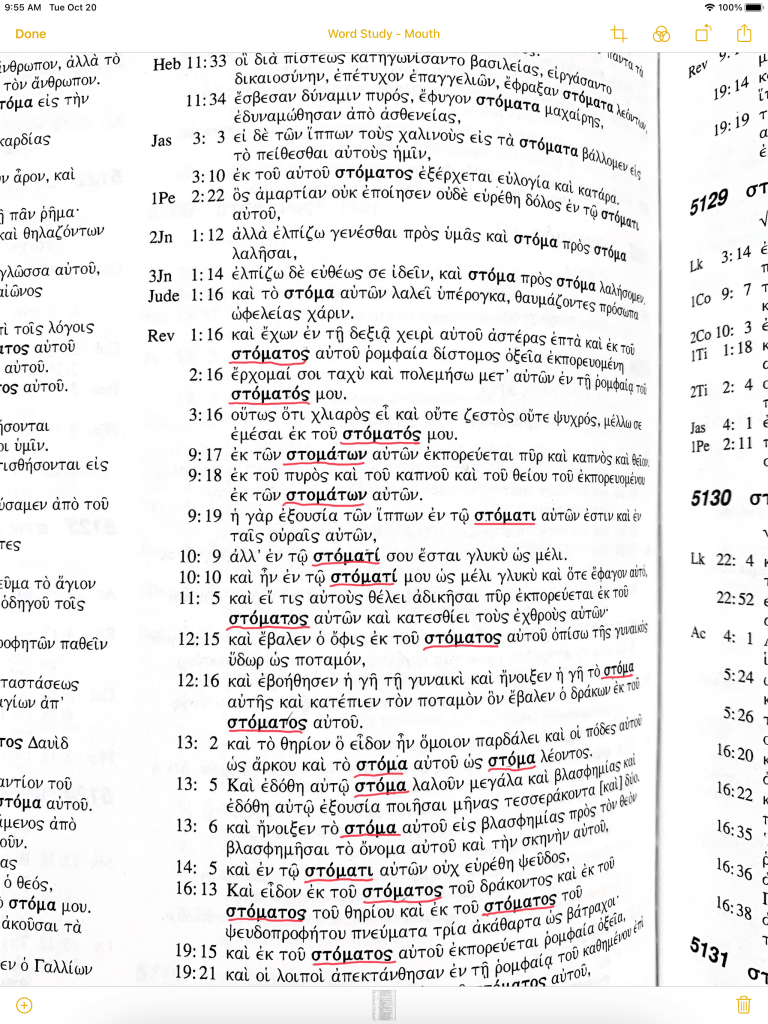
But I will help you. You might do a book-wide word study. As you might expect, one key word you need to study is mouth. In Revelation, the word mouth appears twenty-two times. To save you a lot of time, I will list every instance now:
Now I will list in narrative order whose mouth is referenced, and what is said or done:
1. Christ – who has a two-edged sword coming from his mouth.
2. Christ – who will fight against the heretic Nicolaitans with the sword of his mouth, unless they repent.
3. Christ – who might vomit out the lukewarm messenger from the Church of Laodicea.
4. The Chimæra Cavalry – from the mouths of whom come fire, smoke, and sulfur (reminiscent of and probably referential to the judgment on Sodom and Gomorrah – see Genesis 19:24-29).
5. The Chimæra Cavalry – who slay a third of humanity with the fire, smoke, and sulfur that comes from their mouths.
6. The Chimæra Cavalry – who have power in their mouth and in their serpent-like tails.
7. John, the Narrator – in whose mouth the small scroll will be as sweet as honey.
8. John, the Narrator – in whose mouth the small scroll was as sweet as honey.
9. The Two Martyr-Witnesses – from whose mouth comes fire, which devours their enemies.
10. The Dragon-Serpent Satan – who hurls water like a river from his mouth, in order to sweep away the woman, the mother of the male child Christ.
11. The Earth – which opens its mouth to swallow the river hurled from the mouth of the dragon.
12. The Dragon – whose mouth-hurled river of water is swallowed by the mouth of the Earth.
13. The Beast from the Sea – whose mouth was like a lion’s mouth.
14. The Beast from the Sea – who has a mouth like a lion.
15. The Beast from the Sea – who was given a mouth to utter arrogant words and blasphemies.
16. The Beast from the Sea – who opens his mouth in blasphemies against God, his name, and his dwelling, that is, those who dwell in heaven.
17. The 144,00 Soldier-Saints — in whose mouth no lie is found, for they are blameless.
18. The Dragon – from whose mouth three unclean frog-like spirits proceed.
19. The Beast – from whose mouth three unclean frog-like spirits proceed.
20. The False Prophet – from whose mouth three unclean frog-like spirits proceed.
21. Christ – from whose mouth extends a sharp sword, with which he strikes the nations.
22. Christ, the Rider on the White Horse – who slays the armies of the Beast and the Kings of the Earth with the sword from his mouth.
In Revelation the Dragon does not emit fire.
Here are some of my observations and interpretations:
Notice that a sharp double-edged sword comes from Jesus’ mouth. A reference to Isaiah 49:2 and Hebrews 4:12, the sharp double-edged sword is the Word of God, and is alternatively a surgical tool or a lethal weapon.
Fire comes from the mouths of the Chimæra Cavalry and from the mouth of the Two Martyr Witnesses. Fire most often symbolizes the Holy Spirit of God in Revelation. The fiery imagery probably references Deuteronomy 4:24 and Hebrews 12:29, both of which say that God is a Consuming Fire. Thus the Holy Spirit might well be the deadly, devouring fire that issues from both the Chimæra Cavalry and the Martyr Witnesses. If so, the Cavalry and the Witnesses could be one and the same entity, that is, the Church. That which issues from the mouth of the Church consumes or devours its enemies. This notion definitely does not work if taken literally: The Church does not and should not go around physically incinerating its opponents with fire. However, it does work if taken figuratively: When we are faithful witnesses, we do bring an ego-exterminating, life-transforming, Spirit-empowered message. Yes, we do. At least, we ought to.
The small scroll is the unique revelation contained in the Book of Revelation. This, in particular, is what John was given to internalize, to write, and to narrate. The small scroll reveals what the end of Daniel conceals, that is, important details about and instructions regarding the eschaton, the end of the age.
The dragon-serpent Satan does not breathe fire. On the contrary, he spews or, more literally, hurls water from his mouth. Is that because the dragon wants to extinguish transformative flame of the Spirit? Yes, I believe so. The dragon-serpent wants to quench the fire of the Spirit.
The Earth opens its mouth and swallows the river of water from the dragon-serpent. Historically, Satan’s attempts to silence and to kill the servants of God has often been frustrated by obedient, courageous acts of earthly concealment. Sometimes the scriptures have been buried or hidden away. Sometimes the messengers of God have hidden themselves in the wilderness or underground. Sometimes innocents have similarly been protected from would-be assailants.
The Beast from the Sea has a mouth like a lion. He utters arrogant boasts and blasphemies. This hubris means that the evil political autocrat of the hour will invariably resort to deception, coercion, violence, and destruction. Every generation has at least one such antichrist. An ultimate antichrist, known in Revelation as the Beast from the Abyss, will be someday be revealed. This antichrist will be particularly intent upon and adept at silencing the Church.
The 144,00 soldier-saints are shown to be blameless by what comes from their mouths. This is the Church at rest in heaven and in victory. These are the elect saints who have already completed their course. These are those who have overcome the Dragon by the blood of the Lamb, and by the word of their testimony, and by loving not their lives, even unto death (see 12:11). These are the same victorious saints who will return to Earth someday with Christ.
The Dragon, the Beast, and the False Prophet comprise an end-times pseudo-trinity. In chorus and conjunction, the three will somehow emit three unclean frog-like spirits from their mouths. I have to admit that I do not understand exactly what this means, other than to say that this pseudo-trinity seems to deliver a particularly potent, deceptive final message or call.
And finally, we circle back to the conquering King of Kings, Jesus Christ, who ultimately overcomes and slays his enemies with the sharp sword from his mouth (19:20-21). The fact that Christ removes his enemies ought not surprise us. And given Christ’s actual and utter righteousness, that fact should not even bother us. It is as it ought to be. He is entirely good and deserving. Therefore, no one should stand in opposition against him. As the King of Kings, Christ must eventually rid his kingdom of all would-be rivals, and eliminate all his enemies. The only question is how a rebel meets his or her end. Will an individual rebel die in submission to Christ’s word or die in defiance to it? Will you voluntarily die to yourself in contrite surrender to the Word of God? Or will you go down asserting your own righteousness in defiance to Christ? The first sort of death, though it does indeed entail death to the ego, turns out to be not much of a death at all. The one who dies in voluntary submission to the Word of Christ does not suffer complete personal annihilation, but instead emerges a transformed person. Those who have yielded to Christ will testify that their submission to his authoritative word was well worth the temporary pangs of death. Alternatively, the second sort of death — the unyielding, defiant death — is a much deeper death, where no hope of escape is mentioned, and the certainty of exacting punishment is assured. In the end, no one will oppose Christ any longer. If Christ were in any way unrighteous or unworthy, that claim would be entirely disturbing and unnerving. But Christ is altogether good and righteous. He is wholly deserving of our allegiance and of our ready submission. Someday Christ will subdue and eliminate all his enemies. That is very good news.
Audio Version Interpretive Minds Want to Know: Who is this Wondrous Woman?
As a rule and whenever possible, I use Scripture to interpret Scripture. That’s especially true with the Book of Revelation. Revelation is constantly referencing prior Scripture. Once an interpreter gets a hold of that fact, interpretation of Revelation becomes a matter of looking back to the scriptural allusions and references, and then connecting the dots into a coherent design.
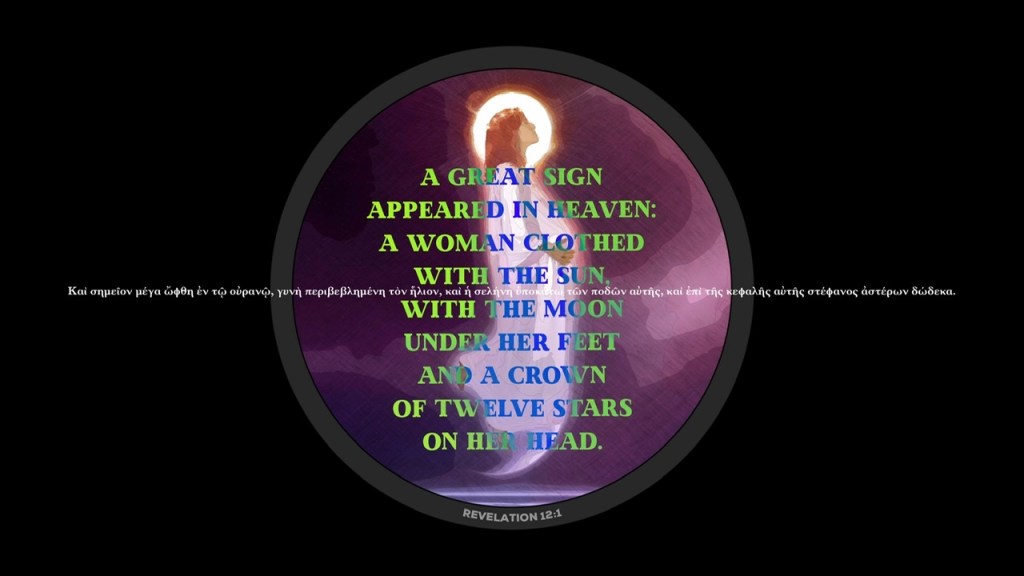
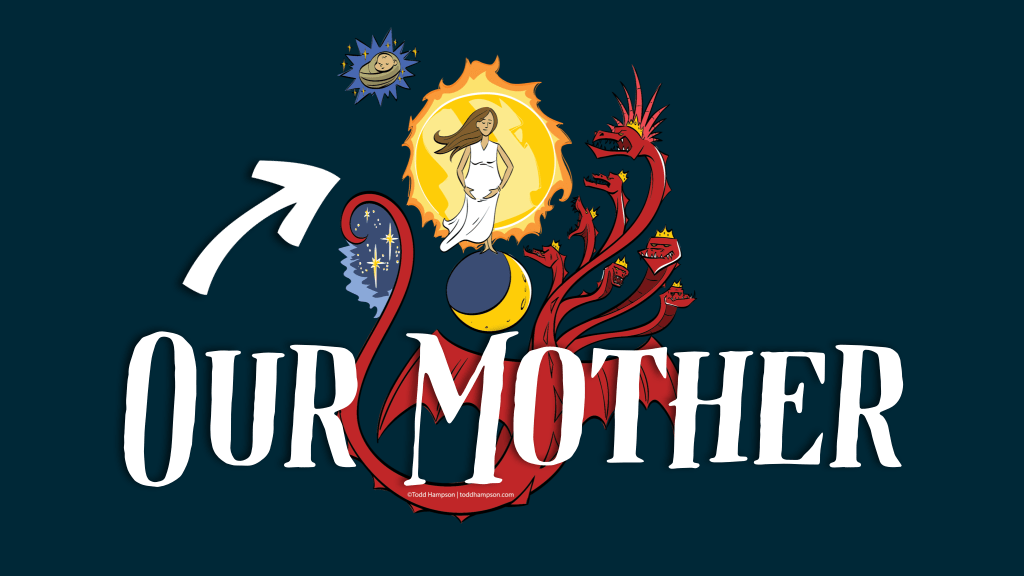
Following Galatians 4:21-31, the Astronomical Wonder Woman in Revelation Chapter Twelve should be interpreted as the Covenant of Promise. In Galatians 4 the Apostle Paul is arguing for the primacy and superiority of the Covenant of Promise over against the Law of Moses. God’s covenant with Abraham comes before and is better than God’s covenant with the Nation of Israel. Both Christ and the Church are born from the Covenant of Promise. As Christians, we are not Children of the Law of Moses, but Children of the Covenant of Promise. Allegorically, She is our Mother. We are the seed of one covenant, not the other. We are children of promise. We are children of The Promise — the ancient promise to elderly Abraham and Sarah (see Genesis 15:5-6; Genesis 18:10-15). Therefore, Revelation Chapter Twelve draws directly upon Paul here.
Am I wrong to suggest that Revelation Twelve might be alluding the a Pauline illustration? No. In fact, it is quite likely that Revelation would draw upon a known New Testament allegory. Galatia was not far from the Roman Province of Asia. By the time Revelation was written and circulating, the Churches of Asia were familiar with all of Paul’s epistles. Moreover, I believe Revelation also alludes to the Book of Ephesians and the Book of Colossians.
Galatia was right next to the province of Asia.
So, that’s how I interpret the Woman of Revelation 12: She is the Covenant of Promise, which ultimately becomes the New Testament.













































 The DeKrakenator Daily