

Dual Recipients

Audio Version


What do a distasteful beverage, a clueless customer, an immature child, an impolite host, a triumphant conqueror, and an attentive listener all have in common? Not much, except that through John, Jesus used all six of these illustrations in quick succession to depict, correct, and inspire the Church of Laodicea and its Messenger (see Revelation 3:14-22).

The Messenger of the Church of Laodicea is like a distasteful, disgusting beverage, neither hot nor cold, which (or who) is at real risk of being spat out. 

The Messenger of the Church of Laodicea is like a completely clueless customer who must first be informed of his or her embarrassing lack of discernment, and then be advised as to what he or she actually needs to acquire. 

The Messenger of the Church of Laodicea is like an immature (and perhaps naughty) child in need of firm correction and discipline from a loving disciplinarian. 

The Messenger of the Church of Laodicea is like an impolite host who leaves an invited (and very important!) dinner guest waiting and knocking at the front door. 

The Messenger of the Church of Laodicea might eventually be a triumphant conqueror.

And anyone hearing Jesus’ message to the Church of Laodicea and its Messenger should be an especially attentive listener. 

Suffice to say, to deliver his message to the Church of Laodicea and its Messenger, Jesus used a lot of short sermon illustrations. 

But I ought to make an aside. Why do I insist on being so wordy? Why do I keep referring to the Messenger of the Church of Laodicea, when I could cut out the extra three words and simplify it to just the Church of Laodicea? Good question. And the answer is this: I want my readers and listeners to catch what gets otherwise omitted, almost every time, in English-speaking settings. Grammatically, it is very clear that Jesus is not addressing the whole congregation of believers at Laodicea — at least, not immediately and directly. Jesus is not speaking directly to the Laodicean church en masse. He is instead speaking first and foremost to someone who is the individual messenger of the church.

But why does that matter?

It matters because the grammatical onus of the passage is clearly on an individual, on the individual messenger, who must personally make necessary personal and corporate changes. This messenger is probably otherwise and more commonly known as the pastor. When the messenger or pastor makes necessary personal and corporate changes, the whole congregation will be better as a result. Thus Jesus’ message indicates that good church leadership matters, and that church leaders sometimes need words of correction — even public correction.
Alternatively and admittedly, the messenger could possibly be understood as a collective singular. While this is a more abstract concept, it basically means that the collective church is personified as a single individual. Maybe this is how we are supposed to understand it. Maybe. But it begs the crucial question of why the singular-collective ambiguity would be used there in the text at all. Jesus could just have spoken to the churches using plural pronouns and plural grammatical forms in general. It is easy to do and would have been much simpler, if indeed the whole church is intended. But no, singular pronouns and singular forms are always used, as if Jesus is speaking to an individual person (which I contend, he is). Therefore, the consistent use of singular grammatical forms points to an intended individual recipient, who is best understood as the leader of the church. (Yes, I do wonder why this grammatical point is so hard for English speakers to accept. It is there for the finding.)

But then again, there is an even better and more nuanced way to understand Jesus’ message to the Messenger at the Church of Laodicea. We can and should read it as applicable to both the individual messenger and the entire congregation. Jesus’ message is meant for both an individual leader and for an entire congregation. Yes, Jesus is speaking most immediately and primarily to an individual messenger, who holds a position of ecclesiastical leadership. But Jesus is also speaking indirectly to the whole congregation. Since the message is supposed to be read publicly, the congregation is meant to overhear it, and take it to heart as far as it applies. If the shoe fits… the listeners should each wear it together. Thus the onus is not entirely on the individual leader. It is also on the congregation, personally and corporately. When we hear and read the Message to the Church of Laodicea in particular, and the Messages to the Seven Churches in general, we do well to keep this intended duality in mind. With each of Jesus’ messages, two recipients per church are intended: the individual leader and the whole congregation. We should strive to keep each of the recipients in view, without forfeiting one for the other.  

Perhaps another time we can look at Jesus’ interesting illustration of an impolite host, who leaves an important dinner guest (that is, Jesus himself) waiting and knocking at the front door.


Why Frogs?

Why Frogs? Audio Version

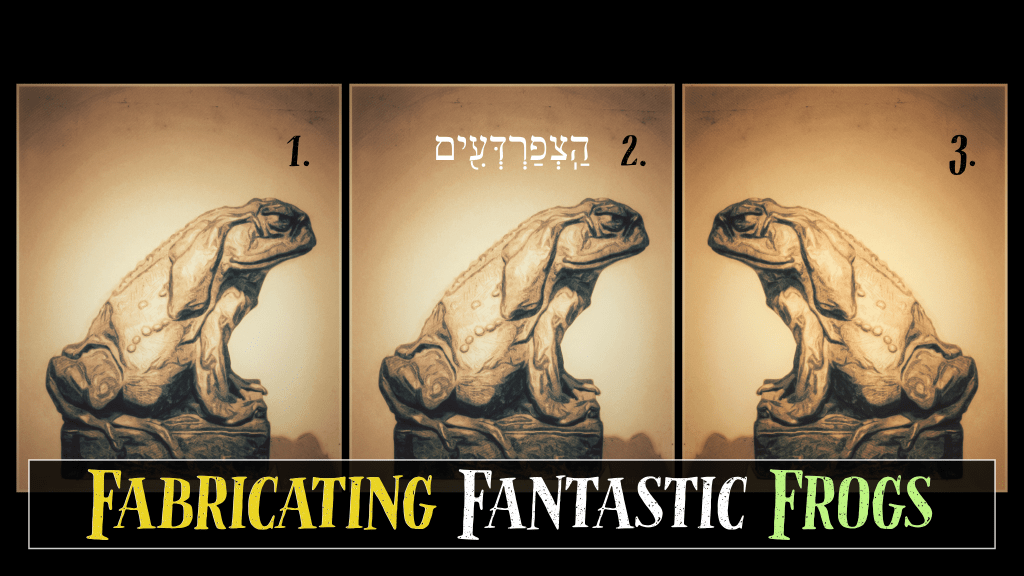
In Revelation 16:13-15, our vision narrator John sees three unclean spirits like frogs jump, or perhaps, ooze out of the mouths of the abysmal, evil pseudo-trinity. Whether they emerge simultaneously or each in turn, these three unclean frog-like spirits slip from the mouth of the serpentine Dragon, from the mouth of the despotic Beast, and from the mouth of the pretentious Pseudo-Prophet.

Revelation’s listeners are informed that the three unclean frog-like spirits are demonic spirits who perform something called signs. But exactly what sort of signs do they perform? We are not told, so we are left to wonder and to speculate. Their signs will probably seem astonishing and even miraculous. At the very least, they will be persuasively compelling. The three sign-performing frog-like unclean spirits will go out and abroad to summon, beguile, and gather a massive military coalition from here, there, and everywhere, on orders from the world’s mesmerized political leaders. And thus, having been persuaded, beguiled, and lured by the three frog-like spirits, the Kings of the Earth, along with their minions and massive armies, will assemble for the renown Battle of Armageddon, the fearsome climatic battle of battles to end the age. The Battle of Armageddon coincides with the Great Day of God, the Almighty. 

And then, a sudden, unexpected parenthetical interruption in Chapter Sixteen occurs. A Voice interrupts this sweeping, bewildering, awesome narrative to forewarn Revelation’s readers and listeners, “Behold, I am coming like a thief. Blessed is the one who stays awake and remains clothed, so as not to go naked and be seen, shamefully exposed.” 

Huh?

Question, questions, questions — for inquisitive interpreters, this passage prompts not only awe and bewilderment, but also a bunch of questions.  

So where do we even start? What are we to make of all the elements in this passage? How are we to comprehend it?

For my purposes in this blog-cast, I want to focus narrowly on the frog-like unclean spirits. The most immediate question I wish to address is this: Why are the unclean spirits said to resemble frogs? I ask that on the assumption that no details go wasted in the Book of Revelation. If a detail is there in the text, it is never incidental or unimportant. Every detail in Revelation is intentional and has meaning. Every detail in Revelation conveys part of a message. Of that, I am thoroughly convinced.

Why, then, are these three unclean spirits said to resemble frogs? 

One possible reason why these unclean spirits are likened to frogs is because frogs are noisy nocturnal creatures. Frogs are croaking creatures of the night. Frogs become especially noisy as daylight fades and darkness falls. Similarly, these three unclean spirits will be especially active and clamorous at the end of the age. I find this reason somewhat persuasive.

A second reason why these three unclean spirits might be likened to frogs is because of the role that frogs play in the pagan mythologies of both Greece and Egypt. In ancient Egyptian mythology, frogs were associated with fertility and with the afterlife. In Hellenistic mythology, frogs were associated with the underworld and Hades. Consequently, the link between frogs and evil spirits would have come as no surprise to Revelation’s first listeners, most of whom were very familiar with pagan mythologies. While interesting, this reason is not satisfactory in and of itself, because other mythological creatures could have been referenced just as readily. However, it does lend persuasive weight to some other reasons.

A third reason why the three unclean spirits are likened to frogs is because of how frogs are featured in the account of the Ten Plagues on Egypt. The Plague of the Invasive Frogs is the second of the ten plagues (see Exodus 8:1-15). Very significantly, by means of their secret arts, the Egyptian magicians could somehow replicate the Plague of the Invasive Frogs. Using demonic sorcery, they could fabricate the same sign. They fabricated frogs, or, more likely, coaxed them from the Nile’s swamps, irrigation canals, and fields. The magicians matched Moses with the same miraculous sign, or something very, very similar. But then they were done. That was it. The fabrication of frogs was the grand finale of their imitative ability. After the plague of the frogs, the Egyptian magicians could replicate no more. Instead, when they attempted to replicate the third plague, the Plague of the Pesky Gnats, the Egyptian magicians had to admit defeat, and informed Pharaoh (in Exodus 8:19), “This is the finger of God!”
This, I believe, is the key interpretive connection we are supposed to make. By means of their unclean frog-like spirits, the abysmal satanic pseudo-trinity will fabricate miraculous signs that will be very, very convincing. They will sway and persuade people — including very important people in high government positions — with displays of astonishing power. Yet like the Egyptian magicians of old, the satanic pseudo-trinity will actually be limited in their powers.

If this is indeed the correct interpretation, I should mention that you might not be present here on Earth when all this occurs. I hope not to be here. I hope you won’t be here, either. Do you remember the Voice in Revelation 16:15 that says, “Behold, I am coming like a thief…”? That voice is Jesus speaking. One way to make sense of his out-of-nowhere narrative interruption is to interpret it as an urgent forewarning to his listeners and readers. It is a forewarning that includes the prospect of an escape. He is coming like a thief. Many people will not anticipate his coming and will not be ready. They will be (to use a dread phrase) left behind. But those who are ready and waiting — those who are awake and dressed — they will escape all the horrors, the deception, and the suffering that will occur during the tumultuous period of the Seven Bowls of Wrath. 

All of this assumes that the Seven Trumpets and the Seven Bowls of Wrath are distinct and successive periods of time, with the Seven Trumpets of Conquest coming first and the Seven Bowls of Wrath following. In my interpretation of Revelation, I do go with that assumption. And I will argue that what separates the Seven Trumpets from the Seven Bowls is the return of Christ and the resurrection/rapture of the Church. But to explain that particular chronology requires a blog-cast (or two or three), and thus must wait for another time.

Mouth, Twenty Two Times Over

Audio Version

In the Book of Revelation, you can distinguish the godly from the ungodly by what comes out of their mouth, or goes into it. Do not take my word for it, though. Study it out for yourself.

Matters of the Mouth

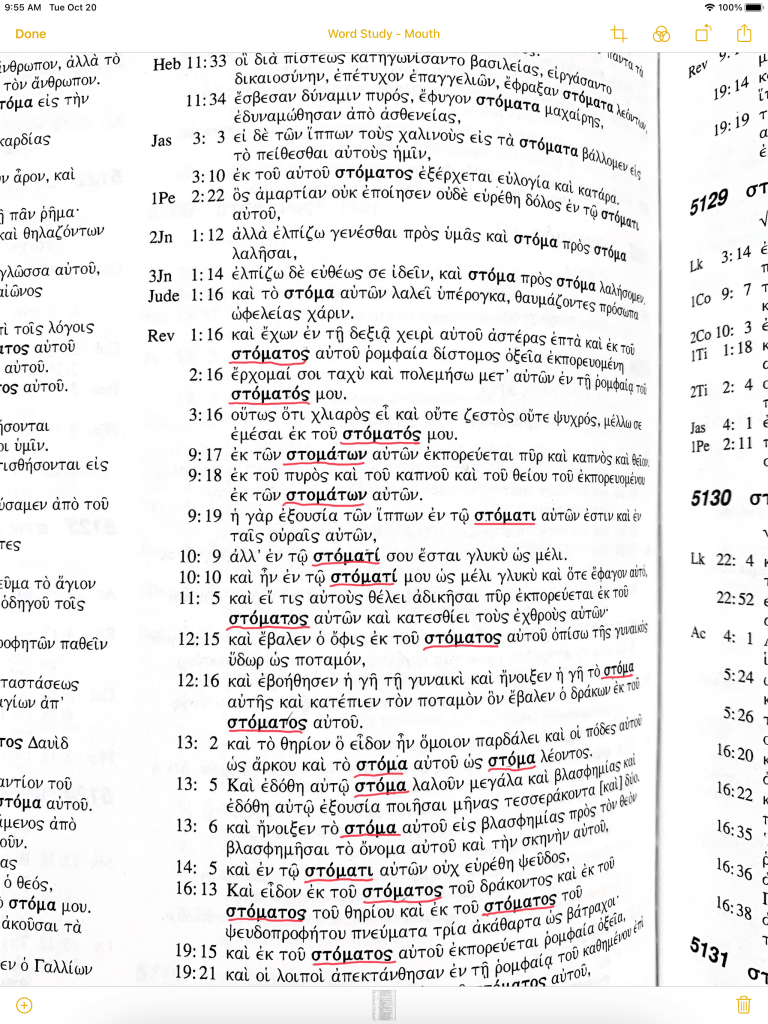
But I will help you. You might do a book-wide word study. As you might expect, one key word you need to study is mouth. In Revelation, the word mouth appears twenty-two times. To save you a lot of time, I will list every instance now:

1:16 2:16 3:16 9:17 9:18 9:19 10:9 10:10 11:5 12:15 12:16 (twice)

13:2 (twice) 13:5 13:6 14:5 16:13 (three times) 19:15 19:21

Here is the word in Greek.

Now I will list in narrative order whose mouth is referenced, and what is said or done:

1. Christ – who has a two-edged sword coming from his mouth.

2. Christ – who will fight against the heretic Nicolaitans with the sword of his mouth, unless they repent.

3. Christ – who might vomit out the lukewarm messenger from the Church of Laodicea.

4. The Chimæra Cavalry – from the mouths of whom come fire, smoke, and sulfur (reminiscent of and probably referential to the judgment on Sodom and Gomorrah – see Genesis 19:24-29).

5. The Chimæra Cavalry – who slay a third of humanity with the fire, smoke, and sulfur that comes from their mouths.

6. The Chimæra Cavalry – who have power in their mouth and in their serpent-like tails.

7. John, the Narrator – in whose mouth the small scroll will be as sweet as honey.

8. John, the Narrator – in whose mouth the small scroll was as sweet as honey.

9. The Two Martyr-Witnesses – from whose mouth comes fire, which devours their enemies.

10. The Dragon-Serpent Satan – who hurls water like a river from his mouth, in order to sweep away the woman, the mother of the male child Christ.

11. The Earth – which opens its mouth to swallow the river hurled from the mouth of the dragon.

12. The Dragon – whose mouth-hurled river of water is swallowed by the mouth of the Earth.

13. The Beast from the Sea – whose mouth was like a lion’s mouth.

14. The Beast from the Sea – who has a mouth like a lion.

15. The Beast from the Sea – who was given a mouth to utter arrogant words and blasphemies.

16. The Beast from the Sea – who opens his mouth in blasphemies against God, his name, and his dwelling, that is, those who dwell in heaven.

17. The 144,00 Soldier-Saints — in whose mouth no lie is found, for they are blameless.

18. The Dragon – from whose mouth three unclean frog-like spirits proceed.

19. The Beast – from whose mouth three unclean frog-like spirits proceed.

20. The False Prophet – from whose mouth three unclean frog-like spirits proceed.

21. Christ – from whose mouth extends a sharp sword, with which he strikes the nations.

22. Christ, the Rider on the White Horse – who slays the armies of the Beast and the Kings of the Earth with the sword from his mouth.

In Revelation the Dragon does not emit fire.

Here are some of my observations and interpretations:

Notice that a sharp double-edged sword comes from Jesus’ mouth. A reference to Isaiah 49:2 and Hebrews 4:12, the sharp double-edged sword is the Word of God, and is alternatively a surgical tool or a lethal weapon.

Fire comes from the mouths of the Chimæra Cavalry and from the mouth of the Two Martyr Witnesses. Fire most often symbolizes the Holy Spirit of God in Revelation. The fiery imagery probably references Deuteronomy 4:24 and Hebrews 12:29, both of which say that God is a Consuming Fire. Thus the Holy Spirit might well be the deadly, devouring fire that issues from both the Chimæra Cavalry and the Martyr Witnesses. If so, the Cavalry and the Witnesses could be one and the same entity, that is, the Church. That which issues from the mouth of the Church consumes or devours its enemies. This notion definitely does not work if taken literally: The Church does not and should not go around physically incinerating its opponents with fire. However, it does work if taken figuratively: When we are faithful witnesses, we do bring an ego-exterminating, life-transforming, Spirit-empowered message. Yes, we do. At least, we ought to.

The small scroll is the unique revelation contained in the Book of Revelation. This, in particular, is what John was given to internalize, to write, and to narrate. The small scroll reveals what the end of Daniel conceals, that is, important details about and instructions regarding the eschaton, the end of the age.

The dragon-serpent Satan does not breathe fire. On the contrary, he spews or, more literally, hurls water from his mouth. Is that because the dragon wants to extinguish transformative flame of the Spirit? Yes, I believe so. The dragon-serpent wants to quench the fire of the Spirit.

The Earth opens its mouth and swallows the river of water from the dragon-serpent. Historically, Satan’s attempts to silence and to kill the servants of God has often been frustrated by obedient, courageous acts of earthly concealment. Sometimes the scriptures have been buried or hidden away. Sometimes the messengers of God have hidden themselves in the wilderness or underground. Sometimes innocents have similarly been protected from would-be assailants.

The Beast from the Sea has a mouth like a lion. He utters arrogant boasts and blasphemies. This hubris means that the evil political autocrat of the hour will invariably resort to deception, coercion, violence, and destruction. Every generation has at least one such antichrist. An ultimate antichrist, known in Revelation as the Beast from the Abyss, will be someday be revealed. This antichrist will be particularly intent upon and adept at silencing the Church.

The 144,00 soldier-saints are shown to be blameless by what comes from their mouths. This is the Church at rest in heaven and in victory. These are the elect saints who have already completed their course. These are those who have overcome the Dragon by the blood of the Lamb, and by the word of their testimony, and by loving not their lives, even unto death (see 12:11). These are the same victorious saints who will return to Earth someday with Christ.

The Dragon, the Beast, and the False Prophet comprise an end-times pseudo-trinity. In chorus and conjunction, the three will somehow emit three unclean frog-like spirits from their mouths. I have to admit that I do not understand exactly what this means, other than to say that this pseudo-trinity seems to deliver a particularly potent, deceptive final message or call.

And finally, we circle back to the conquering King of Kings, Jesus Christ, who ultimately overcomes and slays his enemies with the sharp sword from his mouth (19:20-21). The fact that Christ removes his enemies ought not surprise us. And given Christ’s actual and utter righteousness, that fact should not even bother us. It is as it ought to be. He is entirely good and deserving. Therefore, no one should stand in opposition against him. As the King of Kings, Christ must eventually rid his kingdom of all would-be rivals, and eliminate all his enemies. The only question is how a rebel meets his or her end. Will an individual rebel die in submission to Christ’s word or die in defiance to it? Will you voluntarily die to yourself in contrite surrender to the Word of God? Or will you go down asserting your own righteousness in defiance to Christ? The first sort of death, though it does indeed entail death to the ego, turns out to be not much of a death at all. The one who dies in voluntary submission to the Word of Christ does not suffer complete personal annihilation, but instead emerges a transformed person. Those who have yielded to Christ will testify that their submission to his authoritative word was well worth the temporary pangs of death. Alternatively, the second sort of death — the unyielding, defiant death — is a much deeper death, where no hope of escape is mentioned, and the certainty of exacting punishment is assured. In the end, no one will oppose Christ any longer. If Christ were in any way unrighteous or unworthy, that claim would be entirely disturbing and unnerving. But Christ is altogether good and righteous. He is wholly deserving of our allegiance and of our ready submission. Someday Christ will subdue and eliminate all his enemies. That is very good news.

Wonder Woman

Audio Version
Interpretive Minds Want to Know: Who is this Wondrous Woman?

As a rule and whenever possible, I use Scripture to interpret Scripture. That’s especially true with the Book of Revelation. Revelation is constantly referencing prior Scripture. Once an interpreter gets a hold of that fact, interpretation of Revelation becomes a matter of looking back to the scriptural allusions and references, and then connecting the dots into a coherent design. 

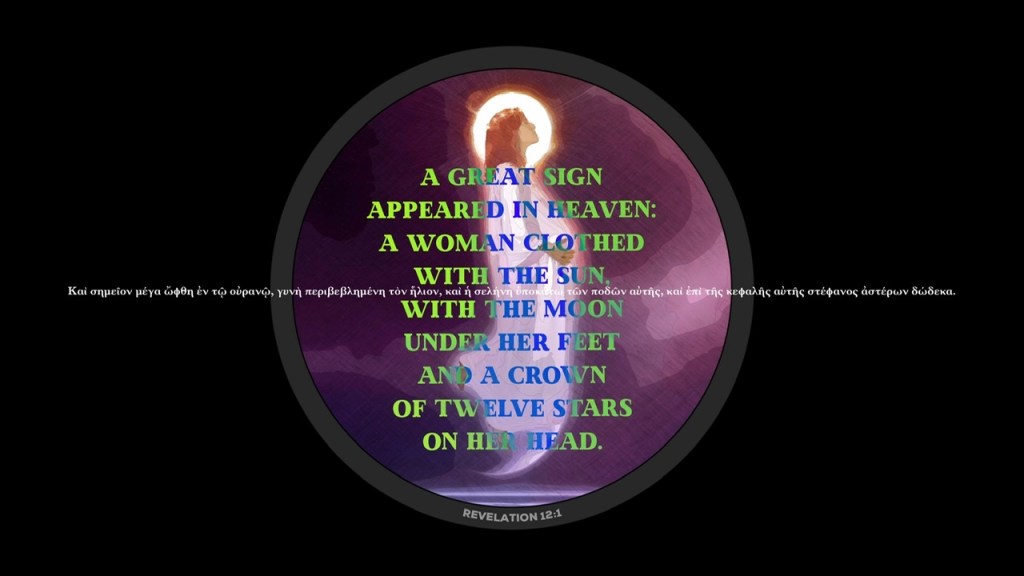
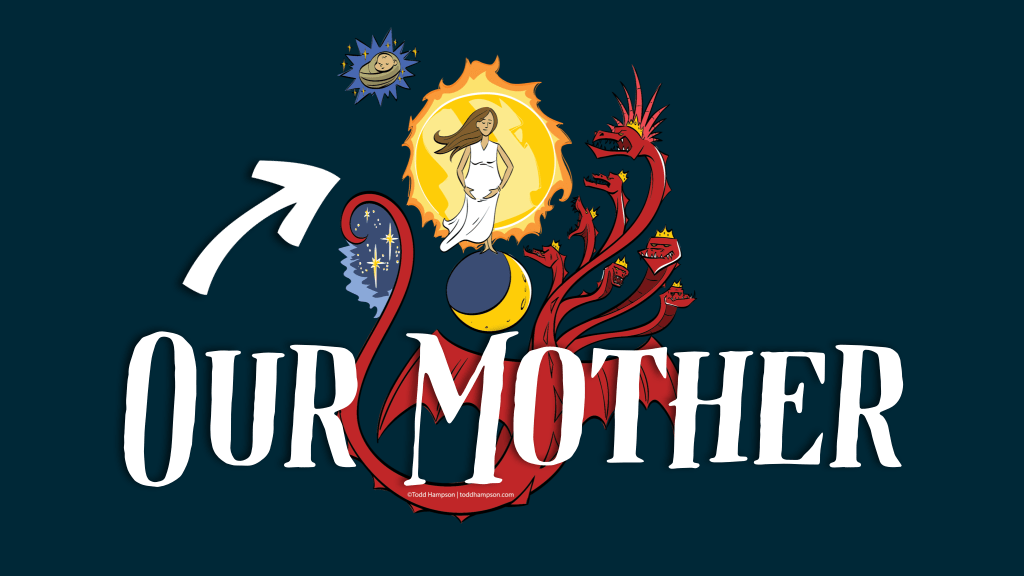
Following Galatians 4:21-31, the Astronomical Wonder Woman in Revelation Chapter Twelve should be interpreted as the Covenant of Promise. In Galatians 4 the Apostle Paul is arguing for the primacy and superiority of the Covenant of Promise over against the Law of Moses. God’s covenant with Abraham comes before and is better than God’s covenant with the Nation of Israel. Both Christ and the Church are born from the Covenant of Promise. As Christians, we are not Children of the Law of Moses, but Children of the Covenant of Promise. Allegorically, She is our Mother. We are the seed of one covenant, not the other. We are children of promise. We are children of The Promise — the ancient promise to elderly Abraham and Sarah (see Genesis 15:5-6; Genesis 18:10-15). Therefore, Revelation Chapter Twelve draws directly upon Paul here.

Am I wrong to suggest that Revelation Twelve might be alluding the a Pauline illustration? No. In fact, it is quite likely that Revelation would draw upon a known New Testament allegory. Galatia was not far from the Roman Province of Asia. By the time Revelation was written and circulating, the Churches of Asia were familiar with all of Paul’s epistles. Moreover, I believe Revelation also alludes to the Book of Ephesians and the Book of Colossians.

Galatia was right next to the province of Asia.

So, that’s how I interpret the Woman of Revelation 12: She is the Covenant of Promise, which ultimately becomes the New Testament.

Death, Good and Bad

Audio Version
Will the Church last?

Try a counter-intuitive approach. Sometimes, surprisingly, it works. Go the opposite direction you might otherwise be inclined to go. Counter-intuit it. Sometimes the best way to approach a confusing passage or theme in Revelation is to flip it upside down or inside out. Sometimes the best interpretation of a passage in the Book of Revelation will first feel a bit weird and unlikely. It will initially confuse you. At first glance, it will not make sense.

Case in point: Death. Death is not always what it seems in Revelation. Death is not always what you might assume it to be.

In Revelation, death is sometimes good. By Revelation’s counter-intuitive reckoning, death is sometimes desirable. Go ahead and wish someone dead. Metaphorically, death is sometimes not just a good thing in Revelation, but the best possible outcome. No, not every time, but yes, death is sometimes exactly what we want. That is because death can symbolize conversion. And if that is a correct interpretation, know that other important New Testament passages say approximately the same thing (for example, Colossians 3:3).

So you’re not convinced? No, I did not think you would be. To use a cliché, the proof is in the pudding. You need to actually look at some key passages to see it there.

But first, let me explain my thought process. The reason I started to suspect that death might not be what it seems in Revelation — that it might sometimes be good — is because I noticed the potentially positive role of fire, especially in the series of Seven Trumpets. If fire is symbolic for the spoken Word of God, as I came to believe, then death by fire might not mean physical incineration, but spiritual purification. The proclaimed Word of God has the inherent power to kill or purge what is wrong within a person, and the power to inspire what is right and good within a person.

Just as baptism is a sacramental symbol of death and resurrection (as seen elsewhere in the New Testament, such as Colossians 2:12), so fire is a narrative symbol of the effective spoken Word of God (in Revelation). The spoken Word of God kills sin within the sinner and yet inspires holiness. That is my line of interpretive reasoning. And it works, if and when you read Revelation accordingly.

At the beginning of Revelation 9, the reader will come across the fifth trumpet and a demonic locust swarm. There is no question whatsoever that the locust swarm is entirely evil, for the passage points out that their king is the Angel of Abyss (see 9:11). Notably, the locust swarm cannot kill, but can merely torment (see 9:5-6). But what does that lack of lethality mean, exactly? From what I determine, our interpretive options are to understand it either literally or metaphorically. Literally, the evil locusts might not be able to physically kill anyone. That is one option. Metaphorically, the evil locusts might not able to spiritually transform anyone. That is another option. But which is right?

Keep in mind that I am arguing that death is good, in this specific context.

Then the next trumpet sounds, the sixth trumpet, and with it comes another motley crew. Surely this fearsome, mutant cavalry is just as bad or worse than the last horde, since they kill a third of mankind (see 9:15). Almost every interpreter I come across believes just so: these are bad guys. But wait. Just how does the cavalry kill? They kill with fire — fire from their mouths. Exclamation mark. What if the fire is not literal, but spiritual? What if the fire is the spoken Word of God? What if the cavalry is actually good and not bad? If fire-breathing is consistently good in Revelation, then this strange army must be good, and perhaps the death of a third of mankind means the conversion of a third of mankind. Exclamation mark. Please consider the possibility.

Is this just wishful thinking? Or might I be on the right trail?

To conclude Chapter Nine, we read that the rest of humanity, those who were not killed by these plagues, did not repent (see 9:20-21). Think about that statement in light of how I suggest the passage be interpreted. I would say, “Exactly, and of course not.” Of course the rest of humanity did not repent, because if they had repented they would be counted among the fire-consumed dead. The dead are the repentant. The dead were those killed by the fire, that is, by the spoken Word of God. The rest, by default, are the unrepentant.

Keep in mind, I am arguing that death is good, in this particular context.

Now I am going to explain when death is not good in Revelation, because sometimes death does refer to physical death, which is not good at all. 

In Chapter Eleven, we read about the Two Witnesses, otherwise and just as accurately known as the Two Martyrs. Curiously, the Two Witnesses have the ability to consume would-be assailants with fire from their mouths. This fire kills their would-be assailants (see 11:5). Yes, I do read this metaphorically. The Two Witnesses, who represent the faithful, witnessing Church, consume (or convert) their foes by means of the spoken Word of God. But later in the same chapter, the Two Witnesses themselves are slain, or martyred, in the Public Square of the great city (see 11:7-8). They are not slain by fire, please notice that. They are simply slain by the Beast from the Abyss. How should we understand this? My suggestion is that we read this disturbing, unhappy passage mostly metaphorically, but also somewhat literally. No, not every Christian will physically die immediately before Christ returns, but some will. And Christians need to be ready for that. The Church will be attacked, will be persecuted, and will be rendered seemingly lifeless. In the eyes of its enemies, the Church will seem wholly defeated. But the ostensive defeat of the Church will not last very long. After a very brief time, the Church will be resurrected (literally), and will be brought to heaven in a cloud (literally), just like Christ in his ascension (see 11:11-12). Therefore, what began as an unhappy allegory ends as a totally triumphant portrait of the Church. Like Christ himself, the Church will seem defeated immediately before it is vindicated in glory.

These Three Are One

Audio Version

Why should anyone believe that Jesus is the Son of God? Why should anyone believe that Jesus is the legitimate Heir of God? 

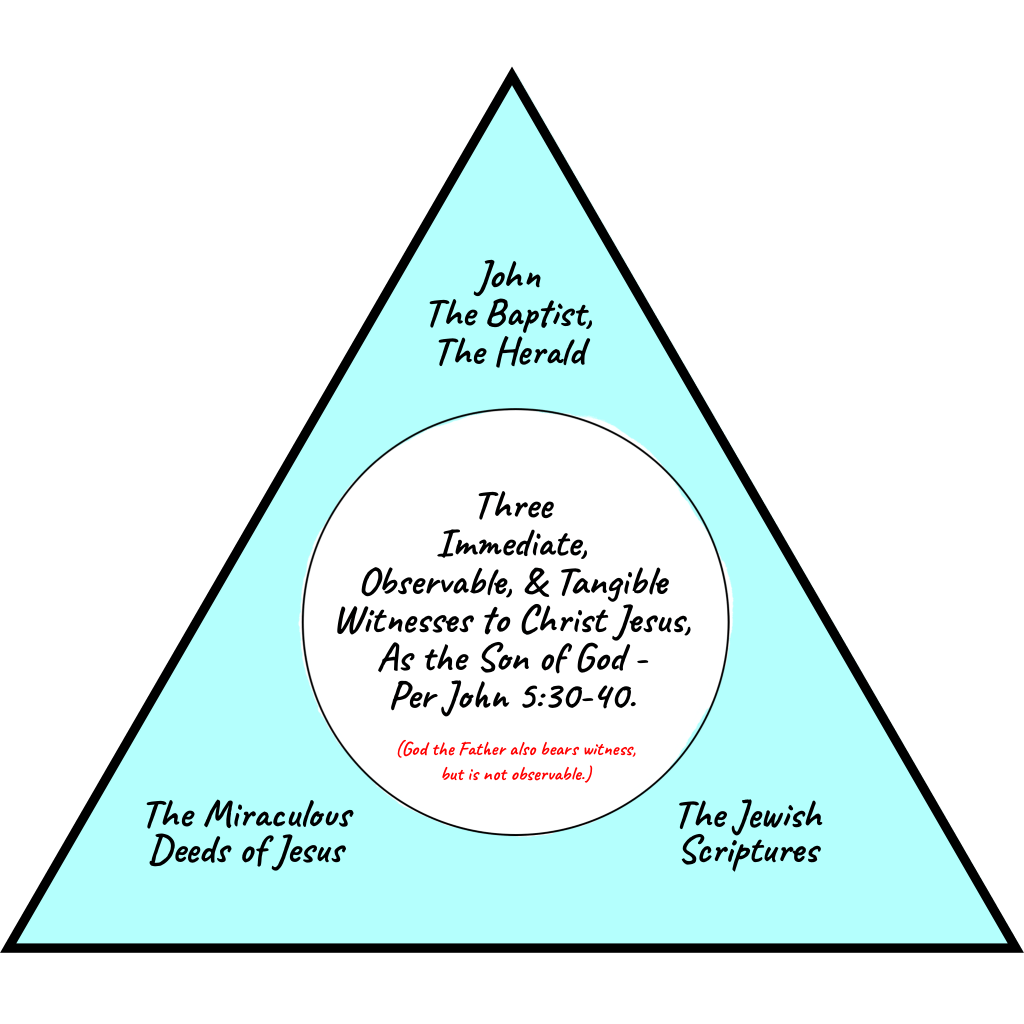
In a lawyerly-like manner, Jesus himself once made a case for why inquirers should accept his potentially blasphemous claim to be the unique Son of God (see John 5:30-40). Since his own assertion was insufficient evidence, Jesus listed four additional witnesses to his claim. His first witness was one of his relatives, a cousin named John. His second witness was — or rather, were — his miraculous deeds. His third witness was his Father, that is, God himself. However, Jesus quickly pointed out that most of his listeners would not and could not ascertain nor receive such testimony, even though it was there and immensely valid. And lastly, Jesus’ fourth stated witness was the Bible, which Jesus refers to as the Scriptures.

These are Three Points from Jesus’ Own Legal Argument

Since his claim is so immensely extraordinary, and since many of his listeners would find his claim not just ludicrous but blasphemous, Jesus necessarily appeals to both testimony and evidence. Three of the four witnesses listed by Jesus were directly or indirectly available on the public record. Although God was not directly available to inquirers, Cousin John or his associates were. Multiple witnesses to Jesus’ miraculous deeds were also available for interviews. Even recipients of Jesus’ miracles could be found. And likewise, the Scriptures could be (and should be) readily referenced.

Considered judicially, Jesus was making his case based on three solid pieces of evidence. Jesus had the testimony of a reputable and widely-respected expert witness, who was also a relative. Jesus had the circumstantial evidence of healings and miracles, along with the testimonies of multiple eyewitnesses to those miracles. And Jesus had extensive documentary testimony. If all that evidence aligns and holds true, it makes for a decisive case, to say the least.

Yet my next question will seem something of a non-sequitur. When? When did Jesus make this controversial claim? When did Jesus claim to be the Heir, the Son of God? And when did Jesus present his four witnesses? Did it happen before the cross or after? And the answer: This happened before he was crucified. He made his extraordinary claim during his earthly ministry years. Jesus himself believed and contended that he was the Son of God. 

According to John’s Gospel, this is the reason why Jesus was rejected. Jesus got himself in trouble with the Jewish religious authorities exactly because he claimed to be the unique Son of God. One of the reasons the Jewish authorities wanted Jesus dead is because they believed his death would decisively invalidate his grandiose claims. A dead Son of God is no Son of God at all, they reasoned.

But ironically, it was Jesus’ death by crucifixion that forever established his claim to be the Heir to the Throne, the true Son of God. Even in the moment of his death Jesus was recognized as the Son of God (see Mark 15:39).

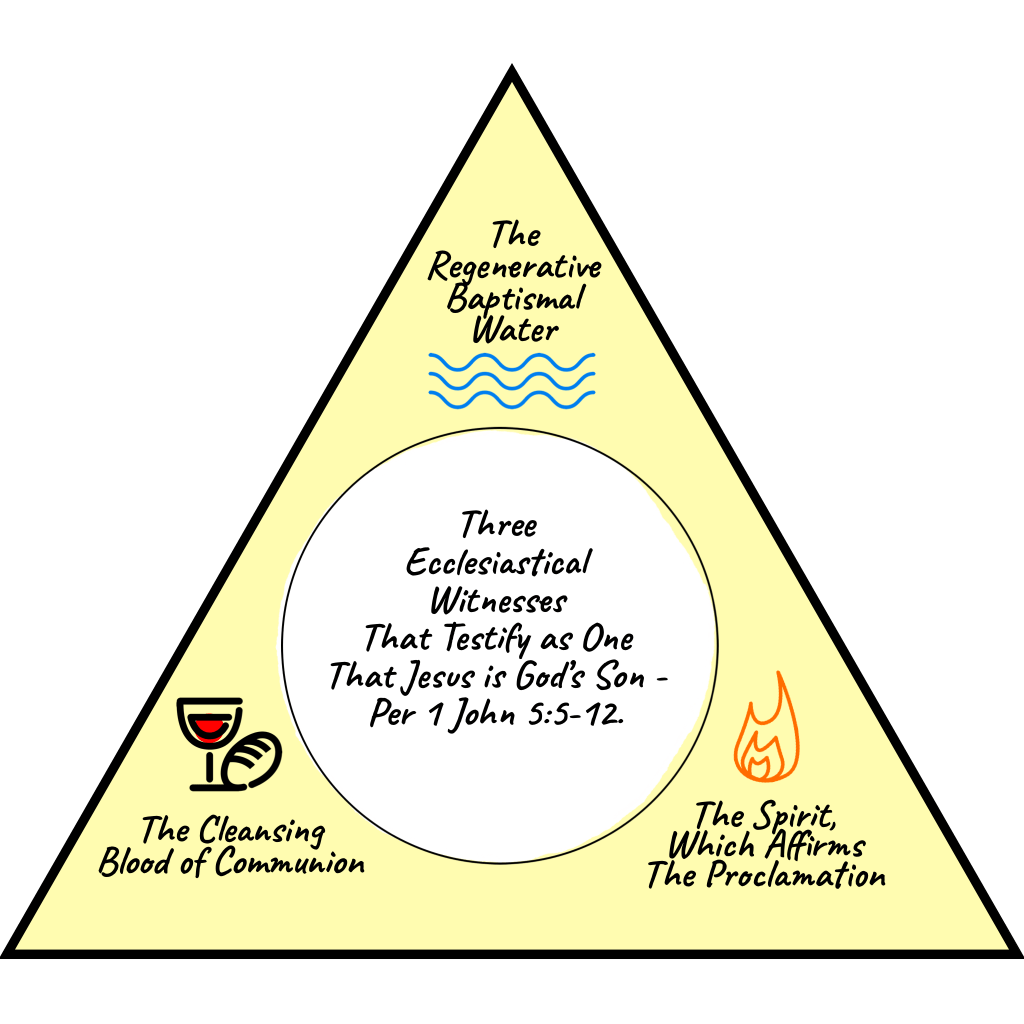
Therefore, in the Gospel of John, Jesus himself presents four witnesses that establish his claim to be the Son of God. This argument is made before the crucifixion and resurrection. Then after Jesus’ crucifixion and resurrection, we again read of three witnesses. The First Epistle of John speaks somewhat mysteriously of three immediate witnesses to Jesus, witnesses who testify that he is the Son of God. Those three witnesses are the Spirit, the Water, and the Blood (see 1 John 5:6-12).

Could it be that the Gospel of John and the First Epistle of John are actually speaking of the same three phenomena, the same three witnesses?

The first witness, the Spirit, corresponds to the Scriptures. Why? The Spirit is the very same Spirit who inspires prophecy and thus the Scriptures — both Old Testament Scriptures and New Testament Scriptures.

The second witness, the water, is surely a reference to baptism. Of course, Cousin John is more commonly known as John the Baptist. He was the one who performed, witnessed, and testified to Jesus’ own baptism. It was at Jesus’ baptism where the Trinity first publicly debuted (see Mark 1:9-11; John 1:29-34). And today, an individual believer’s baptism publicly signifies his or her conversion (or rebirth) and induction into the Church.

And thirdly, there is the blood, which corresponds to the work of Christ. Although it might first seem strange to think of Jesus’ bloody crucifixion as one of his miraculous deeds, it was actually his miraculous work par excellence. The ultimate saving work of Jesus was wrought when he bore our sin in his ghastly execution by crucifixion, and triumphed over the power of death in his glorious resurrection.

An Ecclesiastical and Sacramental Interpretation of First John 5:5-12

Thus the Scriptures, John the Baptist, and Jesus’ own miraculous deeds all once testified that Jesus is the Son of God. Likewise today, the Spirit of Truth, the regenerative Water of Baptism, and the ever-sanctifying Blood of the Lamb continue to testify that Jesus is the Son of God, the rightful Heir to the Heavenly Throne, the King of Kings and Lord of Lords.

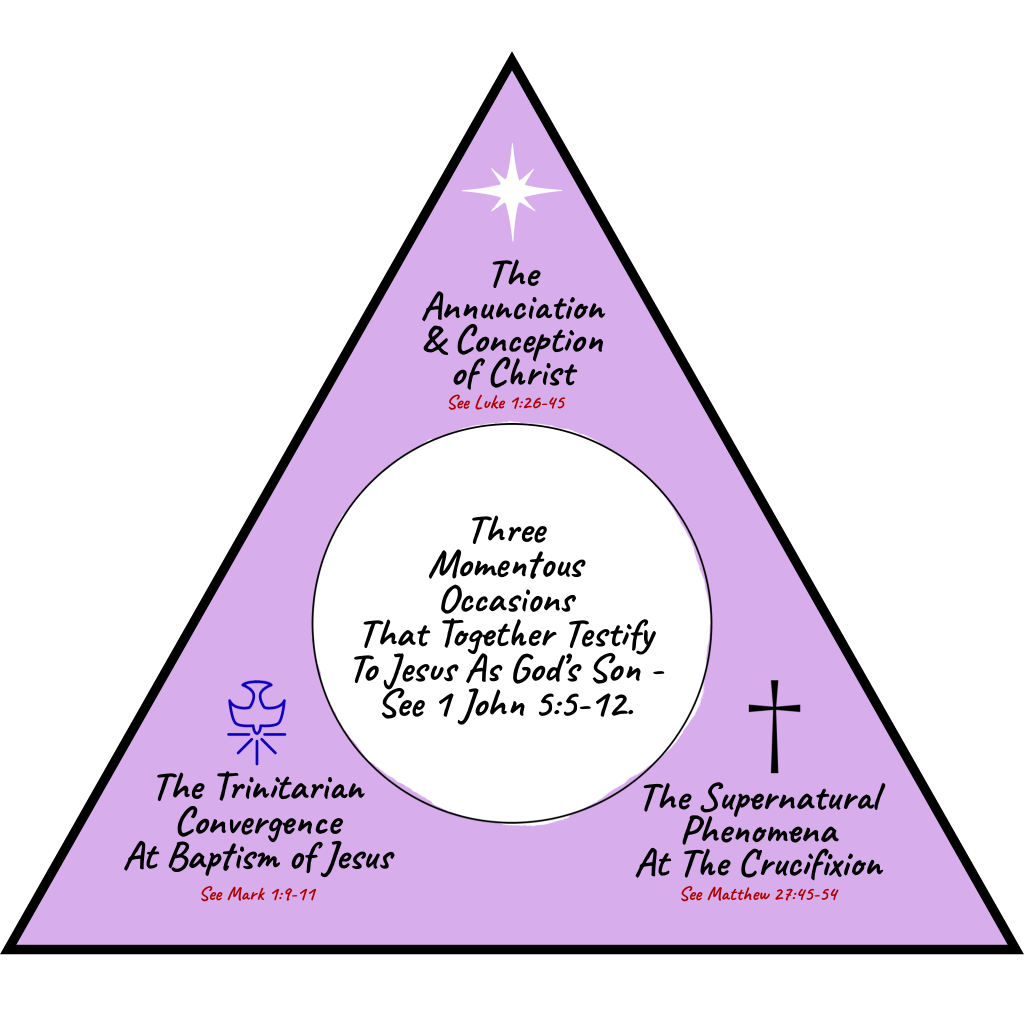
But wait — there is one more way to interpret 1 John 5:5-12. The passage can be understood as referring to three revelatory events around the life of Jesus, three times he was clearly said to be the Son of God. The first event was when his mother Mary was informed by an angel that she would have a child, “the Son of the Most High” (see Luke 1:26-45). The second event was when John the Baptist baptized Jesus in the Jordan River, and a voice from Heaven affirmed Jesus as “My Beloved Son” (see Mark 1:9-11). The third event was when a Roman onlooker to Jesus’ final moment was so moved by what he saw that he proclaimed Jesus must be the Son of God (see Matthew 27:54). While there were several other times that Jesus was identified as the Son of God, these three pivotal events fit the criteria of Spirit, water, and blood nicely.

Historic Events that Testify to Jesus’ Identity

There are three who testify; and these three align and agree (see 1 John 5:7-8).

Chapter Eleven Bankruptcy

Audio Version

Here in the United States, the two words “Chapter Eleven” are usually associated with debt, insolvency, and bankruptcy. The eleventh chapter of the U.S. Bankruptcy Code provides a means of debt reorganization under court supervision. A Chapter Eleven Bankruptcy becomes an unhappy legal necessity when a corporation or an individual has debt that cannot be met. No one wants to go through the considerable trouble of a Chapter Eleven Bankruptcy. It is always best avoided. But sometimes it has to happen. Sometimes it becomes inevitable. When creditors come knocking and the bills go unpaid, a Chapter Eleven Bankruptcy sometimes becomes unavoidable and necessary. A Chapter Eleven Bankruptcy is unwelcome, unpleasant, and undesirable — except if it ends well. And every once in a while, it does end well.  

Now let’s turn from Chapter Eleven of the U.S. Bankruptcy Code to Chapter Eleven of the Book of Revelation. It ought to be said up front that one major similarity exists between the two Chapter Elevens: yuckiness. They’re both rather unpleasant eventualities. Both Chapters Eleven are very, very undesirable. Like Chapter Eleven of the U.S. Bankruptcy Code, Chapter Eleven of Revelation involves a lot of hardship, humiliation, and hostility. For faithful Christians, Chapter Eleven of Revelation is no fun. But it ends quite well.     

Welcome to Chapter Eleven of the Book of Revelation. Welcome to an uncertain future. Expect a bumpy ride. Our immediate future will likely be a dystopian nightmare. Chapter Eleven brings us past the present day and into a dismal future.

In Chapter Eleven you will read about Two Martyrs. The English translation you read will almost certainly say “two witnesses.” Your translation is not wrong; it just fails to catch the nuance of martyrdom that is there. The original Greek word is actually martyr. And in Chapter Eleven, the two witnesses are more than just witnesses. They physically die. They are killed. They are killed for their testimony. They are martyrs. 

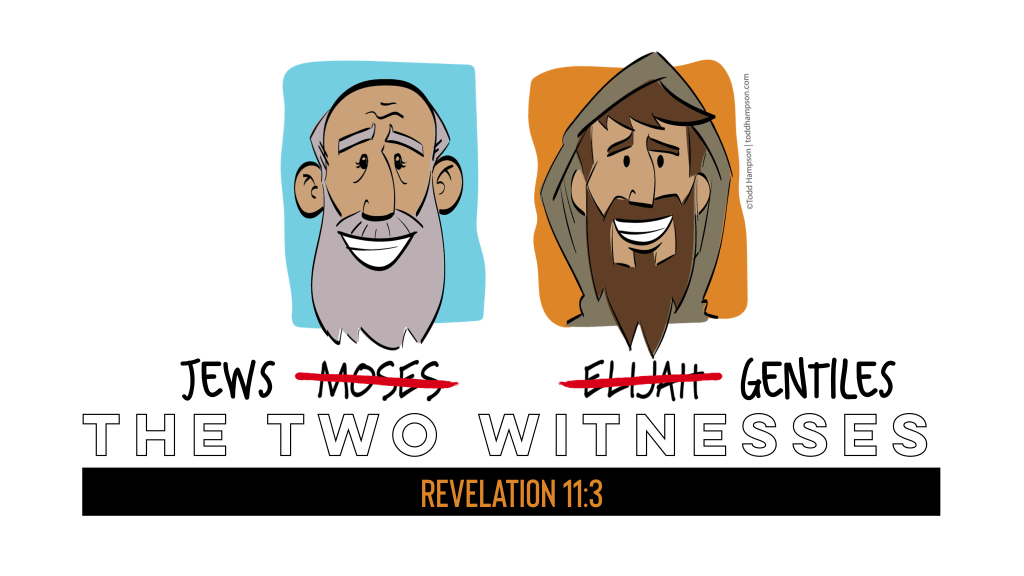
Some interpreters will say that the Two Martyrs will be Moses and Elijah. Those interpreters are slightly right and mostly wrong. The Two Martyrs will be prophets like Moses and Elijah. But Moses and Elijah will not be the Two Martyrs. The text never says they will be. Instead, the two martyrs are much more immediate. You and I will potentially be the Two Martyrs. Yes, you may be a martyr. And I may be a martyr. Reconcile yourself to that possibility right now. We are supposed to count the cost. It could well cost you your life. Jesus made that very clear when he called his disciples to take up their cross and follow him. He was serious. 

The Two Martyr-Witnesses: Jewish and Gentile Believers

I forewarned you. This is not a pleasant chapter, at least not up front.

Someone somewhere is asking how I see all this in Chapter Eleven. How do I come to these conclusions? Why do I settle upon this interpretation?

As I mentioned in my last blog-cast, Chapter Eleven presents a number of symbols from the very first verse. It mixes a lot of seemingly strange metaphors. And yet for someone familiar with the Bible, these are easily recognizable metaphors. Most of the metaphors presented in Chapter Eleven are used elsewhere in the Bible as metaphors for just one thing: the Church Universal. We are being presented with a symbolic, metaphorical collage of the Church. 

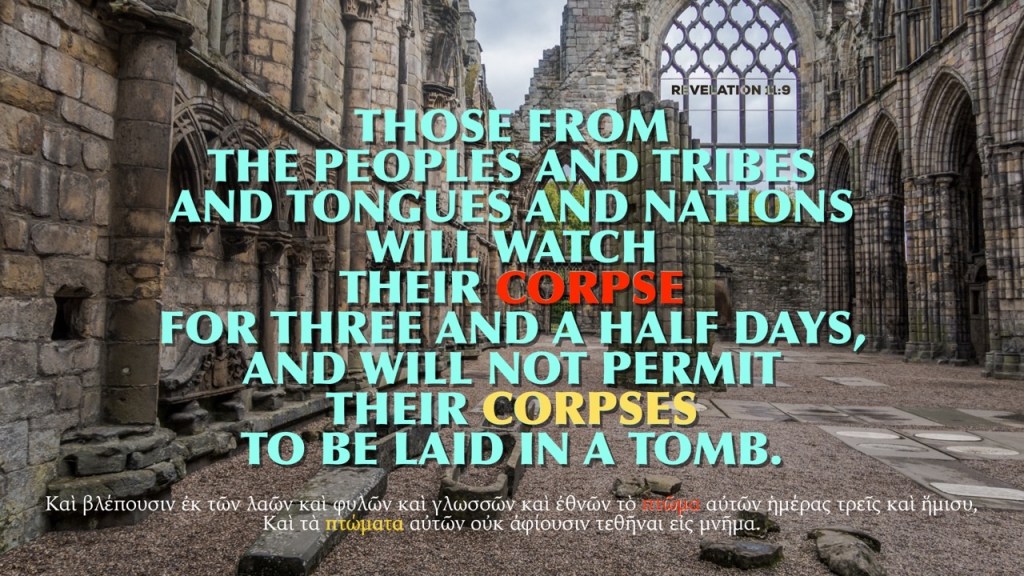
In the end, when the Two Witnesses are finished with their testimony, the ascendant Beast from the Abyss will make war on them, conquer them, and kill them (see Revelation 11:7). The Beast from the Abyss will bring about their elimination. The Two Witnesses will be slain in the Public Square. Their corpse (singular) will be under close watch. Their corpses (plural) will be left unburied. Their opponents will celebrate their demise, albeit only briefly.

On one hand, this can be understood to mean that the Two Witnesses will be physically killed. On the other hand, it can be understood to mean that the Two Witnesses will be politically or economically eliminated. I mean that the Two Witnesses will be forcibly silenced or otherwise rendered incapacitated. Based on what has happened historically, I think that both types of killing will occur. Not every Christian will be physically killed, but some will. And those who are not physically killed will be incapacitated through social or economic means. The Church will be silenced, sidelined, and persecuted immediately before Christ returns. Yes, I do know in some places this is happening right now. I just think that the scale and the intensity will increase immediately before the Church is resurrected and rescued. When he taught about the events at the end of the age, Jesus instructed his disciples to pray that they have the strength to escape all these things (see Luke 21:36). It is no mistake that his words were recorded in scripture for later generations. We likewise are supposed to pray that we have the strength to escape or endure all these things. 

This is the gist of the first ten verses of Chapter Eleven. This is the ugly part of the chapter. Much happier events are soon to occur. But for now, those happier events must wait. 

Many interpretive questions linger. I did not cover everything in the first ten verses. I know that. I am leaving a lot of questions unanswered. I mean to answer more questions sometime soon. But I wanted to cover the essential message of the first half of Chapter Eleven first. I intend to work through more of the details in upcoming blog-casts.