The Last Temptation of Alexander Hamilton

Saturday, May 16th, 2020

I have a tender reliance on the mercy of the Almighty, through the merits of Jesus Christ.

Alexander Hamilton
The gravesite of Alexander Hamilton in Manhattan
The Last Temptation of Alexander Hamilton, Audio Version

The quote from Alexander Hamilton cited above was spoken as an affirmation of faith shortly before his death. Hamilton died on July 12th, 1804, thirty one hours after suffering a mortal wound in a pistol duel. Aaron Burr, a bitter personal and political rival, was the culprit. Burr took deliberate aim and gunned down Hamilton. At the time, Burr held the office of Vice President of the United States. Strange though it may be in our hearing, the Vice President of the United States shot his political rival in a duel, knowing that death was a likely consequence. Worse still, Aaron Burr was never arrested nor prosecuted for the deed. But the duel did forever derail Burr’s political ambitions, which is exactly what Hamilton anticipated and wanted. Though he died in the process, Alexander Hamilton meant for the duel to undo the ambitions and aspirations of Vice President Aaron Burr.

Some historians speculate that Hamilton may have had another motive for the duel, as well. Hamilton felt personally responsible for the dueling death of his son Philip. Philip had dueled and died over a slight to his father’s honor. It’s quite likely that Hamilton, distraught with grief and consumed with guilt, actually had a suicidal death wish. Hamilton probably considered it apt that his own death come by duel, just like his son’s.

A Portrait of Alexander Hamilton by Walter Robertson

Perhaps we can describe that fatal duel as the last temptation of Alexander Hamilton. Notice that it was a temptation in not one but two ways. The duel with Burr was a temptation for Hamilton and a temptation by Hamilton. For Hamilton, the temptation was death by duel itself. And Hamilton used the duel to draw Burr into bloody temptation. If this is an accurate read, then it worked, in both ways. Hamilton was doubly successful, but quite dead in the end.

Aaron Burr was a vindictive, self-serving, unprincipled, ambitious politician. Hamilton knew that. It is precisely why Hamilton opposed Burr. Based on his negative and yet accurate assessment of Burr’s character, Hamilton had reason to believe that Burr would be vengeful and aim to kill in the duel. Hamilton, on the other hand, went into the duel with no intention of shooting Burr. Hamilton intended to miss. Thus Hamilton read Burr’s dark motives accurately. But Burr completely misread Hamilton’s intentions. Had he understood Hamilton’s intentions and the consequences of his own actions, Burr would not have shot Hamilton. But sadly and predictably, Burr did shoot Hamilton. Burr seethed with malice. He wanted to exact revenge. He wanted blood.     

I watched Hamilton examine the terrain; I wish I could tell you what was happening in his brain.
This man has poisoned my political pursuits; most disputes die, and no one shoots.

Lyrics to “The World Was Wide Enough,” sung by a remorseless Aaron Burr in the musical “Hamilton

What does this bit of historical trivia have to do with the Book of Revelation? A lot.
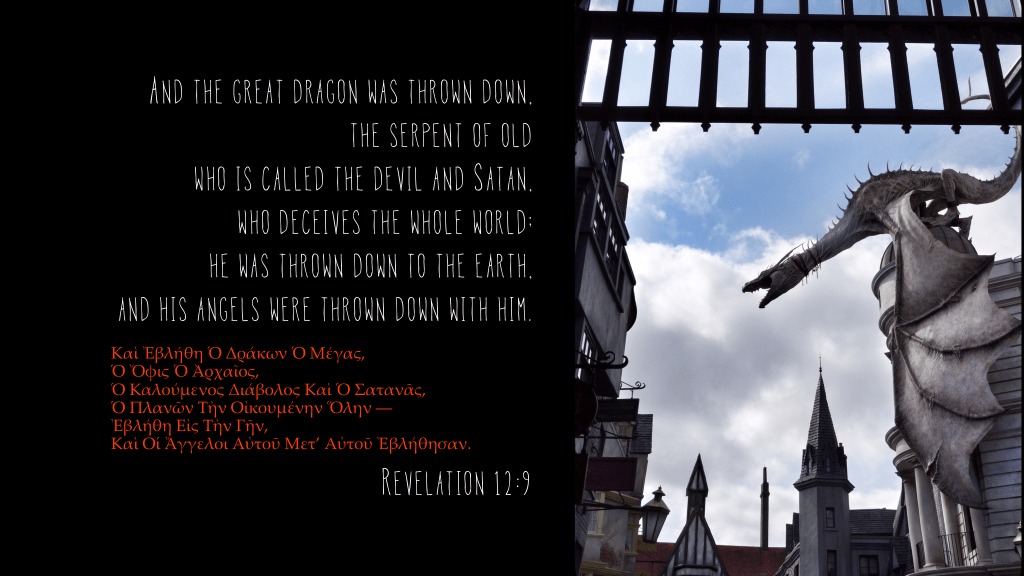
The triune God and the diabolical pseudo-trinity arranged for a deadly duel that put Jesus Christ on a Roman cross. The triune God knew well how his hateful opponents would behave in that situation. But the satanic dragon completely misread God. Had he accurately understood God’s intentions and the consequences of his own actions, the dragon Satan would not have deliberately killed the son of God. But predictably, he did. The dragon was vindictive, self-serving, unprincipled, ambitious, and murderous. The dragon wanted blood.

The dragon’s character hasn’t changed. He is still pure evil. He is still self-serving, unprincipled, and ambitious. He still wants blood — our blood. But we can use his malice against him, through truth-telling and self-sacrifice. When we testify to the truth and practice self-denial, he predictably over-reacts. When he can, he lashes out. He tempts himself to violence. He cannot help himself. It’s his corrupted nature. He wants blood. But ironically, God works it to our advantage. God turns it to redemption. Like Christ before us, we overcome the adversary, even when is able to attack us.   

The last temptation of Christ was actually not a temptation but a double determination. Christ Jesus himself was “tempted” to embrace death, or rather, was determined to embrace death in love — to die for our sake. And God “tempted” the dragon, or rather, determined that the dragon would be allowed to tempt himself and slay the Lamb of God.  And so Christ Jesus died violently, a sacrifice for sin. God foresaw and foreordained that Christ’s death would be the sacrificial undoing of our sin and of diabolical, malicious evil. And in that determination, God was doubly-successful. In death, then, Hamilton and Christ have some remarkable commonalities; but unlike long-gone Hamilton, Christ is no longer dead. It’s encouraging to know that Hamilton professed faith in Christ before he passed.  

Skyscrapers

Friday, May 15th, 2020

An Aerial View of Manhattan
Skyscrapers, Audio Version

Does New York City have anything to do with the Book of Revelation?

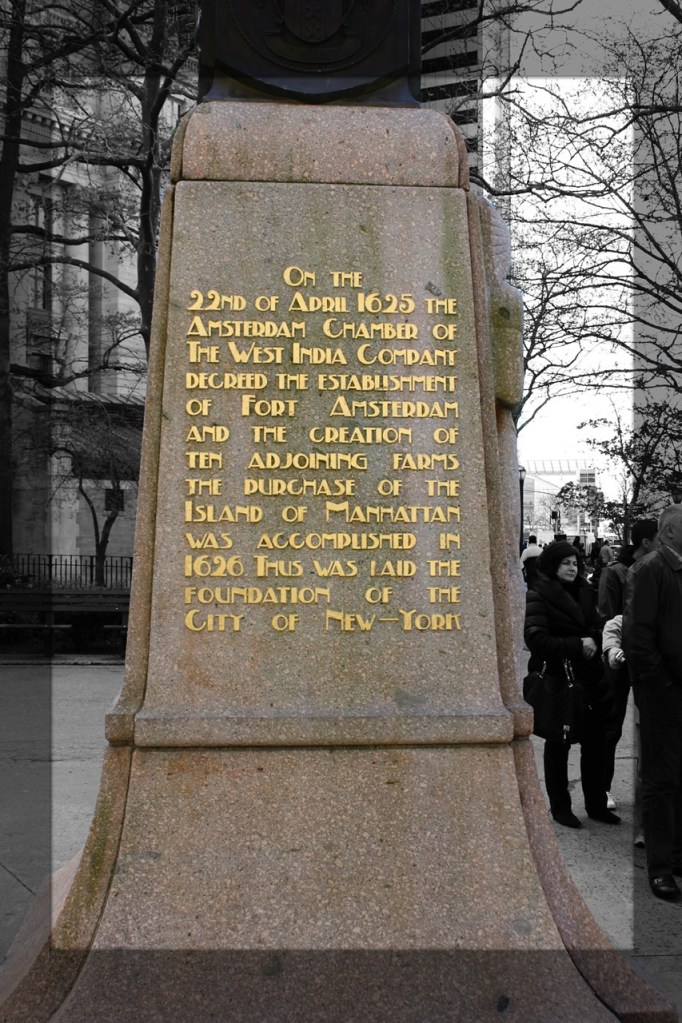
New York City was originally named New Amsterdam. Manhattan Island, now the iconic sky-scraping heart of the city, was largely an unpopulated forest when it was purchased on May 24th, 1626. It was bought with some bartered seventeenth-century trade goods. The buyers were Dutch traders; the seller was Seyseys, chief of the Canarsee Amerindian Tribe. At that time, the Dutch estimated the value of their trade deal to be about sixty guilders. In economic terms, it’s possible a lopsided deal was struck. A novice realtor, Seyseys might have miscalculated a bit. He slightly underestimated the value of the rocky, then-forested island. Like many traders after him, Seyseys misjudged the net worth of his Manhattan holdings, and may have gotten ripped off.

In retrospect, many historical commentators have expressed amazement at the economic exploitation inherent in that initial trade. The urbanization of Manhattan Island was made possible by a massively disproportional deal. In that initial transatlantic deal, one trading partner exploited the naïveté of the other, because, well, they could. It was an intercultural economic injustice. 

In spite of their trading savvy, though, the Dutch were not able to keep control of Manhattan very long. Sovereignty over the island went back and forth between two imperial rivals, between Dutch and British authorities for several decades, until control was formally ceded to the British in November, 1674. All the while, construction projects on Manhattan Island and its surrounding environs proliferated as the European immigrant population grew. Geographically ideal as a port of trade, the British deemed the entire area a crucial imperial holding, and renamed it New York City. That name has stuck, in spite of another change of sovereignty and flag after the American revolution. As names go, though, another might fit the city even better — a much older name.

The Tower of Babel?

Nearly four hundred years have passed since the Dutch bartered their purchase of Manhattan. Over those four centuries, Manhattan caught and surpassed other world-class cities to claim the title of the world’s most important commercial center. That New York City both is in fact a global trade center and has a sky-scraping tower called the World Trade Center may matter much, by Revelation’s Reckoning. At the time the Book of Revelation was written and first heard, the de facto world trade center was indisputably the imperial capital city, that is, Rome. All roads led to Rome, by design. The wealth of the developed world was carried by soldiers, merchants, and slaves as tribute to Rome. Rome controlled the commerce of the entire Mediterranean World, and even beyond. Everywhere else was uncivilized hinterland, as far as the Romans were concerned. And if they could, they would take it someday, civilize it, and exploit it. 

However, in spite of its prominence, the name that the Book of Revelation uses for Rome is not Rome. Instead, Revelation refers to Rome with a code name. In Revelation, the code name for Rome is Babylon. And why does Revelation refer to Rome as Babylon? Rome is called Babylon because of how similarly Rome and Babylon behaved. In its monuments, conquests, and exploits, the Roman Empire resembled the earlier Babylonian Empire. Rome also recapitulated the worst of Babylon, especially in sieging Jerusalem and destroying God’s temple that stood there. 

Somehow though, Babylon reappears in the last days as a villainous vixen. While Babylon is repeatedly called “the Great City” in the Book of Revelation, it is also likened figuratively to a woman. The Romans depicted Roma as a female figure, resembling the Statue of Liberty. But in Revelation, Lady Babylon is always an exploitive seductress. She’s a woman of ill-repute, a harlot. And she lures the naïve until the end, until Christ’s appearance, the Parousia. Then Babylon is dealt her sudden and violent destruction. 

Lady Liberty

Is New York City a latter-day Babylon? In some ways, New York City fits Revelation’s description. The final great city Babylon is portrayed as exceedingly wealthy, as a massive maritime metropolis. But Babylon is even bigger than the Big Apple. Babylon represents a corrupt economic system and an entire commercial network of cities — a money-worshiping, laborer-exploiting, violence-dependent syndicate. Her/their ruin is sudden and fearsome. See Revelation 18:1-24. 

Do we need to be afraid? No and yes. It depends on your holdings. What is your source of security? In the end, the inhabitants of the whole world will experience unprecedented catastrophe and loss, not just those of one city. Money and assets won’t matter, at all. But God’s elect are assured that He is mighty to save, even while the foundations crumble. Cling to the security that only Christ can give. Everything else is destined to fall.

Unexpected Turbulence

Wednesday, May 13th, 2020

Clouds Below, What’s Ahead?
Unexpected Turbulence, Audio Version

Back in the day, in the old pre-flight advisory safety announcements, an airline spokesperson (usually a bored stewardess rehashing a memorized script, intercom in hand) would advise passengers to please wear their seatbelts “in case of unexpected turbulence.” I would often tighten my seatbelt a bit at that point. Unexpected turbulence might occur. I had been told. Have my readers/listeners noticed that the phrase “unexpected turbulence” has been replaced with the words “rough air”? Personally, I prefer the original phrase — unexpected turbulence to rough air. Ruff hair. I’m having a ruff hair day.   

Speaking of which, years ago I worked with a man named Rob. His name, I have tweaked. Rob’s job required that he travel from city to city across a large country in Asia. To traverse the long distances involved, Rob had the option of traveling by train or by plane. To save himself time, Rob would choose to fly, when possible. Rob thus became a frequent flyer, flying frequently over and across a very large country in Asia, one that shall go unspecified. But if you would like to know which one, imagine how someone from Boston might say the word diner. The country rhymes with that. People from Boston often drop the letter r.  

One of Rob’s flights (in the country that kinda rhymes with diner) suddenly got very, very violently bumpy. Without much, if any, warning, the plane flew into some incredibly rough air. Unexpected turbulence… it occurred. Many people on board the flight were not wearing their seatbelts. Human pinball — that’s the description I believe Rob used. People were thrown around the inside of the airplane. People were bouncing off the ceiling of the plane. People got seriously hurt. Rob, however, did have his seatbelt on, probably because he was used to hearing the same old boring, rehashed precautionary announcement. Rob was not hurt, just shaken. By virtue of listening to the same message repeatedly, Rob had been habituated into safety, into wearing his seatbelt. 

To repeat, he had heard the same precautionary announcement, over and over, ad nauseam. He had been habituated, even tediously so, into proper practice. Therefore, when unexpected turbulence came, he was ready, without even knowing it. In the moment it mattered most, he was ready. Although he was very alarmed, he was unharmed, unlike many of his fellow passengers. 

Regarding the very perilous period before his second coming, Jesus emphasized to his listeners the importance of informed readiness: “See, I have told you beforehand.” If you want to know the context of his statement, go read Matthew 24:25 and the surrounding verses. Here’s the same precautionary statement, translated a bit differently: “Behold, I have told you in advance.”

Be Vigilant

We have been told in advance. Expect unexpected turbulence. Be prepared. Be ready. It will come when you’re not expecting it. He will come when we’re not expecting him. All of which is alarming to hear, and ought to prompt some questions, such as: How do I expect the unexpected? How can I be prepared? How can I get ready? How can I protect others around me? What should I do?

Here, let me help you tighten your seat belt. First, you should read the safety instructions provided. They’re easily within reach. All you need to do is take the time to read them. Also, listen to the flight attendants, even if they are boring and mumbling their way through the same old message. They went through extensive training on this — at least they should have. Plus, you usually can tell if they know what they’re talking about. Above all, pay attention to the pilot. He knows what’s going on. He knows what’s up ahead, even when we don’t. You can even call upon him. Unlike a lot of other pilots, he’s truly the very best. And he’s quite willing to hear you and respond to you.

Just so you know, I do have some training as a flight attendant. I cannot see what’s ahead like the pilot can; but I will tell you — from experience and from what I’ve learned — that it feels like we’re already hitting some rough air, some turbulence. It could get worse. I hope I’m wrong. But I think you ought to know. Buckle up, just to be safe.    

Oh, and keep a wary eye on the leader of the country that kinda rhymes with diner. He is behaving a lot like Decius did. See my previous post if this confuses you.

The Mark

Monday, May 11th, 2020

The Mark of the Beast
The Mark, Audio Version

In January 250AD the newly-proclaimed Emperor Decius issued a do-or-die decree, an urgent edict. Decius decreed that everyone in the empire must make a patriotic public offering. Each and every inhabitant of the empire was required to appear in person before a local magistrate in order to make an offering to the gods, for the new emperor. The wording of the edict really matters here: the offering was to be made to the officially recognized gods, for the emperor. Anyone who refused to make the required offering could face the consequence of torture and execution. Only Jews were exempted from the edict, not Christians.

This posed a real dilemma for the empire’s Christians. To comply with an order to pray to their own God for the emperor — that they could do. To appear before a local magistrate and offer their patriotic service or support or money — that they probably could do. But to make a public offering to the pantheon of traditional gods — no, they could not do that, at least not in good conscience. It was a clear violation of a sacred command. God alone was to be worshiped. The emperor’s decree and God’s command were thus irreconcilable. They could obey the emperor or they could obey God; but they could not obey both in this. Christ is Lord, not Caesar, not Emperor Decius, nor his pantheon of officially-sanctioned gods. 

Was Decius Foretold? See Revelation 17:10-11.

Nonetheless, for fear of severe punishment and loss, some Christians reluctantly complied with Decius’s decree. They capitulated and made the required offering. Others, though, held fast to their convictions and refused to make the offering, knowing they were likely to be subjected to torture and execution. And many of them were indeed tortured and martyred, including Fabian, the Bishop of Rome. 

By Revelation’s reckoning, anyone who did comply with the edict thereby took the mark of the beast. Even if they made the offering reluctantly, they yielded to an early version, or prototype, of the mark of the beast. Was it forgivable? Probably so, at least back then. It might not be in the future.

Do recognize that my last paragraph makes a couple of very strong claims. To some of my readers, they may seem completely wrong, or at least too sweeping. How is making a coerced pagan sacrifice equal to taking the mark of the beast? That is a good question, and worth pursuing.

Those who made the sacrifice for the Emperor Decius were given an official certificate called a libellus. Copies of such certificates have survived through the centuries. Those who made the sacrifices would have kept their certificates on hand. They would not have literally kept the certificates strapped to one of their hands. But they would have kept the certificates with them, as a means of ready self-protection against accusation. They kept official certificates that notarized their participation in a pagan ritual where? They kept them on hand, in case they needed them.

Now, fast forward many centuries to the Third Reich and the Nazis. How were Germans taught to show their loyalty to their Führer? With their extended right hand. To avoid any suspicion and to show expected allegiance, they need only raise their right hand in salute of their leader and say two words. Was their salute actually the mark of the beast? Well, it leaned in that direction. It was not necessarily the mark of the beast for everyone who ever did it, because it did not require a deliberate choice against Christ. However, if someone did make a deliberate choice against Christ, such a salute might constitute something akin to the mark of the beast.

From my reading of the Book of Revelation and history, I submit that the ultimate mark of the beast is to be conveyed in a public ceremony, rite, ordeal, or trial. It indicates to all that the recipient has consciously and deliberately repudiated Christ and given his or her allegiance to another master — even if that decision is coerced and made in duress. The mark thus functions as an anti-baptism. It might involve a literal, physical brand or distinguishing mark of some sort, but not necessarily. Whatever form it takes, it is to be avoided absolutely, even if that means enduring a painful death. We see precursors of it now, whenever someone must officially repudiate faith in Christ in order to get ahead, stay afloat, or save their skin. Yes, the prospect of being in such a do-or-die situation is a scary thought. But Christians are called to count the cost, and stay faithful, even unto death.

Time & Again

Friday, May 8th, 2020

Time & Again, Audio Version

What comes to mind when you hear these two questions? If you thought of the worn patience of a child on a long journey, that’s what I intended. When I was young, I used to pester my poor parents with these questions on long road trips. They would assure me — time and again — that they would let me know when we were near our destination. After a while, though, I would resume asking the same questions. Sometimes it is hard for a child to just sit and wait, especially in the midst of uncertainty. That might be true for some adults, too. 

“Are we almost there? When will we get there?”

These two questions are also on the mind of most of us as we read the Book of Revelation, and with good reason. Right up front, Revelation itself gives us ample reason to wonder when. The audience of Revelation is told they can expect a blessing if they listen and keep the words written therein. That’s what Revelation 1:3 says. The same verse then concludes with time-sensitive watch words: for the time is near. Thus the when? question appears at the very beginning of the book. We’re supposed to be asking it.

Someone might be tempted to cynicism here. The Book of Revelation was written almost two millennia ago. Nearly two thousand years ago, Revelation claimed that the time was near. Presumably, the original recipients of the Apocalypse believed that Jesus Christ would appear soon. He would be arriving for them anytime. “Sometime soon Jesus will come for us.” That’s the idea; right? That claim seems rather ridiculous now. It seems like a farce after two thousand years of waiting. How can it be taken with any seriousness?  

It is indeed an important question. It even has its own technical terminology. In seminary-speak, it is called the delay of the parousia. The word parousia means appearance — the appearance of Christ, that is. But simply injecting a bit of academic terminology here is not particularly helpful. Just to identify it with some jargon does not resolve the inherent problem. Why hasn’t Jesus appeared after two thousand years, especially when Revelation says “the time is near”? Why the long delay? Many people reject the reliability not only of Revelation but the entire New Testament on this very point. John and even Jesus were wrong, they say.

Allow me to push back against the cynicism, if I may. The Book of Revelation actually anticipates the delay of Christ’s appearance. It does. I’ll show you exactly where it does in a few sentences. This same delay is also anticipated elsewhere in the New Testament.  

The delay of the parousia can be identified as the entirety of chapter seven… period. An explanation is in order here. Through chapters five and six, we see Christ, the Lion/Lamb, breaking open six of seven document seals. As each of the document seals is broken open, one peculiarity after another is unleashed. The sixth seal depicts human horror at the disintegration of the cosmos and the apparent end of the world. It seems like THE END, except at the very end, it’s not. Surprise! We’re not there yet. The hammer never falls. The climax never comes. Instead, chapter seven comes. Behold, the delay of the parousia, per the Book of Revelation.  

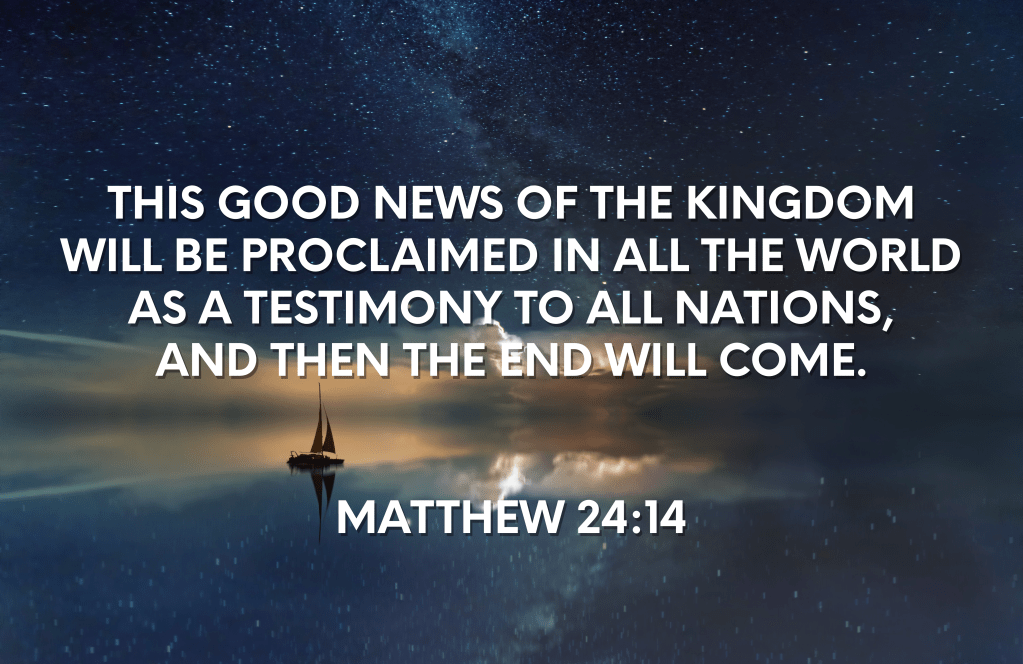
Rather than THE END, the Book of Revelation presents something previously unanticipated: the purpose and mission of the Church. This begins at chapter seven. Christ’s appearance is postponed until the mission of the Church is accomplished. The Book of Revelation shows all this, symbolically.

Since I constrain myself to a word limit in these blog posts, I will have to hit pause for now, just like the Book of Revelation does at the end of chapter six. I am well aware that I am leaving a lot of questions hanging unanswered and a lot of material unexplained. Stay tuned, please. We’re not there yet, but we’re almost there. The time is near; even if it is not here quite yet.

Two Tables & An Ear

Wednesday, May 6th, 2020

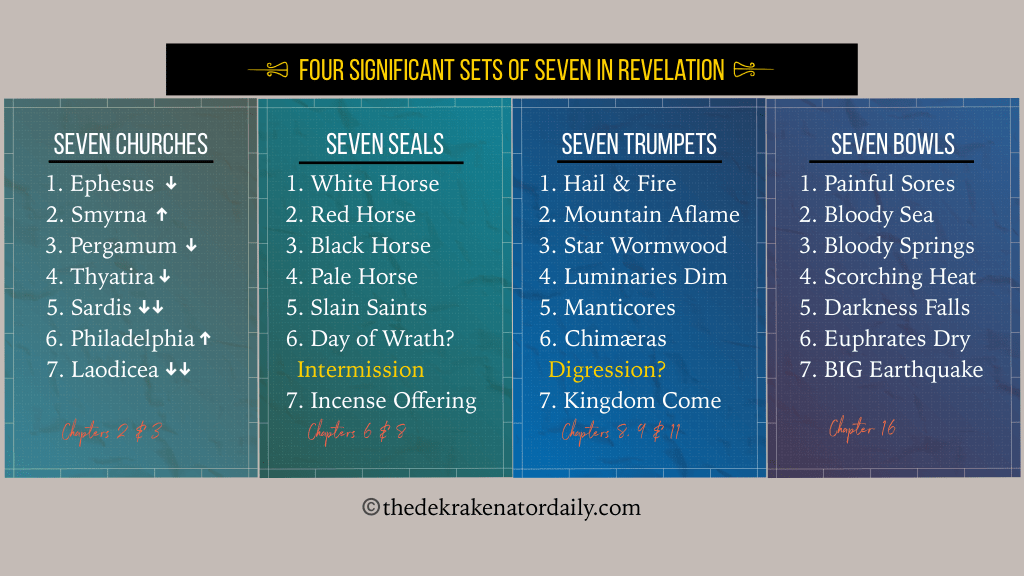
Percentage-wise, most of the Book of Revelation focuses on four series of seven topics. In narrative order, the four series are 1) the Apostolic Epistles to the Seven Municipal Churches in the Greek-speaking Roman province of Asia, 2) the Seven Document Seals, as they are progressively broken open by Jesus Christ, the Lion/Lamb, 3) the Seven Clarion Trumpets, and the very bizarre symbolic, yet historic events that occur as those trumpets are sounded, and finally 4) the Seven Bowls of Absolute, Catastrophic Wrath.

In future posts, I hope as best I can to explain the two middle series, the Seven Document Seals and the Seven Clarion Trumpets. Just to prepare my readers, I should say that interpreters of the Book of Revelation vary widely and wildly in how they explain these two sections. Even the most esteemed biblical scholars seem to have trouble making sense of these sections. But I’m going to try anyway. And be forewarned: I am willing to explore some ideas you have probably never encountered before. When I do, I will try to inform you of what I am doing interpretively, and why I am doing it.

The two tables I have included in this post give a big picture overview of some of the narrative topics and polarities in the Book of Revelation. Readers familiar with the book will likely understand much of what I present in the tables, but not all. I hope the material you don’t understand will bring you back to read future posts.

That’s all for today.

Come & Die

Monday, May 4th, 2020

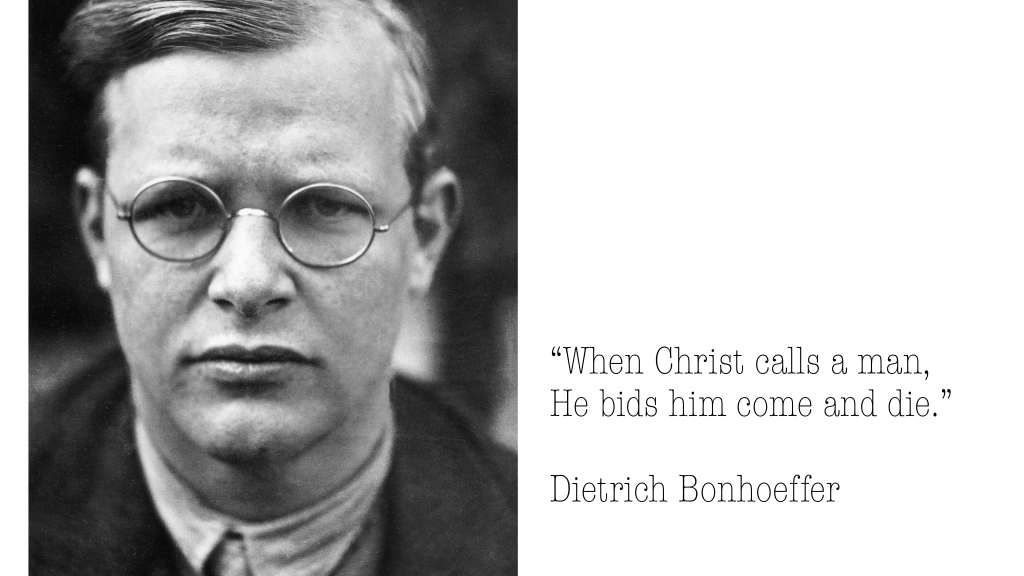
Quotation from The Cost of Discipleship
Come & Die, Audio Version

It almost goes without saying that this call to come and die is not gender specific; it also applies to women. When Christ calls anyone, he calls that person to come and die. This statement, however harsh, is true and worthy of full acceptance. If you do call yourself a Christian, you have received and accepted a friendly invitation to follow Jesus, and with that, a summons to come and die. If you have even the slightest lingering doubt about that claim, go read what Jesus says in the Gospel of Mark 8:34-38. Jesus there issues the call to each of his listeners to deny themselves and take up their respective crosses. That was how Jesus issued his invitation, his altar call. It was and is a clear call — a chillingly clear call to come and die.   

How, then, are we supposed to die? What does it mean for you and for me to deny ourselves and take up our respective crosses? That’s a good question. Yes, it could mean physical death.

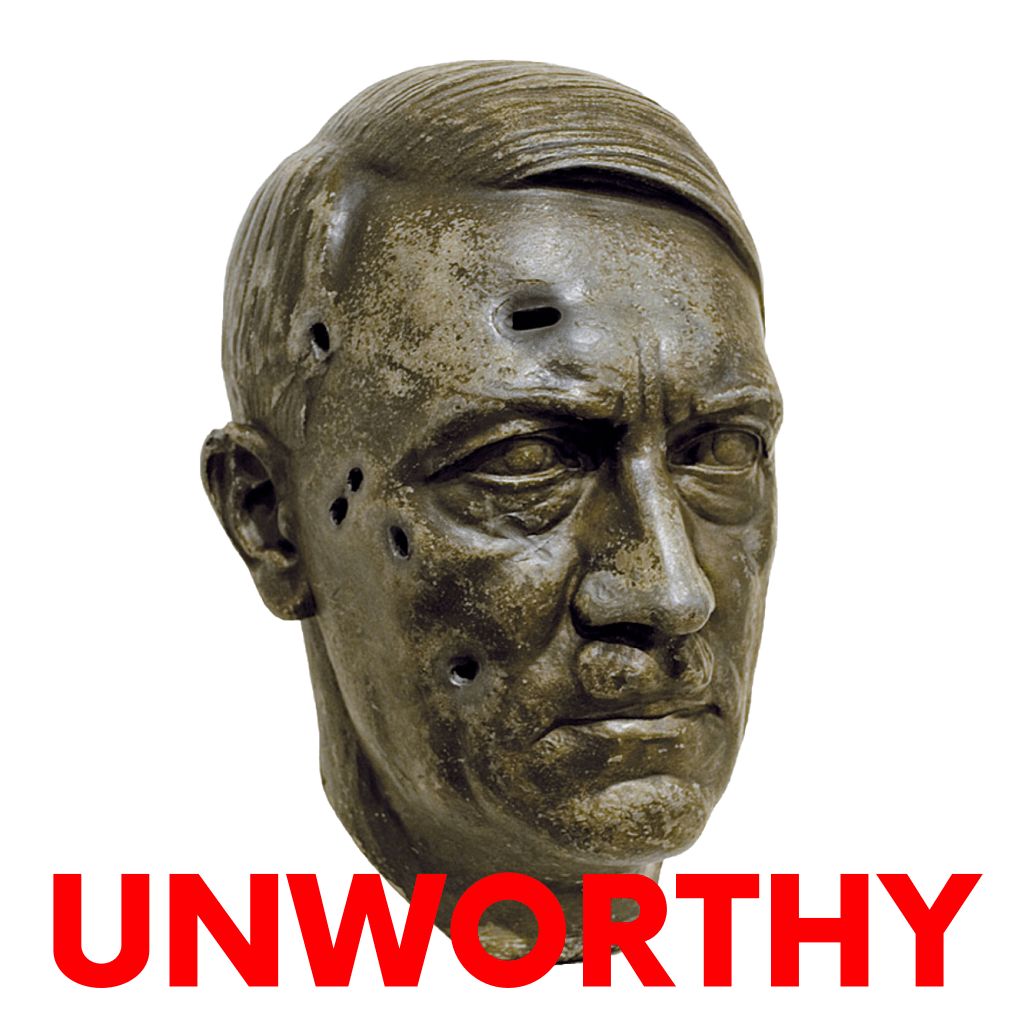
Pew-sitting Christians are likely to have heard biographical snippets about Dietrich Bonhoeffer. Bonhoeffer was a 20th Century German theologian — a theologian who ranks as a top-tier favorite of pastors and preachers, and deservedly so. Indeed, Bonhoeffer is doubly-deserving of honor. Not only did he pen the devotional classic The Cost of Discipleship, Bonhoeffer also died at the hands of the Nazis in the final days of the Third Reich. Many consider Bonhoeffer a modern-day martyr. I believe it is also fair and accurate to say that Bonhoeffer died precisely because he actively resisted a beastly antichrist. Bonhoeffer courageously resisted and defied Hitler. And Hitler was, by Revelation’s reckoning, a forerunner of the beast, that is, a type of the antichrist. Hitler qualifies as apocalyptic beast and an antichrist because he demanded absolute allegiance and loyalty — the kind of absolute loyalty that only Jesus Christ deserves. Jesus is Lord, not Adolf Hitler. Jesus Christ alone is worthy of our absolute allegiance.

Captured Bust of Hitler, Displayed at Fort Bragg

Bonhoeffer died young. He died on Nazi gallows as a relatively young man. But Bonhoeffer’s words live on. Bonhoeffer’s words have outlived himself and Hitler. And someday Bonhoeffer himself will rise again from the dead. Not only Bonhoeffer, though — someday all martyred Christians will be resurrected in victory to life eternal. I hope you will be in that number. I hope you will be one of those martyrs. If you’re a bit confused by my martyr-speak, please go read my earlier blog post on the meaning of the word martyr. The word martyr originally meant witness

This is all very morbid sounding, and thus somewhat repulsive: death, death, and more death. Jesus calls us each to deny ourselves and die. Jesus himself died young, by execution, upon a cross. Bonhoeffer also died a young martyr, executed by the Nazis. Bonhoeffer wrote a book about Jesus’ call to come and die. “Death, death, and more death — please talk about something else.”

Sorry, but the words of a martyr/witness will inevitably end in death. But they will also impart life. Faithful witnesses to Christ will speak words that result initially in the death of self, the death of ego, but then offer eternal life. As Proverbs 18:21 says, death and life are in the power of the tongue. That’s just a fact. If a martyr/witness conveys the gospel message faithfully, a listener will face a hard choice: to die to self now, or die in sin at the end. Death cannot be skirted. Death is unavoidable, either way. That all said, never forget that the gospel is truly good news, for it comes with the incomparable offer of life abundant and eternal. That is the most important part of the message entrusted to us. The cross comes first, but the victory of resurrection follows. That was the pattern for Christ, and is the pattern for each of us.  

Photo from The Passion of the Christ

Burnt or Fired?

Friday, May 1st, 2020

http://www.metmuseum.org/art/collection/search/466572
Audio Version

In my last blog post, I referenced the sobering obituary in Leviticus 10 of the deviant, errant eldest sons of Aaron, brother Nadab and brother Abihu. They lost not only their priestly jobs but also their mortal lives to an incinerating blast of furious flame. They were very literally fired.

To speak of their fearsome demise as being fired, might sound glib. But I do have a good reason. I am not just playing cute with terminology. My intent is to demonstrate the important difference between the literal use of a word as opposed to the common use of a word. 

For example, if I were to say, “I got fired today” you would very likely understand the word fired in a common, conventional way, and not in a strictly literal way. We know that the phrase to get fired means that one’s employment was abruptly revoked. That is just how the expression to get fired is commonly used. But it is not the literal meaning — not at all. Hopefully, no one got burnt, singed, or scorched in the event. Someone simply lost their job.   

This confusion of the literal and the conventional can become a problem for us when we read texts in translation, like the Bible. Our tendency is to lean too much on the literal meaning of a word. Unsurprisingly, we want to read things literally. It is seemingly the most straightforward and simple approach. But it is not necessarily the best approach. Sometimes a word is better understood through common convention or specialized use. We need to find out how that word was commonly used or how it might have been understood in a special context.

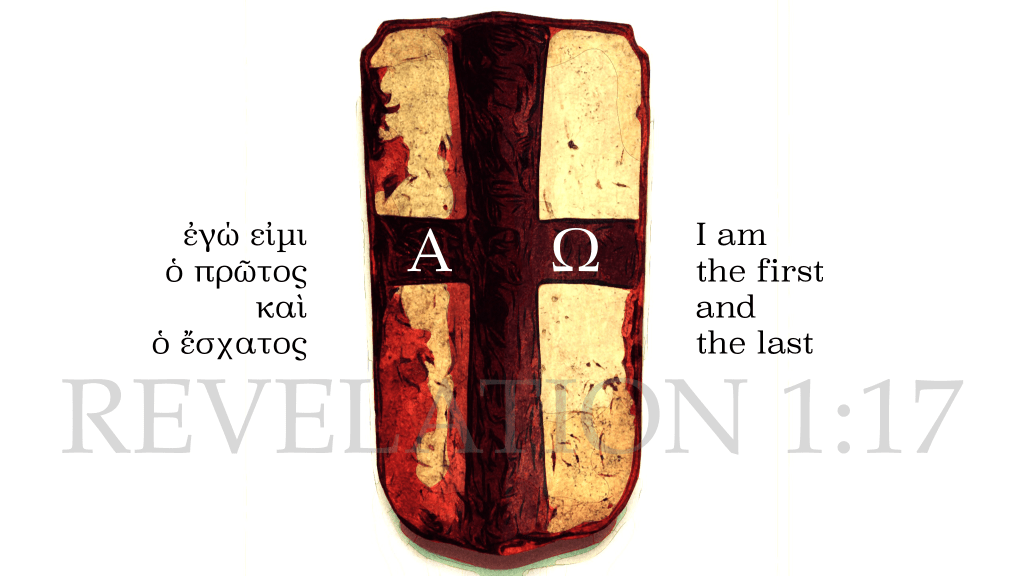
For example, in the Book of Revelation Jesus is spoken of in many different ways. He is called Jesus Christ. He is called the Alpha and the Omega. He is called One Like a Son of Man. He is called the Faithful Witness. He is called the Son of God. He is called the Holy One, the True One. He is called the Lion of the Tribe of Judah. He is called the Root of David. He is called the Lamb. He is called the Word of God. He is called King of Kings and Lord of Lords. He is called the Bright Morning Star. He is called all of these names and titles, and quite a few more.

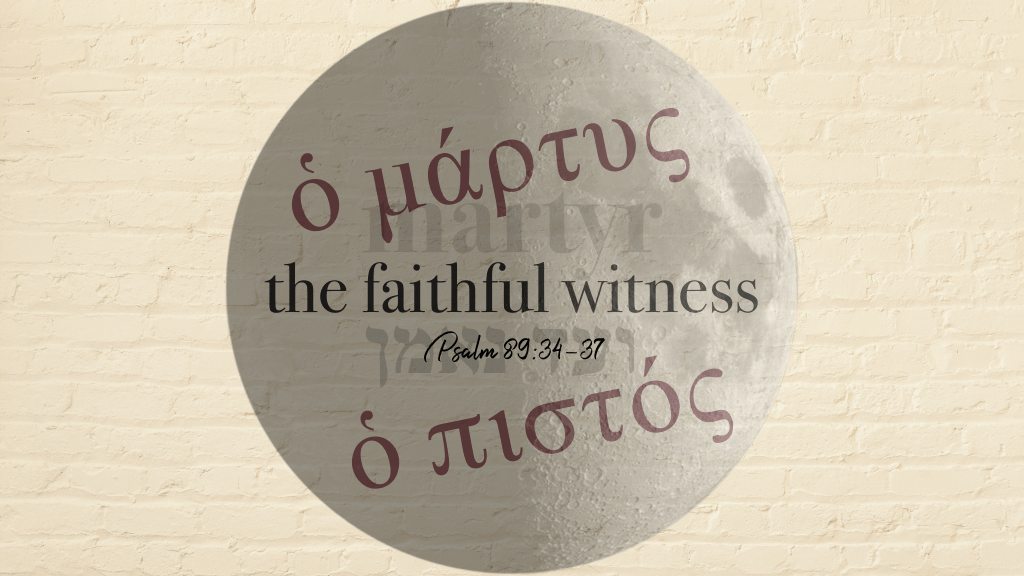
Some of these names and titles for Jesus are literal. He is literally the Son of God. He is literally the Faithful Witness. But some of the names given to Jesus in the Book of Revelation cannot possibly be literal. Jesus is not literally a lamb. Jesus is not literally two Greek letters. He is not literally a lion. He is not literally a star. We should acknowledge the difference. And we should try to understand these non-literal names and titles within their historical and literary context, and by virtue of their common, conventional use by Christian churches way back in the first century.

Rather than think of the Book of Revelation in strict literal or non-literal terms, it is much more helpful to think of the book in historical and contextual terms. We should ask questions like: How would first-century Christians in the Roman province of Asia have heard and understood this? What would have been their common understanding of this word, this sentence, this symbol, this image, or this reference? 

We should also pursue answers to questions like: What exactly is being referenced here? Is there a historical reference here? Is there a scriptural reference here? That last question is especially important, since subtle scriptural references appear in almost every verse of Revelation. That’s no exaggeration. 

In conclusion, we cannot read Revelation in strictly literal terms. It has too much symbolism. And it contains far too many subtle references. But sometimes Revelation does have literal elements. Since every reader is an interpreter, every reader must try to discern when the book is presenting literal material and when it is not. Revelation itself will often provide telltale clues. Always try to discern whether what you are reading is symbolic, literal, or a blend of the two. 

Terminated and Fired

Thursday, March 18, 2021

Terminated and Fired – Audio Version
Illustration from The Bible Project, The Book of Leviticus

What did Nadab and Abihu do wrong? 

Aaron’s eldest sons Nadab and Abihu served in the tabernacle as duly ordained, incense-offering priests, just like their father. But one day Nadab and Abihu took a bad turn. They became priests gone bad. They offered something strange to the LORD.

It is not entirely clear in Leviticus Chapter Ten what Nadab and Abihu did wrong with their offering. But Nadab and Abihu did do something wrong. Whatever they did wrong must have been pretty bad. It was bad enough to result in their immediate termination. They got fired. 

We know from the incident report that Nadab and Abihu’s dereliction got them summarily fired. They had not followed proper procedure. They had not adhered to clearly stated guidelines. Consequently, they were terminated. They lost their jobs. They were no longer priests.

We know from the same incident report that Nadab and Abihu got fired — fired in the most literal way imaginable. They lost their lives. They lost their lives in a hot, searing blast of flaming, consuming fire. They were burnt alive. They were burnt to death, incinerated. 

So fire came out from the presence of the LORD and consumed them; and they died before the LORD.

Leviticus 10:2

Thus Nadab and Abihu were terminated. They were executed. They were literally fired, incinerated.

The whole point of this account is to instill respect — no, something more than mere respect. Try fear. Be afraid. Be very afraid. Do not play games with the Holy One of Israel. Do not mess around with the LORD, for our God is a consuming fire (per Hebrews 12:29).

Someone may protest that this is just an Old Testament account. Everything has changed. Everything is different now. We’ve gone from B.C. to A.D. God does not behave this way anymore. God’s hot wrath has been entirely appeased. As a result of the beautiful and yet gruesome cross of Christ, the LORD has been placated and pacified, once and for all; right? 

Well, yes and no. Yes, the crucifixion of Christ does completely satisfy God’s holy, burning anger against our sin. God’s anger has been dealt with, once and for all. Through Christ’s self-sacrifice on our behalf, God’s burning wrath has been appeased. The big seminary word for that is propitiation. God has been propitiated. And it’s true. And it’s wonderful. It’s why we say that the cross of Christ is not just gruesome, but also beautiful. We can rejoice in that. 

Ultimately, Mercy Triumphs Over Judgment.

And yet the Holy One of Israel is still holy; and Holiness means He is hostile to sin. That has not changed. Sometimes we are too quick to forget that God still hates sin. No, that’s not too strong a statement. God hates sin. God abhors sin. God detests sin — even A.D., even now, regardless of what some may say. 

A conspicuous counterpart to the Old Testament’s account of Nadab and Abihu is the New Testament’s account of that duplicitous husband and wife duo, Ananias and Sapphira. Their rather scary incident report can be found in Acts 5:1-11. Just as Nadab and Abihu had displeased the LORD by means of what they were offering, so Ananias and Sapphira displeased the LORD with their dishonest offering. And just like Nadab and Abihu before them, Ananias and Sapphira promptly wound up dead and deceased. God punished them severely. God pulled the plug on them. Their deaths were meant to serve as an example to their contemporaries and to us. Do not play games with the Holy One of Israel. Do not mess around with the LORD. God can still play tough, as we shall see in forthcoming blog posts about the Book of Revelation.  

Great fear seized the whole church and all who heard about these events.

Acts 5:11

Fire

Monday, April 27th, 2020

Audio Version

When Moses met God, what does the Book of Exodus say happened? What did Moses see? Moses saw a bush aflame, yet not consumed. Why did God reveal himself to Moses from fire or perhaps even as fire? Why does God appear in the midst of fire again and again in Exodus? Does fire have specific scriptural symbolic significance?    

I would like to suggest here that fire is indeed an important scriptural symbol. Fire does have symbolic significance, beginning in Exodus, if not before. And fire continues to have the same symbolic significance through the whole Bible. Somewhat cryptically, Hebrews 12:29 says, “Our God is a consuming fire.” What does that mean? How is God a consuming fire? 

We need to understand that fire signifies something. Fire is a symbol.

So what does fire signify in scripture? What does it symbolize? Some say that fire signifies or symbolizes judgment. Granted, to see judgment makes a lot of sense. Fire often implies God’s wrath and thus judgment. But in scripture fire does not always imply judgment and wrath. For example, consider the burning bush encounter. Through most of the passage the LORD appears in the fire, yet does not initially evince anger — not until Moses repeatedly attempts to refuse the LORD’s commission. Then yes, the passage says that LORD’s anger burned against Moses (see Exodus 4:14). At the very beginning of the burning bush encounter, though, God calls attention to another of his characteristics. A divine attribute is specifically brought to the fore and emphasized. In Exodus 3:5 Moses is told to take off his sandals for a reason. Moses is standing on holy ground.   

Here’s my suggestion: How about seeing fire as holiness, instead? Maybe holiness is a better fit. Judgment is not out and out wrong. It’s just not broad enough. In scripture, holiness is what is signified by fire. I’ll say it again, and for the record: Holiness is what is signified by fire.

Why does it matter? It matters because it will help you understand how the symbolism is used throughout the Bible and in the Book of Revelation. When you hear or read fire in Revelation, think in terms of holiness. It will help. It will help you make sense of what you read.

Another thing comes to mind. If you’re willing to consider the possibility that fire does symbolize holiness, then go back and ponder what you already know about fire. 

Fire is terrifyingly destructive. It can completely consume. It hurts. It even kills. It is incredibly dangerous. It needs to be approached with deliberate forethought and great care. 

But, if approached properly and handled correctly, fire is hugely and positively transformative. Fire means heat. It can heat ovens, rooms, houses, cities. It can also purify and purge. It can empower. It can transform. It can be exchanged and transferred without loss, over and over and over. It gives off light. It’s easily one of humanity’s most important tools. Civilization depends on fire. 

And fire is also intrinsically fascinating. It is beautiful to behold, thus the allure of campfires. And it is mysterious, even paradoxical. What even is it? Thinkers have asked that for aeons.

Given all these qualities of fire, we return to scripture. In scripture God intentionally and often associates himself with fire. It’s an important symbol, a symbol he chooses for himself. Our God is a consuming fire, which is another way of saying God is holy. We are wise to treat him accordingly. And as we read through Revelation, keep that symbolism in mind. It will help.

For further study, read this brief but terrifying account.


P.S. The Bible Project video on the theme of holiness is really good: https://bibleproject.com/explore/holiness/