If We Disown Him

Thursday, February 25, 2021

If We Disown Him – Audio Version

Can someone cease to be a Christian? 

“Obviously yes. Next question.”

But wait a second: The answer is not an easy and obvious “yes” for someone who takes the Bible seriously. 

Recently, I spoke with a friend of mine about this question, which has ceased to be merely hypothetical and become more immediate. Someone near and dear to him publicly claims to be a believing Christian, but privately fails to behave like one. In essence my friend asked, “Does hypocrisy and moral inconsistency ever disqualify someone from the Christian faith?”

The question of potential disqualification vexes Christians like my friend (and, to a degree, me). If moral inconsistency and blatant hypocrisy do disqualify someone from the Christian Faith, can anyone ever actually remain qualified? Most Christians will readily admit to a degree of inconsistency, and will acknowledge moments of shameful hypocrisy. We call it sin (or, if not, know that we should). And we are supposed to confess sin as such whenever we know we have committed it. 

But can someone simply go too far? Is there a time (or are there times) when someone is no longer a genuine Christian because he or she has sinned too egregiously, or has been too inconsistent for too long? These are important issues, and can be urgent existential questions for those who take their Christian faith seriously. For now, I will restrain myself from launching into ready examples and real-life case studies. Instead, I just want to push the disqualification question to the forefront. It is a question that worries a lot of people, so it requires a good, thoughtful, biblical answer.   

A closely related question is whether a genuine Christian can ever actually abandon the Faith. Can someone become an actual apostate, an ex-Christian? Sadly, on occasion, this is not hypothetical. Sometimes individuals will openly renounce once-held faith in Christ. Sometimes ex-Christians become vocal opponents of Christianity. I once met a woman who was matter-of-fact and outspoken about her status as a former Christian. She did not seem to care that her Christian relatives and friends found her claim extremely worrisome. She had been persuaded to be contrary to Christianity. She was no longer a Believer. To use once-common Christian vernacular, she has lapsed. Yet she was certain that her lapse was more than just a temporary lapse: Hers was a permanent determination and identification. She has voluntarily denied Christ. She is an apostate.

But wait a second, because as a Bible-believing Christian this is disturbing and disorienting: Even a potential lapse from sincere Christian faith seems to contradict some scriptural assurances and promises regarding the unlikelihood thereof or even its impossibility. At the very least, such a scenario does not easily square with statements that Jesus once made about his metaphorical sheep being entirely un-snatch-able (see John 10:28).     

So which is it? Can someone cease to be a Christian or not? Is apostasy a real possibility? 

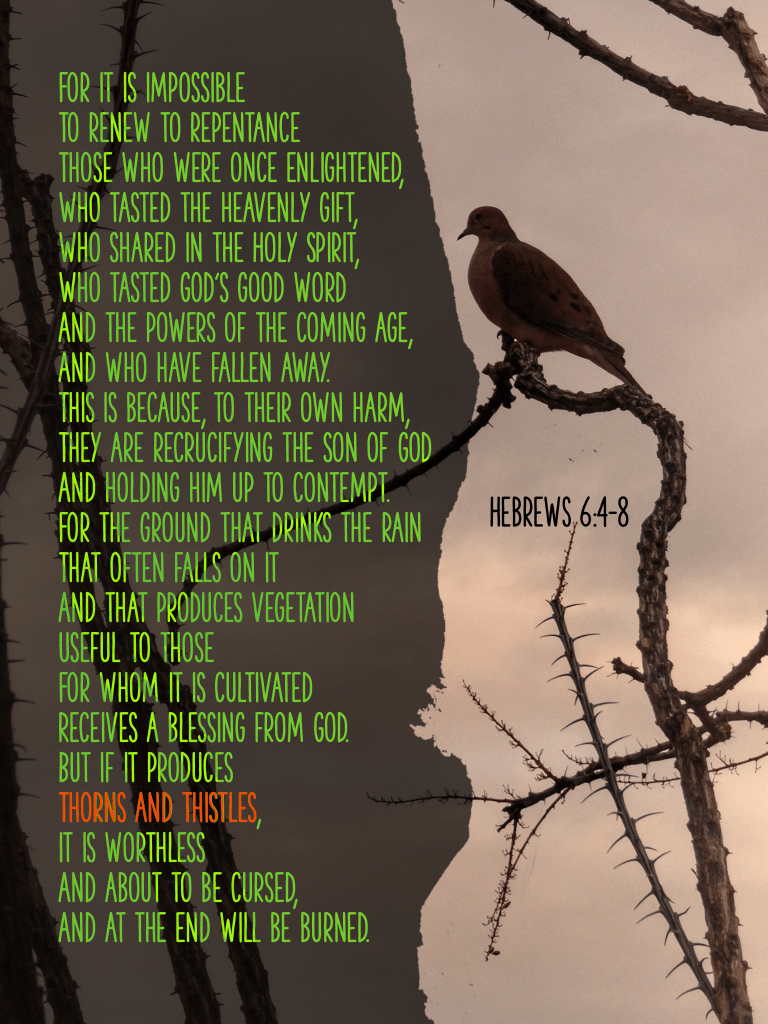
To make things quicker and easier for my listeners, I am going to fast-forward and skip directly to my theological conclusion here in this paragraph. In classic term-paper style, I am going to state my thesis first, and then give my supporting evidence. But I hesitate. I wonder if I would actually do better to lay out the Scriptural evidence and only thereafter state my conclusion. Hesitation aside, I will argue that the preponderance of relevant Scriptural passages — including some very clear and sharp commands — insist on the continued need for diligent, vigilant, faithful perseverance. That one observation pushes me to the conclusion that it must be possible for some individuals to disobey (through unbelief and persistent sin) to the point of their own damnation. The command to persevere negatively implies that someone might actively choose not to persevere. Although I believe it is quite rare, a person can indeed lapse completely from the Christian Faith, particularly if and when that someone is wholly determined to reject Christ and walk away. Should such a determined lapse occur, it is more than a mere temporary lapse; it is a final, irreversible defection. It is apostasy. According to one especially relevant passage (Hebrews 6:4-8), the apostate defector is thereafter beyond any hope of spiritual recovery. In such a case, the breach cannot and must not be attributed to God. God was faithful to both the defector and to His promises until the final terrible breach of faith occurred. But this is an absolute worst-case scenario. I suspect that God is much more likely to bring someone to an untimely, premature death than to allow such an utterly horrifying occurrence (see 1 Corinthians 11:27-31, which speaks of Christians getting sick and dying because they do not judge themselves properly). Yet we must not claim that no one ever truly goes apostate, because Scripture does allow for it as an open possibility. Again, see Hebrews 6:4-8, in particular.  
However, I need to stress that in most cases of sinful self-justification and moral inconsistency, God patiently works to bring the carnal, back-slidden Christian back to Himself. The inward-dwelling Holy Spirit, although grieved and stifled, persistently calls that person to repentance, again and again, with appeals to his or her memory and conscience. This is by far the most frequent state of spiritual affairs for those who have turned away from obedience to God. Although such a person is estranged from God by rebellion, he or she has not yet completely rejected Christ, and, given the faithful persistence of God, probably never will.  

Bear in mind that God is likened to a parent throughout Scripture — especially to a loving Father. One reason why that is so is because parents have a unique bond with their children, and are especially unlikely to give up on their children, even in the worst situations. A good and loving parent will only sever the relationship with his or her rebellious child if that child is bound and determined to reject the parent, or if the rebellious child endangers the family. God is like any good and loving parent, only more so.    

Now I ought to list and comment on some of the most relevant passages. I have already mentioned Hebrews 6:4-8. Anyone wishing to deny the possibility of outright spiritual defection and bona-fide apostasy needs to adequately grapple with and explain this sobering, scary passage. Most of the time, when it is explained away, it is said to be simply subjunctive, merely hypothetical — an as-if-but-not-actual thought exercise. I wonder why the Holy Spirit would see fit to include a stern Scriptural warning about something that is not really a possibility. On Jesus’ own authority, we take it as a general given that the Holy Spirit is the Spirit of Truth (see John 16:13), and thus will never warn us against disingenuous scenarios that can never actually occur. The passage is there, and is there for a reason. It is a stern warning against forsaking our faith to the point of apostasy. We should not explain it away.

Hebrews 3:12-13 comes as an earlier warning in the same book. In tone, it anticipates the extreme seriousness and severity of Hebrews 6:4-6. Indeed, it is accurate to say that the entire Book of Hebrews was written to encourage Christians to keep the Faith and not quit. I will return to Hebrews 3:12-13 at the end of this post.  
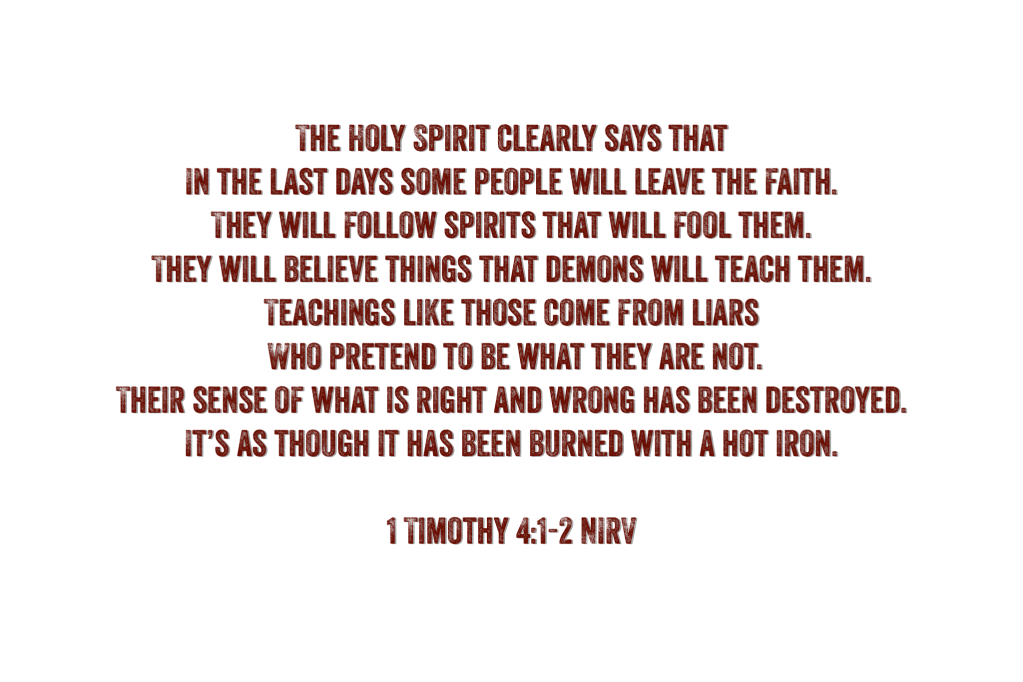
According to 1 Timothy 4:1 “the Spirit explicitly states that in latter times some will depart from the Faith by devoting themselves to deceitful spirits and teachings of demons.” Again, Jesus elsewhere identifies the Holy Spirit as the Spirit of Truth. The Spirit (of Truth) clearly states that in latter times some will depart (transliterated: apostatize) from the Faith. How does anyone argue with what the Spirit of Truth clearly states? (Yet some do, and doggedly so.) 
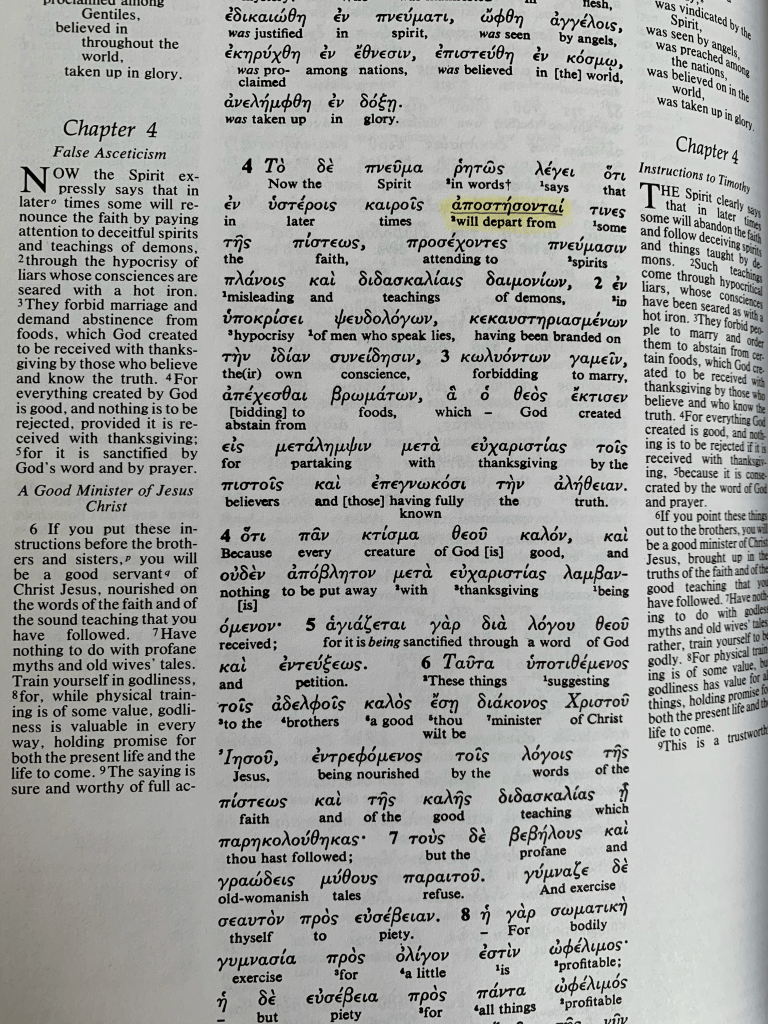
This is how we know what the Original Greek says.

But I should not be rash or dismissive. Why do some people say that Christians cannot actually depart from the faith? To be fair, the real reason is because they correctly say that God loves us, remains ever faithful, and is wholly determined to never let us go. They especially lean upon passages in the Gospel of John, such as John 6:37-40 and John 10:27-30. In those passages, Jesus says that he will “lose nothing” of what God gives to him, and that “no one will snatch” his sheep out of his hand. These are immensely important passages that are especially comforting to anyone prone to worry. I once heard a preacher say that if anyone does harbor the worry that “all is lost and my salvation is now void,” that same worry is a sure and certain sign that their salvation is neither lost nor void. That preacher was very likely right, because such worry probably demonstrates a righteous, God-ward desire. And God will certainly not disown any of the redeemed who do not disown Him (see Psalm 51:17).  

But I need to say more about the twin “eternal security” passages in the Gospel of John. To start, there is another passage in John that points the other direction. In John 15:2, Jesus uses a gardening analogy to assert that bad, unfruitful branches get cut off, but good branches are pruned so as to produce even more fruit. It is interesting to note that Hebrews 6:7-8 uses a nearly identical analogy to warn against the real possibility of apostasy. So there’s that. 

As for the fact that Jesus will “lose nothing” of what God gives him, and that “no one will snatch” his sheep out of his hand, I do admit and think it is fair to say that we might-could conclude that Jesus’ reassuring statements here teach eternal security, except for everything else against eternal security in rest of the Bible. Simply said, there are just too many New Testament passages that point the other direction. Thus we seem to have signposts pointing different directions. Sometimes we do encounter tension and paradox in Scripture. These passages are admittedly paradoxical (but not contradictory). We need to wrestle through the paradox — or just accept the tension — lest we quickly lose our balance.

And how might we lose our balance? We might lose our balance by presuming that someone’s salvation is secure no matter what they say or do, on one hand, or by fearing that some sin means that we are no longer acceptable to God, on the other hand. Salvation is not a ticket that someone can pocket, neglect, and forget. Alternatively, salvation is not a fragile snowflake that evaporates away because of a stubborn, sticky sin. Salvation is instead a security deposit that is guaranteed to be valid, if only it is valued for its worth.

In 2 Timothy 2:11 we find this “trustworthy saying,” which (according to a scholar named Ralph P. Martin) might have been an early Christian baptismal creed or hymn:
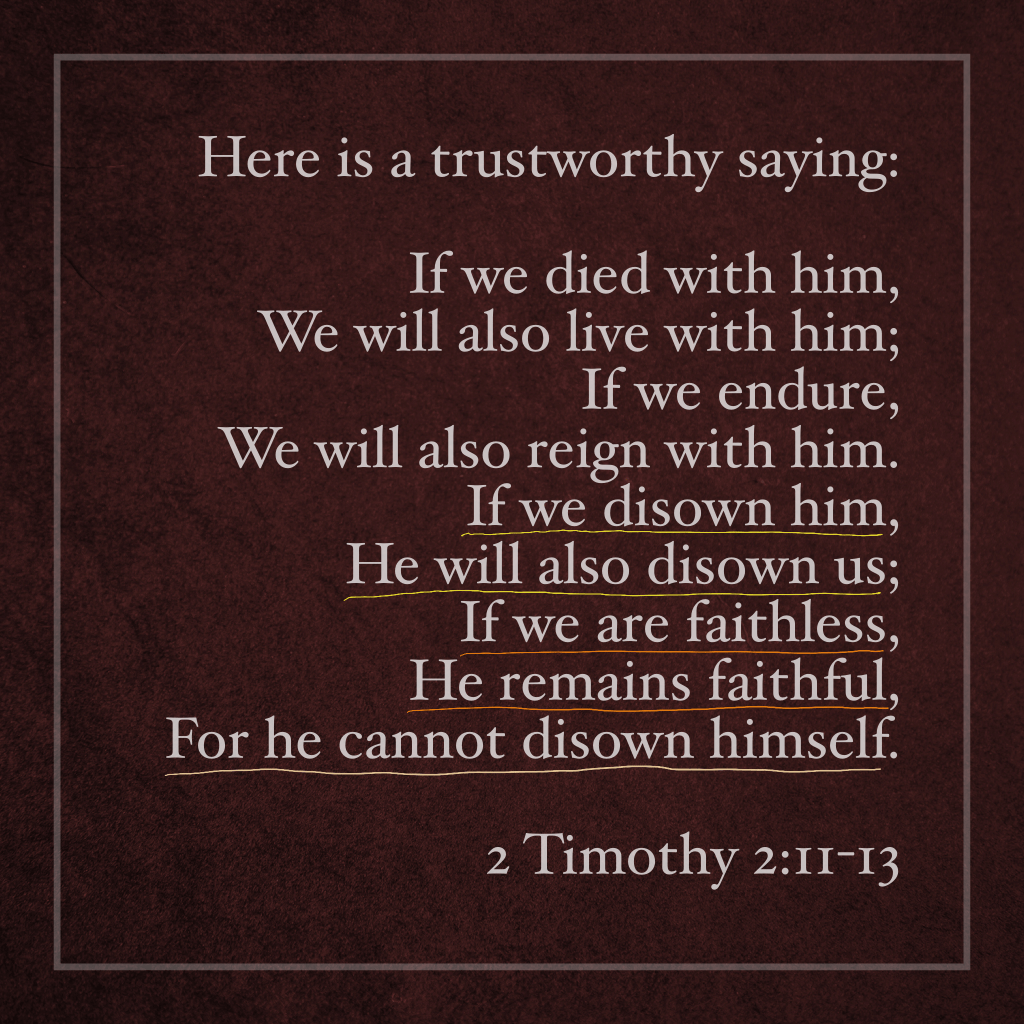
If it was an early Christian baptismal creed, this “trustworthy saying” both warns new, initiate Christians against intentional apostasy and reassures them of Christ’s continual faithfulness. They were warned never to disown Christ, with the threat that if they did, Christ would likewise disown them. But they were reassured that Christ would remain absolutely faithful to them, even if and when they slipped into faithlessness. 

My friend comes immediately to mind here. This particular passage ought to reassure him. Most of the time, faithlessness is our problem, not outright, intentional apostasy. We slip into sin because of our faithlessness. But that is not the same as deliberate “I once believed but now actively oppose Christianity” apostasy.

Finally, I want to return to Hebrews 3:12-13, which reads: 

12 See to it, brothers [and sisters], that none of you has a sinful, unbelieving heart

that turns away from the living God. 

13 But encourage one another daily, as long as it is called today, 

lest you be hardened by the deceitfulness of sin. 

Whomever Wrote Hebrews (Scholars Still Debate This)

The danger with sin is not that it immediately ends our salvation. It does not. We know from Hebrews 6 that if salvation is actually lost, it can never, ever be regained. And we know from the Gospel of John that Jesus himself is absolutely committed to keeping us from falling away. So we need not worry that sin will somehow easily strip us of salvation. God is not fickle, nor weak. And God will fight us tenaciously to keep us saved.  

Instead, what we actually need to worry about is that sin will seduce us and deceive us. When we sin, we give ourselves over little-by-little to deception. And the deeper we sink into deception, the more likely we are to be hardened by sin. Someone who does apostatize has gone down exactly that path, and has gone down it a very, very long way. An apostate has first embraced sin, then fallen deeply into deception, and finally has lost all connection with the living God. Terrifying to even consider.   

All that said, we cannot be completely certain that someone we meet or know is an actual apostate, even if that person claims to be an ex-Christian. God is ultimately the one who judges people; and God knows our hearts even better than we do (see 1 John 3:20). Like any good parent, God is exceedingly patient with us because He loves us deeply. If we believe someone we know may be an apostate or may be in danger of becoming an apostate, we ought to pray earnestly for that person’s return. There might still be hope for him or her, because God always desires everyone to be saved (see 1 Timothy 2:4).    

Admonition and Emphasis

Thursday, February 11, 2021

Admonition & Emphasis – Audio Version

A bearded, bespectacled theology professor once told his students that they were reading their Bibles much too personally. They were wrong if, when reading about David’s slingshot toppling of Giant Goliath, they extrapolated that God would help them overcome their giant personal problems. That is not the point of the passage, the professor repeatedly insisted. The account about David and Goliath itself makes no such personal promise. We misread the Bible if and when we attempt to pull out unsubstantiated applications and unstated promises from stories like David and Goliath. “So sorry, my naïve college students, but most of those personalized Sunday school lessons you heard while growing up were ~somewhat~ wrong and misleading.” Whether or not such is an exact quote of his, it accurately captures the gist of my professor’s point. He wanted us to know that we may well be misappropriating a lot of presumed promises from the Bible. So an important question begs the asking here: Was he right or wrong? 

My professor left me feeling quite confused and conflicted. On one hand, I did understand his admonition: When reading the Bible, people sometimes do errantly lay claim to presumed promises. And sometimes people come away with questionable applications. Yet on the other hand, something about what he said (or how he said it) felt slightly fishy. It seemed somehow off to me. But what was it, exactly? If asked to articulate or explain my misgivings, I knew I had a problem. I had only a vague sense of how I felt uneasy. But that would never fly. Since I could not explain what bothered me, I chose to say nothing. 

As an aside, do we not find ourselves in that particular position with some frequency? When we are confronted with thoroughly prepared experts, a sense of uneasy befuddlement besets us at times; does it not? And who are we to second-guess the expertise of recognized experts?

Our gut reaction is not necessarily wrong, though. Sometimes we are not wrong to second-guess the experts. With the hindsight of many years and much study, I can now articulate my misgivings. (Not a quick response, I must admit.) What really disturbed me during that lecture long ago was not my professor’s admonition, but his emphasis. In and of itself, his admonition was correct and corrective. However, he emphasized it to such an extent that he left many of his students (including me) wondering if anything they read in the Bible could be taken and applied personally. My professor should have assured us that significant sections of the Bible can and should be taken personally. But he did no such thing. Consequently, he made the Bible (and the God presented therein) much less approachable to us. Not good. 

An axiom can be distilled here: Experts can be entirely correct in the information they convey, but entirely incorrect in the importance they ascribe to that information.  

“Yes, what you say is accurate, teacher; but it is not as important as you seem to think it is.”

Now for a walk through the weedy details we go…

It might be helpful to some of my readers if I explain in detail exactly how my bearded, bespectacled professor was both right and wrong. He was entirely correct when he insisted that a lot of the Bible stories we read are not immediately and personally applicable. Not every promise and not every inspirational message in the Bible applies immediately and directly. The words immediately and directly carry a lot of freight in the last sentence, so please take notice of them. If we misapply messages or misappropriate presumed promises we could well find ourselves both disappointed and ridiculed. So we must not presume upon particular promises and immediate messages that were never, ever intended personally for us. That point could be illustrated with a myriad of tragic examples from history, including very recent history. This, then, was my professor’s admonition. And he was entirely right about this. 

And yet my professor was wrong about something he left implied. By simple omission of balancing biblical information, he implied that much (if not all) of the Bible is not intended for each one of us. But that is wrong. It is wrong because the God of the Bible is not just the God of the there-and-then, but is also the God of the here-and-now. The Bible was and is intended for you — yes, for you personally. And the Bible was and is intended for me, for me personally. The Bible is also intended for us corporately.

How can I claim that, though? Was the Bible not written long, long ago by individuals who knew nothing about you or me? Yes, that is true enough. The Apostle Paul did not have you or me in mind when he initially composed his epistles. So in one sense, we certainly are reading someone else’s long-dated mail when we read what Paul wrote to the Church at Rome, or the Church at Corinth, or the Church at Philippi, et cetera. Since that is true, we must keep the historical particularity of the Bible in mind when we read. 

But what Paul wrote to those long-dead Christians is not just their long-dated mail. It was inspired by the Holy Spirit of God. And therein lies all the difference between Paul’s ancient correspondence and the correspondence of many other ancients. Significantly, Paul and those long-dead Christians were even aware of the fact that what Paul was writing was inspired by the Holy Spirit. If something originates with God, it just might have a transcendent quality — a transcendent quality quite unlike anything that originates with any other source. The books of the Bible have that kind of transcendent quality. They transcend time and place, and speak cross-culturally through the centuries. 

Crucially, this is an all-or-nothing proposition and a point of yea-or-nay, up-or-down, in-or-out faith. Either the Bible originates with God, or it does not. If the Bible does not originate with God, it can be dismissed as unimportant and ignored as irrelevant. But if the Bible did indeed originate with God, it necessarily carries an authority unlike any other document. If it is God’s Very Word to humanity, it should be treated with utmost seriousness and respect.

My bearded, bespectacled professor wanted to stress the historical particularity of the Bible. He was not wrong about that. It was written by historically particular persons in historically particular places to historically particular others about historically particular situations. True. True. True. And true enough.

But in addition the Bible was and is inspired by God, and is intended for you and me today, personally and corporately. Therefore, we must recognize both its historical particularity and its temporal transcendence. If we uphold both of those truths, we can begin to approach the Bible as it ought to be approached. 

With all that said, I have not yet said enough. I have not told you which passages of Scripture do apply directly to us and what promises are applicable to us. Most simply stated, anything written to the earliest Christian communities (churches) can be directly appropriated by us today, but only after careful contemplation and consideration in the context of Christian community, lest anyone misread and misappropriate what Scripture teaches. 

How Herman Hears

Friday, February 5, 2021

How Herman Hears – Audio Version

What the Apostle Paul says about the Second Coming of Christ can and should be taken literally. Literally, you should read Paul’s writings literally (most of the time). What John the Apocalyptic Narrator says about the Second Coming of Christ should (almost always) be taken figuratively, and not literally. Figuratively, you should read John’s Apocalypse figuratively. 

If you get and keep that straight, it should help you a lot, even immensely. It will help you (and your community of devoted listeners) avoid a plethora of potentially perplexing problems and may clear up accumulated clouds of contradictory confusion. With the Apostle Paul, do default to a literal reading. With John the Narrator of the Apocalypse, do not default to a literal reading, but instead default to a figurative reading. This will help you. Please try it out, even if you are reluctant to believe me. 

Forgive me. I know I sound pedantic and even tedious. But this point needs to be hammered home, because many, if not most, of the interpretive problems circulating in the churches and especially in pop culture can be explained as simple hermeneutical malpractice. If the word hermeneutics is unfamiliar to you, I will explain it in just a bit.  

Parenthetically (but importantly), interpreting Jesus himself requires both a figurative approach and a literal approach, because sometimes Jesus flips into his mysterious, cryptic mode and speaks figuratively, as when he tells parables in public; and sometimes Jesus very deliberately takes a less mysterious tack and speaks literally, as when he answers his disciples’ questions privately. Since Jesus talks about his Second Coming Advent and the End of the World Age both figuratively and literally, we are left to sort things out a bit. And that is where the Apostle Paul in particular is quite helpful, simply because Paul speaks to his audience more literally.  

But what does the word hermeneutics mean? A hermeneutic is how a reader, viewer, or listener approaches a book, movie, television show, play, or radio program. If you think to yourself, “This television show is probably going to be boring,” you have not only a grudging attitude, but also a skeptical hermeneutic, which will probably make it harder to win your appreciation. Your hermeneutic has everything to do with your expectations of what you are about to see, read, hear, and experience. Your expectation and your hermeneutic: They forever go together. Clear enough; yes?

Usually, we are pretty good guessers, when it comes to our various hermeneutics. What we expect of a play or a movie or a show is often accurate. But sometimes we are not good guessers, at all. Although we were expecting one thing, it turned out to be something somewhat different or entirely different. And when our expectations of a spectacle or an event are wrong, it sometimes has to do with what someone else told us about it beforehand. Other people can and often do mess with our hermeneutic. That is especially true when we consider our hermeneutic influencer a reliable expert. “But my friend told me that this was such a good movie. And she is usually right.”    

When it comes to understanding the Bible, we are often very, very influenced by the Pastor. If he or she tells us that a particular passage must mean something, we usually believe him or her. Naturally so. But do realize that if the Pastor is wrong about the passage in consideration, it might completely skew your hermeneutic — maybe completely, and potentially for the rest of your life. That is why it is good to listen to more than one reputed expert. And it is even better to know the Bible well for yourself. Yes, indeed. 

Now I will let you in on a secret: A lot of pastors have a hard time themselves figuring out and understanding what the Apostle Paul and John the Apocalypse Narrator and Jesus himself had to say about the Second Coming Advent of Christ and the End of the World Age. Part of the reason these pastors have a hard time figuring it out is because they are influenced by scholars who do not recognize what needs to be read literally and what needs to be read figuratively. 

That last sentence actually explains a lot. I hope it carries adequate weight for you. 

You may be wondering at this point why you should believe what I am saying here. Okay, I am glad you asked that. You do not need to believe me, at all. I just want you to hear my claims and consider them. Let them roll around in your head for a while. See if they pass the test of time. You might even ask your pastor if there is some validity to what I am saying. While he or she might take issue with what I say should be read literally and what I say should be read figuratively, your esteemed pastor will likely concede my point about the influence of skewed hermeneutics. Your hermeneutical expectation of a passage of Scripture is very likely to determine how you read it. And that expectation — that hermeneutic — was probably formed by what you heard from the pulpit.      

Much more importantly, go back to the Bible and try to read all those passages about the Second Advent and the End of the Age anew. Are you understanding what you are reading too literally? Are you understanding what you are reading too figuratively? Most readers err one way or the other.

Crass Literalism

Wednesday, February 3, 2021

Crass Literalism – Audio Version

Within the last week, one of my readers asked me to cover the thirteenth chapter of Mark. If I am not mistaken, I think that reader wants me to interact with what the Right Reverend N.T. Wright has written about Mark Chapter 13. This, then, is that. 

Since the Right Reverend Wright wrote in an academic manner for his fellow scholars and for seminarians, I might slip back into egghead mode here. If I do, one or two reasons explain the slippage: Reason One – They trained us to write in a particular, peculiar way until it became an ingrained habit. Reason Two – I am striving for clean, concise precision. If you dislike academic jargon and despise seminary-speak, this might not be the blog post for you. But if you’re even moderately tolerant of seminary-speak, please do read/listen on. 

Basically, N.T. Wright claims that Mark Chapter 13 is not about Jesus’ Second Coming, but instead about the destruction of Jerusalem in 70AD/CE. You heard (or read) that right.  

In response, I will sing my usual refrain: Wright is right in what he affirms and wrong in what he denies. Yes, Wright is right when he claims that Mark Chapter 13 is about the destruction of Jerusalem in 70AD/CE. Wright is quite wrong when he claims that Mark 13 is not about Jesus’ Second Coming. Wright unnecessarily forces a false dilemma on his readers. We do not need to choose between the Destruction of Jerusalem in 70AD/CE on one hand, and the Second Coming of Jesus on the other. Mark 13 speaks to both and links both. Highly important point.

Some of my readers/listeners might wonder if I portray Wright’s position fairly and accurately. Yes, I believe I do portray it accurately. However, if you want substantiation and if you want to double-check my claims for yourselves, you can locate what he says in his book Jesus and the Victory of God, (hereafter abbreviated as J&VoG) Chapter 8, Section 4, beginning on page 339 in my copy from 1996. You will need to wade through several pages of material, though, to get what I give you in my brief summary above. 

Again, Wright forces a false dilemma. And a lot of people fall for it. Wright argues persuasively that Mark Chapter 13 is about the destruction of Jerusalem in 70AD/CE, because it is in fact about that destruction of Jerusalem. But it is also about Jesus’ Second Coming. Verses 24-27 ought to erase any doubt as to whether Christ’s Second Coming is also in focus. It is. Here are verses 24-27:

24 “But in those days, after that tribulation: The sun will be darkened, and the moon will not shed its light; 25 the stars will be falling from the sky, and the powers in the heavens will be shaken. 26 Then they will see the Son of Man coming in clouds with great power and glory. 27 He will send out the angels and gather his elect from the four winds, from the ends of the earth to the ends of heaven.

Wright insists that these four verses are entirely metaphorical. He points out that they contain imagery from the Old Testament. And they do. But the implication is that they must not be understood literally, at all. He spends several pages explaining that verse 26 does not mean that Jesus will someday visibly descend from heaven, but rather has already ascended to heaven in vindication, because the word translated as coming can mean either coming or going in the original Koine Greek (refer to J&VoG, Chapter 8, Section 4, Subsection v The Vindication of the Son of Man, pages 360-365). Wright wants his readers to conclude that Mark 13 is solely focused on the destruction of Jerusalem in 70AD/CE. It is a “crass literalism” to perceive a “physical collapse of the time-space world” (p. 361) in these verses. 

Is it really a crass literalism to perceive the Second Coming in these verses? Is it a crass literalism to perceive the Rapture in these verses? I ask because verses 26 and 27 read like the Second Coming and Rapture to me.

In Wright’s defense, someone might point out that these verses must be metaphorical because we know enough about astronomy to know that the stars will not literally fall from the sky. Plus, verse 25 says that “the powers in the heavens will be shaken.” What does that even mean? It sure sounds metaphorical. Maybe Wright is right here?

Hang on, though. Such a line of reasoning says more about our contemporary assumptions of what must be literal than about how the original hearers would have heard it. The language of these verses evoke vivid phenomenological imagery. We can visualize a sunset, and still know that really it is not setting because the Earth is actually rotating. But we call it a sunset all the same, because that’s what we see. Likewise, we can visualize stars falling from the sky and imagine curious disruptions to the normal order of the heavens. In a way, this is all quasi-literal language, because it is how it would appear phenomenologically. It would see, sound, and feel as Scripture describes. So though it is not necessarily scientifically literal, it could very well be phenomenologically literal. And significantly, it also can be metaphorical. We don’t necessarily have to choose one way or the other.     

But I have an even more pointed reply to Wright; and that is this: Other passages of Scripture do portray Jesus descending in a second coming, and very literally so. In Acts 1:11 two men dressed in white robes (presumably angels) ask the skyward-gazing apostles a question. They inquire, “Men of Galilee, why do you stand looking into heaven? This Jesus, who was taken from you into heaven, will come in the same way as you saw him go into heaven.”

Uh huh. 

That’s as literal as can be, N.T. That ain’t metaphorical, at all. Jesus literally ascended upward into the sky. And someday he will descend from the sky. And that we call the Second Coming.

Notice that I am using another passage of Scripture to interpret Mark 13. Is that a legitimate move on my part? Yes, it is. It is legit because of the nature of Scripture. You get pieces of information from here and pieces of information from there on the same topic. Both Mark 13 and Acts 1:11 speak to Jesus’ coming and going, or going away and coming again. You can begin to get a feel for eschatology — for what will happen — when you pull the pieces of information together. Jesus will literally descend from the sky. That is how it will appear to us.

That all said, you can learn a lot of valuable information from N.T. Wright about the Bible. He is right when he says that Mark 13 references the destruction of Jerusalem. He is also (partially) right when he says that the destruction of Jerusalem vindicated Jesus, because Jesus predicted it would happen.

My issue with N.T. Wright is that he forces unnecessary choices on his readers. He misses prophetic parallels, echoes, and patterns, and insists instead on this or that. He puts his readers in a false dilemma. 

Humiliation

Tuesday, February 2, 2021

Humiliation – Audio Version

If you are reading this to see how I will attempt to refute the Right Reverend N.T. Wright on the question and reality of the Rapture, please feel free to skip past the historical stuff about Antiochus Epiphanes that follows immediately hereafter, interesting though it may be. However, you will be skipping some valuable information.

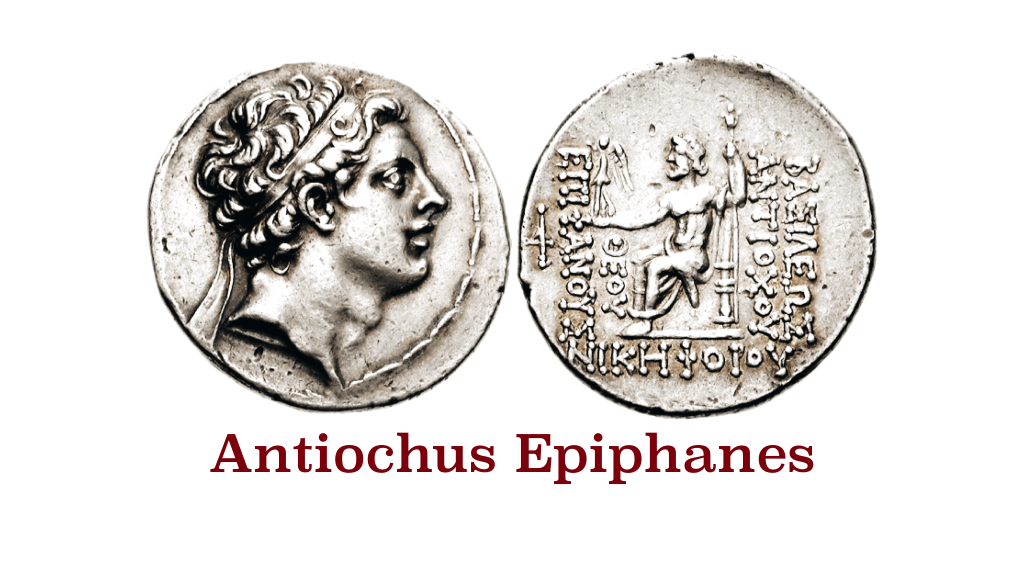
King Antiochus IV Epiphanes was a bad guy, a very, very bad guy. From a biblical perspective, Antiochus Epiphanes was one of the absolute worst bad guys ever. He was really, really bad. I wrote about the Greek Monarch Antiochus Epiphanes in a previous post entitled Damnational Geographic and explained why he was so bad. But I did not include an important historical anecdote about Antiochus in that post which I will include now. Antiochus only went totally bad after someone forced him to make a hard unequivocal humiliating choice. Antiochus was forced to decide something significant, and decide it immediately, publicly. He was literally put on the spot, right then and there, in front of his underlings. Only after he was forced to make that very humiliating decision did King Antiochus IV Epiphanes become one of the absolute worst bad guys ever. So exactly what happened? Here I will let brittanica.com tell the tale:

In Eleusis, a suburb of Alexandria, the Roman ambassador Gaius Popillius Lænas, presented Antiochus with the ultimatum that he evacuate Egypt and Cyprus immediately. Antiochus, taken by surprise, asked for time to consider. Popillius, however, drew a circle in the earth around the king with his walking stick and demanded an unequivocal answer before Antiochus left the circle. Dismayed by this public humiliation, the king quickly agreed to comply. Roman intervention had reestablished the status quo. By being allowed to retain southern Syria, to which Egypt had laid claim, Antiochus was able to preserve the territorial integrity of his realm.

A Roman ambassador drew a circle in the sand and in so doing forced Antiochus IV to decide whether or not to withdraw his forces from Egypt and Cyprus. Antiochus knew he could not defeat the militarily superior Romans, so he conceded to Ambassador Gaius Popillius’s demands. Then in his humiliated fury, King Antiochus turned in a raging rampage against the less-than loyal Jews who lived in the territory that he still held. His humiliation turned proud Antiochus into a seething, vengeful tyrant. The Jews would bear the brunt of his fury.

Why share all this information about Antiochus? I am figuratively attempting to get two birds with one stone. As for the first bird, I want to remind my readers and listeners of who Antiochus IV Epiphanes was, because he is a historical prototype of the Antichrist. As for the second bird, this account of Popillius humiliating Antiochus is originally where we get the idiom “to draw a line in the sand” and its variants. Popillius literally drew a circular line in the sand and in so doing forced Antiochus to make an unequivocal decision.

Sometimes lines must be drawn. Sometimes decisions must be forced on the reluctant.

There are things you have to believe. And then there are things that you do not have to believe. There are times we must draw hard and fast lines, and firmly insist that any equivocators make up their minds to be in or out of those lines. And then there are times when lines should not be drawn distinctly — or drawn at all.

Somewhere over Arizona, I believe.

Now I will address the Rapture, and my disagreement with N.T. Wright. Christians do not need to draw hard and fast lines on the question of the Rapture. It is not an essential matter. Fellow Christians will probably disagree with me after what I argue here, no matter how well I argue. But whatever. It is not an essential matter.

That said, I will argue it all the same. If someone were to ask me, “But since you admit that it is not essential, what does it matter?” I would respond with, “In my opinion, the Rapture matters because it makes Eschatology more coherent.” At which point, my hypothetical questioner might completely lose interest and check out, because I dropped an unfamiliar seminary word. “What does eschatology even mean?” N.T. Wright would be familiar with that word, though. He understands it from every direction. 

Let me try again: The Rapture matters because it will help you understand certain sections of the Bible better. I hope I made myself more understandable that time. N.T. Wright would disagree with that claim, though. On his blog, NTWrightPage.com, you can find a brief post entitled Farewell to the Rapture. I encourage you to go read it for yourselves. It is always best to let someone in question speak for himself or herself. And N.T. Wright speaks for himself ably.

He was in a hurry when he signed my book.

If you were to distill everything down, basically N.T. Wright and I disagree about one primary passage of scripture, just one crucial verse: 1 Thessalonians 4:17. It is well worth remembering that, because what someone believes about that one verse will likely determine what he or she concludes about the Rapture. I am going to argue that 1 Thessalonians 4:17 can and should be read literally. N.T. Wright argues that it is metaphorical. In his own words, here is what Wright says:

Paul’s mixed metaphors of trumpets blowing and the living being snatched into heaven to meet the Lord are not to be understood as literal truth, as the Left Behind series suggests, but as a vivid and biblically allusive description of the great transformation of the present world of which he speaks elsewhere.

Therein is the difference. I say it is literal; N.T. Wright says it is not. So who should you to believe and why? Me. Me. Me. Choose me. But that is not the most convincing argument. It might help if you had a better idea of why N.T. Wright does not like a literal interpretation of the Rapture. It has everything to do with his… wait for it… eschatology, his understanding of the End Times. N.T. Wright works within a particular scheme of how history will unfold. He has a hypothetical understanding of the future. That is called his eschatology. For anyone who takes the Bible seriously, eschatology is unavoidable simply because the Bible talks about future events.

Now we turn to the key passage itself. In 1 Thessalonians 4 Paul seems to be describing a future scenario in which Jesus descends from heaven, resulting in the resurrection of the dead (the dead in Christ — Christians who have died) and the ascent of all the faithful to meet Christ in the air. Notice that I skipped a few details; I only did so for the sake of keeping my focus on what I consider to be the three essentials. Essential # 1 – Christ Jesus himself descends from heaven. Essential # 2 – The dead in Christ are resurrected. Essential # 3 – All the faithful ascend (or are caught up) and meet Christ in the air. 

Essential # 3 is what many call the Rapture. And it is extremely controversial. A whole lot of Christians join N.T. Wright in pushing back here with the claim, “Well, that is not literal.” But curiously, they will not argue against the literal-ness of Essentials # 1 and #2. Please do not miss that. Those who reject the Rapture usually know better than to argue against a literal descent of Jesus (because that is taught very clearly in the New Testament); and they know better than to argue against a literal resurrection of dead saints (because, same reason). Nevertheless, they will argue against a literal ascent of all the faithful. That, or they will say that any such ascent must immediately turn into a descent as soon as the Meeting with Jesus in the Air occurs. 

But why? Why take Essentials #1 and #2 literally, but not Essential #3? Well, one reason why some dispense with or modify Essential #3 is because it has an embarrassing, humiliating recent history, a humiliating history which N.T. Wright himself references with the derisive words “as the Left Behind series suggests.” Over the last fifty years, eschatology, aka the End Times, has become a pop-culture fixation. And Rapture-talk has been a frequent source of embarrassment for Christians, time and again. That is one primary reason why N.T. Wright and his devotees want to bid farewell to the Rapture. Understandably so. 

But in 1 Thessalonians 4:17 does Paul present a literal Rapture or not? Historical humiliation aside, a literal reading of the verse makes perfect sense, and is simple and straightforward. The real problem is not with a literal reading of 1 Thessalonians 4:17, but with literal readings of other eschatological verses and passages, as we shall see in forthcoming posts. Sometimes a literal understanding of a biblical passage is the best understanding; but sometimes it is emphatically not. TBC.

Inoculated Against

Sunday, January 31, 2021

Inoculated Against – Audio Version
Are you immune to certain ideas?

Thirty years ago, I asked a young defense attorney if he had ever won an acquittal for a defendant he knew without doubt to be guilty. He gave me an easy yes, and explained that he had prepared a believable but bogus line of defense, a misleading argument that the jury had naively fallen for. As a result, his guilty-as-sin client was wrongly ruled innocent and walked off as free as can be. The attorney had won his case; but justice was not served. Justice did not have its way that day. To my befuddled bewilderment, the young defense attorney was upfront about what happened, and yet completely unbothered. He felt no need to justify what he had done. He took a matter-of-fact and nonchalant attitude about it all. I probably should not have been as surprised as I was. Like the hoodwinked jury, I was rather naïve.

If I had to squeeze a somewhat positive takeaway from my bewildering conversation with the young attorney, it would be this: Well-presented arguments matter, matter a lot.  

Regrettably, a wrong-headed and yet well-presented argument can win out against a better argument presented poorly. Falsehood can have its way if it is presented more persuasively than truth. Truth ought to prevail, to be sure and absolutely so. But how it is presented might matter quite a bit more, at least in the short term.

Why is that, though? The simple reason why the presentation of an arguable claim can matter as much as the truthfulness of its content is because people are often naïve and gullible. Yes, that was a wordy sentence. Sorry. But think it through. How something is presented can matter as much or even more than whether it is true; and that it is because people are gullible.     

Most people will buy a lousy idea if it is spun persuasively enough, and if others they respect fall for it. Consider that an important axiom that you can pocket and revisit. Know as well that it explains a massive amount of foolishness that routinely plays out around you. A lot of people have been inoculated against the truth because they have heard persuasive or pervasive lies. That was well-worded, so I will repeat it: A lot of people have been inoculated against the truth because they have heard persuasive or pervasive lies. Yes, I ought to give you some examples. And yes, I need to explain why I am pointing this out to you.  

As for why I am pointing this out to you, I intend to argue against a first-rate and very influential theologian, whom I will refer to as the Right Reverend. I hope to persuade you that the Right Reverend is quite wrong on something quite big. He once presented a persuasive correction of a controversial biblical doctrine known as the Rapture. And his persuasive correction has become pervasive. Succinctly stated, the Right Reverend says there will be no Rapture. But I mean to correct his correction. Although the Right Reverend is right about a lot, here he is wrong. There will be a Rapture. It is a doctrine that can be established biblically. And we are supposed to expect it. 

But before I get into the nitty-gritty of my arguments for the Rapture, I want to talk about the influence of the Right Reverend. Over a dozen years ago, I went to a local church where a very popular young pastor referred pejoratively to the Rapture as “Evacuation Theology.” The very popular young pastor insisted that God has no intentions of evacuating us Christians out of the world, but instead intends to return to this world and make Heaven and Earth one — one habitation for God and the Redeemed of Humanity. 

Fancy Phrase here: The very popular young pastor was right in what he affirmed, but wrong in what he denied. And that is another important axiom to pocket: A lot of pundits are right in what they affirm and wrong in what they deny. How was he right? The popular young pastor was right when he affirmed that God intends to return (Christ) to this world and make Heaven and Earth one habitation for Himself and the Redeemed of Humanity. True, that. But the popular young pastor was wrong when he denied that God will evacuate the Church. On the contrary, according to scripture God will evacuate the Church, albeit for just a little while. 

The message I heard from the popular young pastor had the fingerprints of the Right Reverend. It is very, very likely that the popular young pastor came to his disparaging views of the Rapture — “Evacuation Theology” — either directly or indirectly from the Right Reverend. If I had to bet, I would bet that the popular young pastor read the voluminous and eloquent writings of the Right Reverend in seminary, just like me. Indeed, the Right Reverend is prolific, and one of today’s best-selling Christian writers. The Right Reverend’s name is N.T. Wright, more casually known as Tom Wright. He is a brilliant and important writer. But he is wrong about the Rapture. I need to do more than assert that, though. I need to explain why Wright is wrong and I am right. Did you catch the pun there? 

Allow me to make a caveat here, though: I hardly think of N.T. Wright as a dangerous heretic. Much to the contrary, I think of N.T. Wright as a profoundly important, orthodox interpreter and theologian. He deserves his status as one of the most important living Christian thinkers. But the Right Reverend Wright does get this one very important point very wrong. 

Since Jesus warned his listeners to be vigilant and ready for the eventuality of his appearance and the rapture/the evacuation that will accompany his appearance, it matters much that we affirm its reality (see Luke 17:20-37, which will be one of my key scriptural references). Jesus urged his followers to be ready upon his appearance to immediately and absolutely abandon everything near and dear. Like Noah’s family and Lot’s family — evacuees, in both cases — his followers need to be ready and willing to leave when the time comes. Jesus puts the onus on his followers to be ready, watchful, and willing to leave when the time comes and he appears. This all makes sense if the rapture involves an urgent angelic summons of those who are ready to go. However, it does not make sense if there is no rapture.

But beating N.T. Wright in a debate about the reality of the Rapture will take a lot more than just a few sloppy paragraphs. I have a negative task and a positive task in front of me. The negative task is to debunk his frankly persuasive arguments. The positive task is to more firmly establish my own arguments. Honestly, I might not convince my readers and listeners. But I am going to try, if only because I really do believe the rapture will happen, and could happen relatively soon. For now, though, I just want my readers to be introduced to what the issue is and whom I arguing against.

Discern the Days

Monday, January 25th, 2021

Discern the Days – Audio Version

Yesterday I went to a nearby church to hear a twenty-something-year-old pastor preach. His message ranks as one of the best I have heard in a long time. He preached about the urgent necessity of self-disciplined discernment — discernment pertaining to various news sources, including both broadcast news companies and social media. Although I think he may have avoided the actual word gullible, in effect he urged his congregants not to be gullible news recipients. He encouraged them to seek out the most-factual, least-biased news reporting possible, while insisting that there is no such thing as a completely objective source. He also suggested they choose to listen to diverse and contrarian voices, lest they only hear one bias on a given narrative. It was all very timely and wise advice, especially coming from such a young pastor. I thought he was quite courageous to wade into such a potentially volatile topic from the pulpit. My chief regret about his message had nothing to do with him. I mostly regret that more people were not present to hear his message. He spoke to a very small crowd.

If I had been tasked with giving the same message, I would have toyed with whether to talk about how we are to discern the times in which we live. His concern and mine do overlap somewhat, but are not one and the same. In his message, my young pastor friend was concerned about how we hear the news, that is, about what we perceive to be true and accurate news. I am concerned about that, as well. Doubtless, getting our facts straight is crucially important. Yet I am even more concerned about the grander, broader narrative in which we insert the various factoids which we glean from the daily or weekly news. 

To make my point here, I will use a river analogy. Imagine you are kayaking or canoeing on an unfamiliar river. Various people along the way shout bits of information to you about your immediate situation or your immediately-impending situation. One somewhat-suspicious character yells out, “Beware! There are lots of hungry alligators just ahead!” Another equally-suspicious person counters with, “The fishing hole just around the bend is absolutely fantastic! You should stop a while and fish there.” Whom do you believe? Should you pause to do some fishing or hurry along to avoid voracious alligators? Obviously, it matters greatly whom you choose to believe. But another, even more important consideration would be the anticipated end of the river itself. What if there are treacherous rapids and a dangerous waterfall ahead? Or what if the river empties soon into a placid lake or a beautiful ocean? Knowing that either scenario is true (or at least likely) will change your kayaking calculus quite a bit. 

If the first scenario were believed to be true — if you suspected that treacherous rapids and a dangerous waterfall were soon ahead of you — it might be high time to get to the next dock, regardless of the voracious alligators or the prospect of fine fishing. Neither reputed fact would be as important as getting to the next dock. 

Alternatively, if the second scenario were believed to be true — if you suspected that the river soon ends in a placid lake or a beautiful ocean — your one aim might be to push ahead and push through, regardless of the alligators or the prospect of a fine fishing hole.      

In either case, your anticipated end can significantly change how you perceive your immediate situation or your immediately-impending situation. 

Does the Book of Revelation tell us anything about the end of the river? Does the Book of Revelation help us discern when the end of the river is near? Consider that question carefully. How you answer it might determine how you respond to the news reports you hear.

I argue that the Book of Revelation does help us discern when the end of the river is near. Indeed, I would assert that the Book of Revelation was given to the Church for that very reason. God wants us to be able to discern the End of the Age as it draws near. If that claim comes across as wacky or weird to you, my counter-question would simply be, “Then among the other books of the New Testament, do you believe the Book of Revelation has a unique and distinct purpose? If so, what do you believe that purpose to be?” Again, I believe that the Book of Revelation is in the Bible to help the Church discern the times, and especially to help us recognize when the End is near. To say so is by no means a claim to establish an exact date, but is instead to claim that God has done us the favor of giving the watchful a descriptive and specific heads-up. Otherwise, the Book of Revelation seems to serve little-to-no discernibly distinctive purpose in comparison to the rest of the Bible, other than to perhaps confound and perplex interpreters. If that last sentence is an overstatement, I hope it still carries my point.

Now, to be very specific about the time in which we find ourselves, I wonder if (and even strongly suspect that) we are living in a prophesied period in which the Church appears to be defeated and done. Does Revelation actually teach that the Church will appear to be defeated? That is exactly how I read Revelation 11:1-10. And if it matters to my readers or listeners, a lot of other well-respected interpreters read this passage precisely the same way, which is to say that my interpretation here is not obscure, nor lightly dismissed. Major interpreters understand the Two Witnesses figuratively, just like me. They say the Two Witnesses must be the Church. Immediately before the Two Witnesses are resurrected and taken to heaven, the Witnesses are somehow conquered and killed by the Beast from the Abyss. Do not misunderstand me here. I am not saying that we should all expect to be killed. This is a figurative interpretation, and not a literal interpretation. Not every Christian dies; we know that from other passages in the New Testament, such as 1 Thessalonians 4:16-17 and 1 Corinthians 15:51-53. But the Church of Christ will appear so defeated to its enemies that they will exult in celebration over their triumph, and even exchange gifts with one another. The more I see the Church persecuted around the world — persecuted both politically and culturally — the more I wonder if this is all happening right before our eyes. But to come to such a conclusion does require a figurative reading of Revelation 11:1-10, not a literal reading.

If my readers and listeners are willing to entertain the possibility that my suggested reading of Revelation 11 might be correct and may fit our current time, then I would suggest that the practical implications are straightforward. We need to be calling people to repentance, while there is still time for them to repent. Granted, if anyone does run with this interpretation, she or he might come across as “a bit much” to those around them. Therefore, one has to decide how to approach others. I choose to blog about it.     

Audacity

Friday, January 22nd, 2021

Audacity – Audio Version

Sometimes you should not show your cards. Sometimes you should. Most of the time you only show the select cards that you believe will benefit you. But both my amateur observations and this card-shark analogy hinge on the presumption that you, the player, are completely invested in your preferred game — that you’re in it to win it. But what if you’re not? What if you’re only in the game for the sake of another player? And what if you do not care if you lose?

When playing games, sometimes I do not care if I win. Sometimes I even want the other player to win. That is true especially if and when I am playing against a child. However, there are times I dearly want to win, so much so that I will go to great lengths to achieve victory. Years ago, my wife beat me in chess — not once, but multiple times. This was entirely unacceptable. My ego was badly bruised. I needed to find a way to beat her. Finally, I managed to pull out a victory. Somehow I did win one game. To this day, I cannot be sure whether I really won outright, or whether she let her childish, overly-invested husband win.

Anyway, I deliberately embarrass myself here because honest introspection is good for the haughty soul. Sometimes ego gets the best of me. When it does, some form of humiliation usually follows shortly thereafter, if not immediately. And we witness that same predictable theme play out repeatedly on the stage of history. In the King James’ idiom, “Pride cometh before a fall.” Yes, it does, again and again.

But the line between pride and due confidence is not always obvious. Sometimes we believe someone to be proud or arrogant when that person is not, but is instead duly confident. For example, my wife is quite good at chess. She really is. And she has ample reason for self-confidence, when it comes to the game of chess (among other things). Yet she is never arrogant about it, nor boastful. If, however, she were to say to you, “I stand a very good chance of beating most people in a game of chess,” she would be right, IMHO. She will not say that, though, so I will say it for her here. You’re welcome, my Dear.

Why am I talking about this? You may be wondering that, at this point. I am talking about this because this blog sometimes gets me in trouble with people I know. Most people are too polite to say so outright, but they believe there is a certain amount of audacity for anyone to claim what I claim. And what is it I claim? I claim that my readers or listeners can learn relevant and important information about very, very controversial sections of Scripture from audacious me. The simple act of posting what I routinely post shows a lot of audacity, perhaps even hubris. Who do I think that I am? A fair question, actually. But most people are too polite and too conflict-avoidant to directly ask that question. That’s okay: If I were in their shoes, I would not ask it either, so I will ask it for them. 

The straight answer to that (usually unspoken) question is this: Rightly or wrongly, I honestly believe that I must blog what I blog. Writing what I do gets me nowhere professionally (at least, not thus far). Nonetheless, the spread of the dread virus affords me the opportunity and time to blog, so blog I will. And my understanding of Scripture is what I sincerely believe I have to offer my readers and listeners, as I have given a lot of time to the pursuit.

That said, there is only one way for anyone to know if what I have to say is actually worthwhile. You have to read it and take the time to consider it. Some people do, for which I am quite grateful. And if you have read or listened to me thus far, thank you. 

Now I am going to show a few of my key cards. I am going to point out exactly where I know most of the experts are likely to disagree with me. And when I say the experts, I mean it. I have read most of the esteemed interpreters of Revelation. Perhaps I should say most of the esteemed interpreters who are published in English (as opposed to German; but most of the German interpreters and theologians eventually get translated into English). Here’s a big card: Most of the esteemed experts would either be uncertain or dismissive of how I interpret the Seven Trumpets, a section of Revelation stretching from the beginning of Chapter 8 to the end of Chapter 11. Yet I will contend that the Seven Trumpets are where I have important insights to offer. And I hope that I can convince some of my readers and listeners to recognize the value of those insights. Yes, I need to be more specific. But I need to take a step back first.

In terms of organization, the Book of Revelation has four sets of seven scenes. The first Set of Seven has to do with the Seven Churches of Asia. This is the least controversial of the four sets. I follow most Evangelical interpreters closely regarding this first set, except that I claim that the respective angel of each of the churches is actually the pastor or bishop. That is a minor point, though. And most of the big interpreters will recognize that my observation might have validity.

Four Sets of Seven Scenes

The second Set of Seven has to do with the Seven Seals of the Scroll, which are broken in succession by the worthy sacrificed Lamb of God, Jesus Christ. Interpreters are all over the place in explaining this set of seven. I understand it as having to do with the progressive historical fulfillment of Old Testament prophecy.

The third Set of Seven is the Seven Trumpets. This is where I believe I can make an important interpretive contribution. As with the Seven Seals, the esteemed interpreters are all over the place in explaining the Seven Trumpets. I understand the Seven Trumpets as having to do with the progressive historical fulfillment of New Testament prophecy, specifically prophecy concerning the Church and its mission. If you were to go read the Seven Trumpets now, there is a very good chance you will think I am crazy to say what I do. But you will probably miss the symbolism, because you will probably be thinking too literally. Each of the Seven Trumpets is symbolic; and the symbolism is only to be deciphered by looking back to Old Testament references, and, to a certain extent, to portions of the New Testament. Everything I claim here depends on a symbolic, cross-referential reading of the Seven Trumpets. That bears repeating: It all depends upon a symbolic, cross-referential reading of the Seven Trumpets. Yes, I do need to flesh that out for you. And I have fleshed it out in a previous blog post; see Eighteen Interpretive Insights, dated September 8th 2020. 

The fourth Set of Seven in the Book of Revelation is the Seven Bowls of Wrath, which is found in Revelation Chapters 15 and 16. I understand the Seven Bowls of Wrath pertain to the awful events that occur in a fearsome period of time after Christ has returned for the Church, but before Christ has returned with the Church. Notice the wording and the distinction there: returned for versus returned with. I believe Christ does take the Church away for a brief time.       

Of course, there is much more material in Revelation to explain. But this should be a helpful introductory overview for any reader of Revelation. You should know that these four sets of seven are there, and that they each need to be interpreted. The last three sets of seven are sequential in historical chronology, in my reading: first the Old Testament, then the New Testament, and then a very brief, very intense, very terrifying period of time before Christ himself comes to visibly and physically establish the Kingdom of God on Earth. In a nutshell, that is how I understand the bulk of the Book of Revelation.    

Figurative Fig

Audio Version – Figurative Fig

Jesus once cursed a fig tree with the words, “May no one ever eat fruit from you again.” The next morning, the tree was withered away to its roots, which shocked his disciples. Yes, this is a weird and disturbing portrayal of Jesus. And it is weird and disturbing in more than one way. But it occurred. Jesus cursed a fig tree for real. It actually, literally occurred within Jesus’ final week of ministry before the cross.

Let me explain why I say it actually, literally occurred. The primary reason to say it must have happened is precisely because of its weirdness. His cursing of the fig tree makes Jesus look a bit mad, a bit off. Who in their right mind gets frustrated with a fruit tree and curses it? Perhaps some of us might be impetuous enough to vent our hungry frustration at an unfruitful fig tree; but if we did, we would probably do so under our breath, lest bystanders hear us and think us potentially unstable. Jesus, however, cursed the fig tree loud enough for his disciples to hear; and they in turn decided that the event (and its dramatic, withering aftermath) needed to be recorded for the benefit of all posterity. 

Yet this is undeniably weird behavior from Jesus; is it not? So why would his followers record it? They would not have invented this. Why would they? The whole point of the four gospels is to glorify Jesus and present him as the Savior of the world, as someone who is worthy of complete allegiance. The point is certainly not to make Jesus look impetuous, irrational, and zany. Therefore, his followers would only have recorded and relayed this rather strange and somewhat embarrassing episode if it actually happened. Moreover, it was recorded not just once, but twice, in both Matthew and Mark (see Matthew 21:18-19 = Mark 11:12-14). In addition, it is possibly alluded to in a parable in Luke (see Luke 13:6-9).

Hereafter, I argue that the parable in Luke serves to interpret the meaning of the indubitably historical event which Matthew and Mark both record. Indeed, the parable in Luke Chapter 13 explains the whole event, even if Luke was not intentionally alluding to it. It does not matter whether Luke the Gospel writer was aware of the connection between the fig tree parable and the fig tree historical event. What matters is that the Holy Spirit orchestrated the scriptural inclusion of the parable in Luke and the two recordings of the historical event in Matthew and Mark. Jesus spoke the parable of the fig tree; and he cursed the actual fig tree on separate occasions. The Holy Spirit made sure that everything related to the fig tree was recorded in the Gospels — including the parable and the two historical accounts of the event. The Holy Spirit did so because the parable explains the event. If you read and understand the parable, it becomes clear that Jesus was not acting in an impetuous, irrational, or zany manner. Instead, the entire event was a veiled prophetic pronouncement. The event was an enacted parable. 

The literal fig tree that Jesus literally cursed represented something else. Get that. The fig tree was a representation or a figure of something else. The fig tree was an effigy. The literal fig tree was a figurative representation. The fig tree represented something else. But what might that something else be? What might Jesus have been so frustrated with? Maybe Luke 13:6-9 will begin to help us figure that out.

Luke 13:6-9 tells the story of a conversation between a land owner and a gardener. Although the land owner is unhappy and ready to chop down a particular barren fig tree, the gardener intercedes on its behalf. He appeals for one more year to tend and fertilize the tree. Yet the gardener concedes that if the fig tree fails to yield fruit after a year, then, yes, the land owner should cut it down. Curiously, the land owner is very specific about how long the he had been looking for fruit from this particular fig tree — three years, which is the same length of time as Jesus’ public ministry. Does that mean that the gardener represents Jesus himself? Indeed, it does. The land owner should be understood as God, and Jesus, as the gardener. The fig-tree parable is about God’s impending judgment upon his own chosen people. Luke Chapter 12 and the rest of Chapter 13 bear this frightening interpretation out. In fact, at the end of Chapter 13, Jesus laments over the forthcoming doom of the City of Jerusalem, since its residents had been unreceptive to him, just as they had with previous prophets.

This interpretation is all the more certain when the Old Testament is cross-referenced. Using gardening metaphors in Hosea 9:10-17, God indicts his chosen people for their rebellion and their obstinance. Verses 16 and 17 include an especially poignant prophecy of judgment. But rather than quote them here, I would encourage my readers or listeners to go read those two verses for themselves.  

The barren fig-tree in the Matthew, Mark, and Luke, then, is a figurative symbol, used consistently in every instance. It represents an obstinate, unreceptive group of people — people who should have known better. But you might miss all this if you do not recognize the symbolism for what it is. And this is how prophetic material often appears in the Bible, in terms of representative symbolism. If a reader catches that, it unlocks the manner in which we are to approach a lot of prophetic material in scripture, in both the Old and New Testaments. 

With an overly literalistic reading of the fig-tree curse, Jesus comes across as an impetuous and maybe even capricious person. But with a symbolic reading of the fig-tree curse, Jesus’ actions are entirely understandable as enacted prophecy. The tendency to insist on the most literal interpretation possible can lead to gross misunderstanding and even theological error.   

Damnational Geographic

Damnational Geographic – Audio Version

“I lift my eyes up to the mountains; from where does my help come?” – Psalm 121:1

“Should I stay or should I go now? Should I stay or should I go? If I go, there will be trouble. If I stay, there will be double.” – The Clash

Be careful, Little Feet, where you go. Be careful, Little Feet, where you go. For the Father up above is looking down … _______________ ( …in love? …to judge? ), so be careful, Little Feet, where you go. 

Your geographical whereabouts can help you or harm you, spare you or sink you. That can be an undeniable, stubborn fact. Yet as it stands, it is not a particularly profound statement. The reason why it is not particularly profound is because it is not always true. Sometimes your geographical whereabouts are simply incidental to whatever happens there. Sometimes serves as the controlling word in the previous sentence. The locale and the events thereof can be unrelated — can be. Yes, a bad thing or a good thing may have happened right here, but it might as well have happened over there. There’s no particular connection to be made between this location and the event that happened here. Should an accident or incident occur here, the location ought to be considered akin to an innocent bystander. “I had nothing to do with it. I just happened to be standing here,” said the unsuspecting house where the dastardly deed was done.   

But certain locations are more likely than others to have incidents and accidents. Oftentimes we are well aware of that fact. Still, we choose to go there all the same and nonetheless. Sometimes our chosen whereabouts are not incidental at all. We go where we go (or don’t go) premeditatedly, knowing in advance that we may suffer the serious consequences of going there (or not). The premeditated part is what matters. We were able to weigh our options in advance. We weighed. We chose. We went or we didn’t. And we will reap what we have sown. Did we choose well? Time will tell: Be assured of that.

Heavy stuff to consider, isn’t it? Lest this be too heavy, it ought to be said that most of our daily whereabout decisions are not do-or-die, life-or-death-hanging-in-the-balance in nature. Unless you drive a car — then they are. But I should not negate myself from one sentence to the next.        

Anyway, this is not a meditation on driving safety, but on an event known ominously as the Abomination of Desolation. Yes, another light and whimsical topic is our intended focus here. Sarcasm intended: This is neither light nor whimsical. But I should not negate myself from one sentence to the next.   

The Abomination of Desolation: What is that? And why would anyone write about it?

The Abomination of Desolation is a dramatic, ominous event that occurred at a particular geographical location in the past. More precisely, it is a dramatic, ominous event that occurred at the very same geographical location at least twice in the past. And it is a dramatic, ominous event that will occur at a similar spiritual location in the future.

Brakes squeal here. We yield here. A lot of knowledgable Bible readers (and friends) will hit pause at this point and begin to argue with me about the final sentence of the last paragraph. They will take issue with the words similar spiritual location and insist I say same geographical location. But I said what I meant and meant what I said. If this confuses any of my readers or listeners, I will eventually explain what I mean in the paragraphs to come. For now, just realize that I believe the future Abomination of Desolation, the ultimate Abomination of Desolation to come, will be similar in its character to the previous two occurrences, but not identical in its location. This is a necessary and important distinction, lest we miss it when it occurs. If you look for it in the wrong place, you will likely miss it.    

The term Abomination of Desolation originally comes from the Prophecy of Daniel (see Daniel 9:27 and 12:11). Historically, the first Abomination of Desolation occurred when a frustrated Greek despot known as Antiochus IV Epiphanes invaded Judea and desecrated the Temple in 167 BC/BCE. Among other sordid doings, evil Antiochus the Fourth desecrated the Temple by setting up an image of Zeus there, and by sacrificing forbidden animals, such as filthy swine, upon the blood-consecrated altar there. To say that this desecration was a shocking sacrilege is a massive understatement. It resulted in a violent reactionary uprising and a regional war. In the intervening period, God’s chosen people were unable to worship God as prescribed by the Torah — not until their sanctuary was liberated, cleansed, and rededicated. The Hanukkah holiday is an annual commemoration of that Jewish uprising and the rededication of their sanctuary, the Jerusalem Temple. For our purposes here, please do note why this occurred. It all began when evil Antiochus interrupted and perverted the prescribed worship of God in the Temple by trampling its precincts and imposing his own preferred form of idolatry. 

Significantly, Antiochus IV Epiphanes went even further afield with his sacrilege and idolatry. Antiochus also insisted that he himself was to be regarded as the human embodiment of a god. The name Epiphanes means manifest — as in god manifest. Antiochus had ego issues. 

We have here the beginnings and makings of a working definition, then: The Abomination of Desolation might be identified as an idolatrous political imposition that both interrupts and perverts the prescribed worship of God in his Temple. And the one doing the imposition often — perhaps invariably — make blasphemous grand claims about himself, even divine claims (regarding this, see Paul’s discussion of the Man of Lawlessness in 2 Thessalonians 2:3-4). 

Another oh-so-close Abomination of Desolation occasion occurred when Emperor Gaius Caligula attempted to once again re-purpose the Sanctuary in Jerusalem into a pagan temple. Sometime in 40AD/CE Caligula determined that a statue of himself, a statue fashioned in the likeness of the Roman god Jupiter, ought to be placed in the inner sanctum of Jerusalem’s Temple, a gilded inner room known as the Holy of Holies. This rightly worried one Herod Agrippa, who was both a royal dignitary from the region and a childhood friend of Caligula’s. Herod Agrippa did what he could to dissuade Caligula from his statue-installation scheme. Moreover and more effectively, even one of Caligula’s own political appointees resisted the scheme. The appointed Imperial Governor of Syria, Publius Petronius, very courageously delayed the implementation of Caligula’s orders. By means of his deliberate delays, Petronius ultimately succeeded in thwarting Emperor Caligula, whose assassination meant the end of the whole crisis. But the Temple’s second Abomination of Desolation was only temporarily stalled.   

The actual second Abomination of Desolation occurred 30 years later when Roman legions under the command of the future Emperor Titus overran Jerusalem, killing or enslaving all its inhabitants, and demolishing its Temple in 70AD/CE. This destruction of Jerusalem came in fulfillment of an anguished prophecy that Jesus spoke against the city, because most of its inhabitants had rejected him as their promised Messiah. Within one generation of Jesus’ crucifixion and resurrection, the Temple was reduced to ruins; and biblically-prescribed worship there ceased (and to this day has never resumed). The City of Jerusalem and its Temple were left both desecrated and desolate, just as Jesus had foretold (see Matthew 23:37-39).  

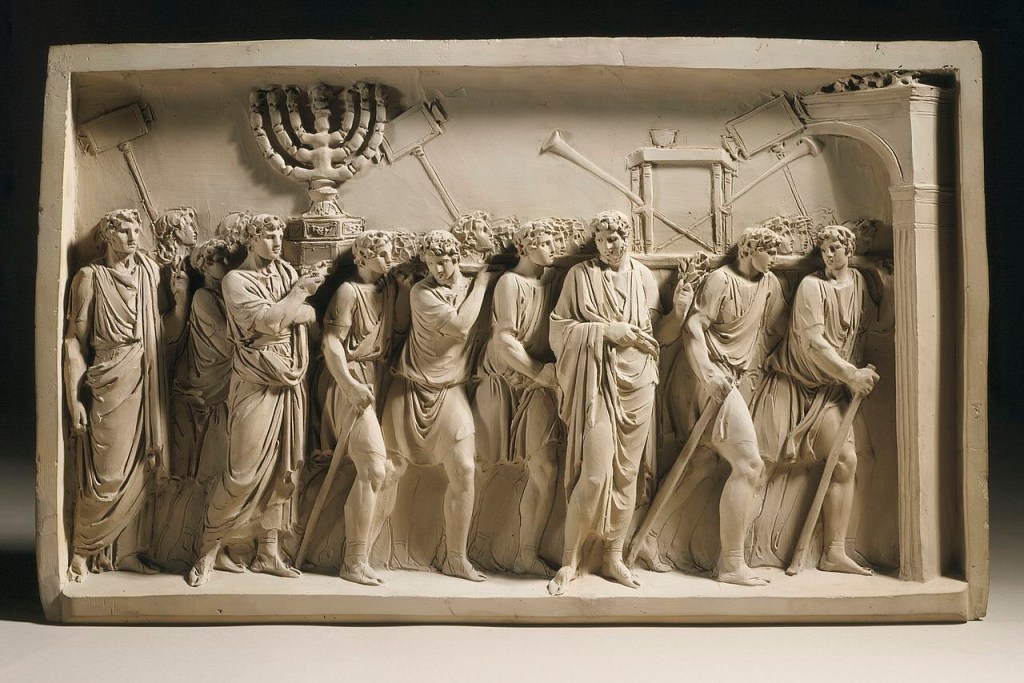
Jerusalem’s destruction came under the command of a Roman general named Titus Flavius. Titus thereafter followed his father Vespasian as emperor, and was succeeded by his brother Domitian. All three of these Flavian emperors practiced pagan idolatry. Titus had his troops carry the Temple’s furnishings to Rome as spoils, where they were presented as trophies before the gods of the Roman pantheon. Thus Titus took what was dedicated to God and belonged to God and offered it instead to his own gods. Titus’s brother Domitian would later encourage his subjects to worship his late father, his late brother, and even himself, and even while he was still alive. Sacrilege and blasphemy ran in the Flavian family line, it seems.

All of this is helpful and necessary background information, because someday a foretold third Abomination of Desolation will transpire. Indeed, in 2 Thessalonians 2:3-4 Paul says that the Day of the Lord will not occur until a rebellion or apostasy occurs, and someone known ominously as the Man of Lawlessness is revealed. The Man of Lawlessness will “oppose and exalt himself against every so-called god and object of worship.” Furthermore, the Man of Lawlessness will “take his seat in the Temple of God, proclaiming himself to be God.”

If the Day of the Lord confuses you, just know that it serves as Paul’s shorthand for the return of Jesus Christ. Paul is saying that Jesus Christ will not return for the Church until some sort of rebellion or apostasy occurs, and the Man of Lawlessness presents himself as an alternative god, the one everyone ought to worship. This, I propose, is the third and final Abomination of Desolation. Paul presents precisely this scenario to the Christians in the Græco-Roman city of Thessalonica as the tell-tale sign that Jesus is about to return. Paul’s whole purpose in writing his second letter to the Thessalonians was to reassure them that they had not missed the Day of the Lord. Rather, they could know that the Day of the Lord was at hand if and when the Man of Lawlessness was revealed by his Desolation of Abomination deed.

On basis of this passage in Second Thessalonians and on basis of passages like Revelation 11:1-3 and 13:5-10, a lot of Bible interpreters expect a future world leader will someday set up an image of himself in a rebuilt Temple in the City of Jerusalem. While it is an understandable interpretation, if it is wrong, it could cause us to look the wrong direction.

This is an extremely important point, simply because Paul told Christians to look out for the event. In Matthew 24:15-16 Jesus likewise instructs his disciples with these words: “So when you see the Abomination of Desolation spoken of by the Prophet Daniel, standing in the Holy Place (let the reader understand), then let those who are in Judea flee to the mountains.”   

A lot of interpreters will immediately react to my last point by insisting that Jesus was talking about the second Abomination of Desolation, the desolation that occurred back in 70AD, when Titus’s Roman legions razed Jerusalem and demolished the Temple. And that is undoubtedly partially right. But “let the reader understand,” including latter readers. I contend that Jesus also means for us to understand he is talking about the third and final Abomination of Desolation, the same event that Paul describes in Second Thessalonians. If so, we are supposed to catch the parallels and the manifest differences between the previous two Abominations and the future third Abomination.

One manifest difference is that no Old Testament-prescribed Temple currently stands in Jerusalem. Yes, Temple furnishings have been made. And yes, there are some who would eagerly rebuild such a Temple, if only they had the opportunity. Nevertheless, there is no such Temple currently in Jerusalem. However, a New Testament-prescribed Temple does exists. It is not in one particular geographical location. Instead it is made of a particular people. According to the New Testament, the global Christian Church is now the Temple of God. 

If the global Christian Church is the Temple of God now, how might the Man of Lawlessness take his seat in it, and proclaim himself to be God in the Church? Perhaps a Man of Lawlessness will somehow have the power to insist that Christians bow to him instead of the Triune God.

And if the Church is the Jerusalem of God, what might it mean for Christians to flee to the mountains when we see the Abomination of Desolation standing in the Holy Place? Perhaps Jesus meant that we should not knowingly associate with a potential Man of Lawlessness or cooperate with his attempts to co-opt the Church and pervert its worship. Instead, we are to distance ourselves from any such personality and eventuality. However we can, we are to withdraw.      

Jesus made it very clear that his return will catch most people unaware and unsuspecting. I wonder if that is because many of us will be looking for events — or for a particular event — that might never occur. I suggest it would be entirely too obvious if the grand debut of the Man of Lawlessness occurs in a rebuilt Temple in Jerusalem. If instead, the Man of Lawlessness is revealed by what he does to or in the Church (which is both the spiritual Temple and the new Jerusalem, by the New Testament’s reckoning) then far fewer people will notice it when it occurs. Indeed, we have already witnessed instances where various political leaders have insisted that resident Christians give their primary allegiance (that is, their worship) to a designated Head of State, instead of to God. 

Jesus is Lord and God, not Caesar nor any other claimant. So when we see pretenders and usurpers insist on total devotion and ultimate allegiance, it is time to pay attention, and may well be time to be contrarian and withdraw. Be careful Little Feet where you go, for the Father up above is looking down in love (and to judge); so be careful Little Feet where you go. And if at all possible, go attend a Christ-centered church, since that is where you are most likely to find help and encouragement “even more as we see the Day approach” (see Hebrews 10:25).