One of the great potential advantages of blogging is candor. To borrow a phrase from a friend and fellow blogger, an internet writer can “hide behind a keyboard.” For anyone who wants to get his or her message out, the prospect of relative anonymity is quite alluring, especially for anyone who might be socially challenged or less-than-photogenic. Indeed, and to borrow yet another phrase, someone “with a face made for radio” might gravitate towards a blog as a preferred communication platform. Of course, I do not mean for any of this initial commentary to reflect in any way upon yours truly, since I am a social savant and forever fabulously photogenic. Wait… who is that I hear snickering in the background?
Anyway — and however — the reason I do open with a somewhat narcissistic paragraph is because I do hope to shield myself with this here (very sturdy) laptop and with the impervious, impenetrable security of cyberspace. I might need both means of defense, though, because in this blog-cast I fully intend to insult a tiny, insignificant percentage of my readers or listeners.
No, I do not mean you — of course not. I mean someone else who might read or listen to this. But if you lean in, I’ll let you know how I plan to insult that someone else. At some point, I am going to subtly suggest that someone else (other than you) might be just a bit lazy.
Is that not a good idea? Perhaps it is not the best way to make friends and influence people. Perhaps it is why I am an anonymous blogger and not an in-demand motivational speaker. Maybe, just maybe. But if the shoe fits… find someone else — anyone else — who wears your size, and offer said specified shoe to that special someone.
But exactly how is that someone else lazy? I cannot say someone is lazy unless I pinpoint precisely how they are lazy. I mean, who isn’t guilty of being lazy here or there, now and then?
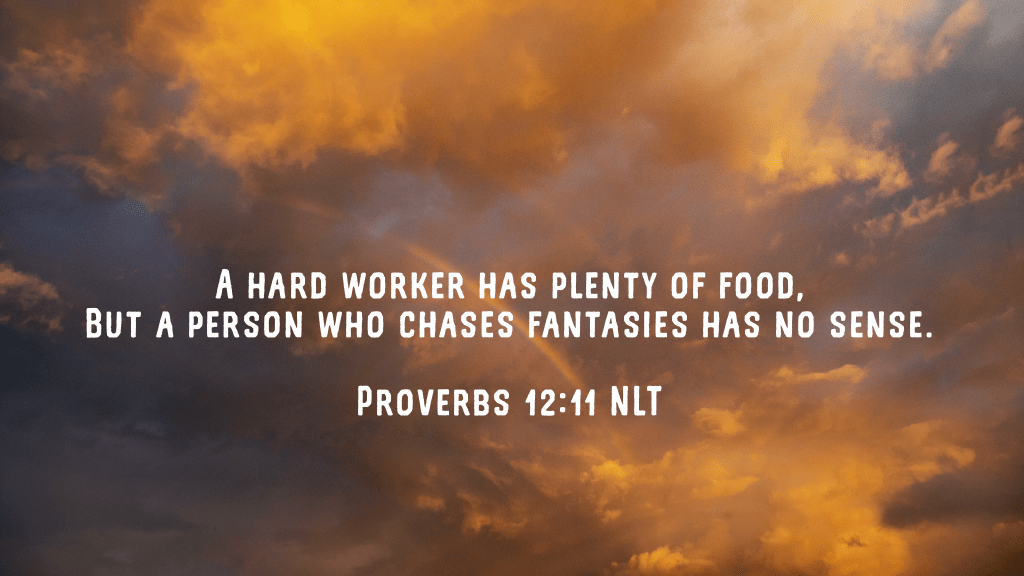
That really, though, is my point: If we’re honest with ourselves, most of us cannot escape the charge of laziness. If you think about it, laziness is really just selective negligence. If someone says you’re lazy, what they fundamentally mean is that you’re somehow culpably negligent. I choose my negligence, everyday. And unless you’re superhuman, you likewise choose your negligence. Positively, it’s called prioritizing. Consciously or unconsciously, we all prioritize. Prioritizing inevitably means that some things get done, while other things do not. And what does not get done allows for the charge of laziness.
So perhaps the real question is: Since you must daily prioritize your time, exactly how are you going to be “lazy”? And some immediate corollary questions include: Why did you prioritize this activity and not that? On what basis did you prioritize? Can you articulate how you prioritize? Are you prepared to take responsibility for what you neglected to do?
Ultimately, we are responsible for what we choose to do and not to do with the time we have. If you are anything like me, you often feel like you are wide open to the charge of laziness. But it is more important by far that you are principled in your commitments, and on that basis can give a sound reason for how you prioritize your time. Sometimes less important stuff can wait.
Here Jesus is surprisingly sneaky. Jesus shows himself to be oh-so sly.
His elite inquisitors, the Sadducees, had Jesus stereotyped. They esteemed themselves to be among the best and the brightest of the Jewish people. They had pegged Jesus as someone somewhat less cultured, less intelligent, and therefore, less worthy of repute than themselves. Given his lower-class upbringing, Jesus could not possibly see things the way they saw things, so doubtless, he must be a bit of a nitwit. In their educated, experienced estimation, Jesus had to be an unsophisticated simpleton, a Bible-banging bumpkin — an unordained, self-promoting preacher. They thought they could easily undermine Jesus’ credibility and popularity by putting his lack of intellectual prowess on public display. So they devised a clever question, a question intended to fully expose his theological sloppiness and general clumsiness.
They presented Jesus with a sexually-tangled legal scenario: A certain woman had been married and widowed seven times. She married seven brothers, each in turn, one after the next. Whose wife then, would she be, come Resurrection Day, given that she and all seven of her late husbands would be physically resurrected? Which brother would be her husband?
His inquisitors, the Sadducees, did not believe in a final physical resurrection. Like many of the Greek philosophers, they dismissed it as a derisible doctrine. Only zombies rise from the dead, not the righteous departed: Something such was the thought. The Sadducees believed that the Torah, that is, the Law of Moses, did not require a resurrection. And the Torah must be given priority over other scripture, they insisted. Only the Law of Moses was their authoritative Bible.
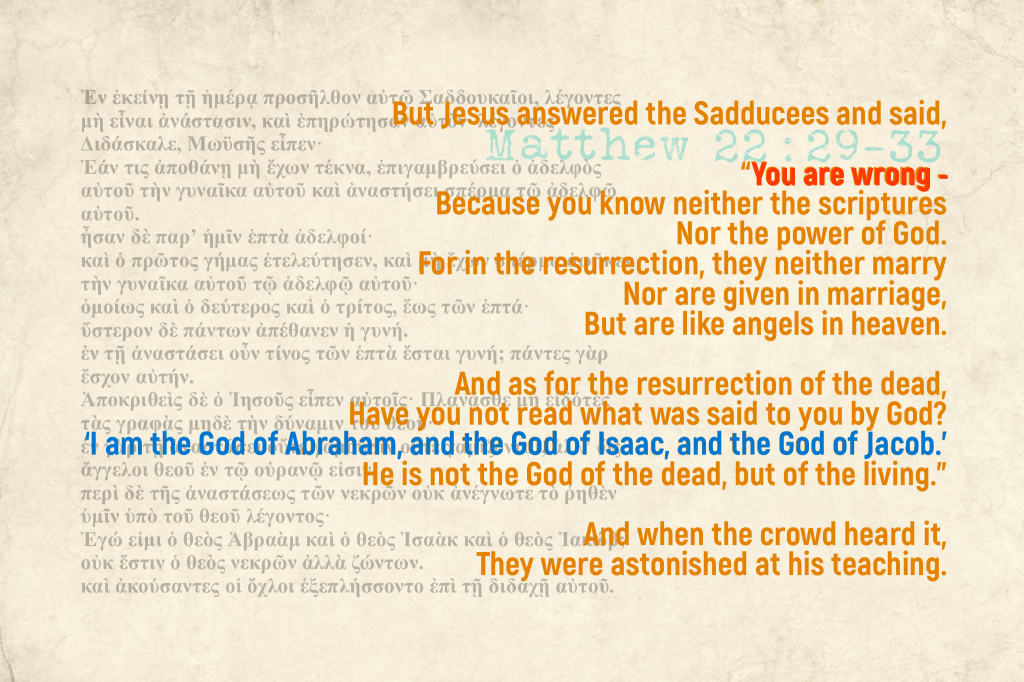
“You are wrong.”
Jesus responded with a blunt retort — which surely came across as an insult. Jesus’ rebuke was aimed squarely at their intellectual smugness. “You are wrong.” And Jesus proceeded to tell them exactly why they are wrong.
“You are wrong because you know neither the scriptures nor the power of God.”
Jesus turns the table on his self-satisfied inquisitors. So who is actually ignorant here? Jesus informs them that they are the ignorant, not him. They are the ones who do not know what they ought to know. They do not adequately know their own scriptures. And they have not begun to comprehend the extent of the creative power of God.
Then Jesus tells them what will actually happen, come Resurrection Day. Marriage will not be an issue for the multipli-married woman, nor for her seven once-late husbands. Marriage won’t be an issue because no one, but no one, will be married then. After the resurrection human beings will be like angels, who do not reproduce nor procreate. Marriage is meant just for this lifetime, not the next.
Jesus isn’t done on the topic of the resurrection, though. He has one final argument to present. Jesus wants them to see that one of their own favorite scriptures implies a final resurrection.
Jesus takes them straight to the Book of Exodus, to a barefoot and awestruck Moses at the burning bush. When He introduced Himself to Moses, God assured him that, “I am the God of your father, the God of Abraham, the God of Isaac, and the God of Jacob.” God did not say that He once was the God of Moses’ ancestors, but that He still is the God of Moses’ ancestors. God says, “I am” their God, not “I was” once their God. According to Jesus, the implication of God’s “I am” is that Abraham, Isaac, and Jacob must live on. They are alive, even long after they died, even though their corpses decay in the grave. God is not the God of dead corpses, but of the living. The afterlife is therefore real. Abraham, Isaac, and Jacob, though dead and gone, are nonetheless alive and present with God.
And because he infers the afterlife from God’s “I am,” Jesus further assumes the resurrection must follow. Jesus does not even feel the need to argue further or appeal to another scripture for the resurrection. If the afterlife is a reality, then the resurrection must be a reality, as well. This is what Jesus claimed. An afterlife essentially guarantees an eventual resurrection.
But surprisingly, Jesus’ line of reasoning leaves something to be desired. Even if it is real, the afterlife, in and of itself, does not necessitate a final resurrection. It is conceivable that people have a spiritual afterlife, without any physical resurrection. After all, many of the Greeks believed in a spiritual afterlife — an afterlife without any final resurrection. And one of his Sadducee inquisitors could have easily pointed out that (non-biblical) belief. In fact, some, if not all, of the Sadducees may have believed exactly that. Having been schooled in pagan mythology and Greek philosophy, they may well have held a Greek conception of the afterlife.
And this is why Jesus is sly. Jesus knew his inquisitors far better than they knew him. Whereas they had stereotyped Jesus, he accurately read them. He knew what they probably believed. And Jesus was daring them to reveal what they actually believe. But it could have been their own undoing. If the Sadducees had argued for a Greek perspective on the afterlife, rather than affirm what the Hebrew prophets had taught about the resurrection, they would have called their own legitimacy into question. The gathered Jewish crowd would have been shocked and scandalized. They might have accused the Sadducees of blasphemy. The Sadducees would have shown that they esteem a pagan philosophical tradition over their own biblical tradition.
Thus, by first appealing to one of their own favorite, foundational scripture passages and then inferring its eschatological implications, Jesus’ argument had boxed in the Sadducees. They never anticipated his sly tactic. They did not see it coming. Jesus had outsmarted them. He had outplayed them. The Sadducees could question him no further without risking their own public embarrassment. They knew better than to dispute his affirmation of the resurrection — definitely not there, not in front of the under-educated, unsophisticated, prophecy-believing people. So, rather than argue with the Bible-banging backwater bumpkin any further, the Sadducees decided to just bide their valuable time and look for an opportune moment to somehow rid themselves of this nuisance, this Jesus of Nazareth. With his demise, the resurrection question would be forever settled, of that they were confident.


 The DeKrakenator Daily